



Yields on US Treasury bonds shot up to their highest levels in years, all within a single trading session. Markets generally move gradually, rising or dipping by a few basis points here and there over several weeks. What happened on Thursday was different. That kind of synchronized, single-day move usually signals a genuine repricing.
Yields across all major durations, from 2-year to 30-year, soared concurrently to make multi-decade milestones over the last few days. The 10-year bond yield has now gained over 30 basis points in just two trading sessions.
Over the past month, the yield has edged up by 0.53% and is 1% higher than a year ago. On Friday, the 10-year note is a shade lower than yesterday’s high, trading at around 5.19%.
But something big is happening in the bond market. Bond yields posting this kind of jump, whether within a single trading session or over just a few days, is not something that happens every day.
The 30-year Treasury bond told an even more dramatic story. It soared as high as 5.47%, a level not seen in 22 years, before holding steady at 5.48% on September 25, 2026. Over the past month, the yield has edged up by 0.31 points and is 0.72 points higher than a year ago. Even the shorter end of the curve moved. The 2-year Treasury note yield rose to 4.941%.
What’s really pushing yields this high?
Two forces converged on the same day. First, a strong batch of economic data came out, strong enough to reinforce the case that the economy still has momentum, which usually means the Federal Reserve has more room to keep raising rates rather than pause.
The S&P Global US Manufacturing PMI increased to 57.0 in September 2026 from 53.9 in August, far exceeding market estimates of 53.6, according to the flash estimate. The result indicated the most significant improvement in manufacturing business conditions since May 2022, with all five components contributing to the increase.
Second, oil prices jumped sharply, and a spike in oil tends to feed directly into inflation expectations, since higher fuel costs ripple through the entire economy, from transport to manufacturing. Key US Treasury yields surged to fresh two-decade highs as the price of oil jumped to as high as $108 per barrel.
Then Iran talks briefly cooled things down. On Friday, Brent crude slipped below $106 a barrel, snapping a two-day surge, amid news that the US and Iran were discussing a phased agreement to reopen the Strait of Hormuz and lift a US blockade of Iranian ports. Even so, yields stayed close to their highs, a sign markets aren’t yet convinced the inflation risk has passed.
Fed hike odds moved just as fast as yields did
Both these factors point toward an inflationary situation that could force the US Fed to continue hiking rates. As yields surged, so did the market’s anticipation of another rate increase from the Federal Reserve. According to the CME FedWatch tool, fed funds futures are now pricing in a nearly 71% likelihood that the Fed raises its key rate again in October.
That number matters because of how fast it moved. Just a week ago, the probability of an October hike stood at roughly 55%. In seven days, the market’s conviction swung from essentially a coin flip to something close to a near-certainty.
Where does this leave bond investors now?
The chart below shows how much worse the situation could still get. The yields have more room to go up.
10-year US Treasury Yields
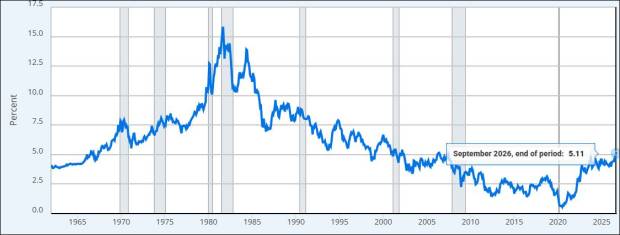
Source: Federal Reserve
With the US fiscal position worsening, interest rates staying higher for longer, and no resolution in sight for the Iran war, which keeps pushing oil prices higher, investor sentiment is turning worse. Investors are now demanding a higher premium to hold government bonds at current yields.
The bond sell-off continues, with yields hitting new highs on every bit of negative economic news. Investors are not just reacting to one data point; they are recalculating what the Fed’s path looks like for the rest of the year, and pricing bonds accordingly.
Disclaimer: This article is for informational purposes only and should not be construed as investment advice. Readers are advised to consult a financial advisor before making any investment decisions.