


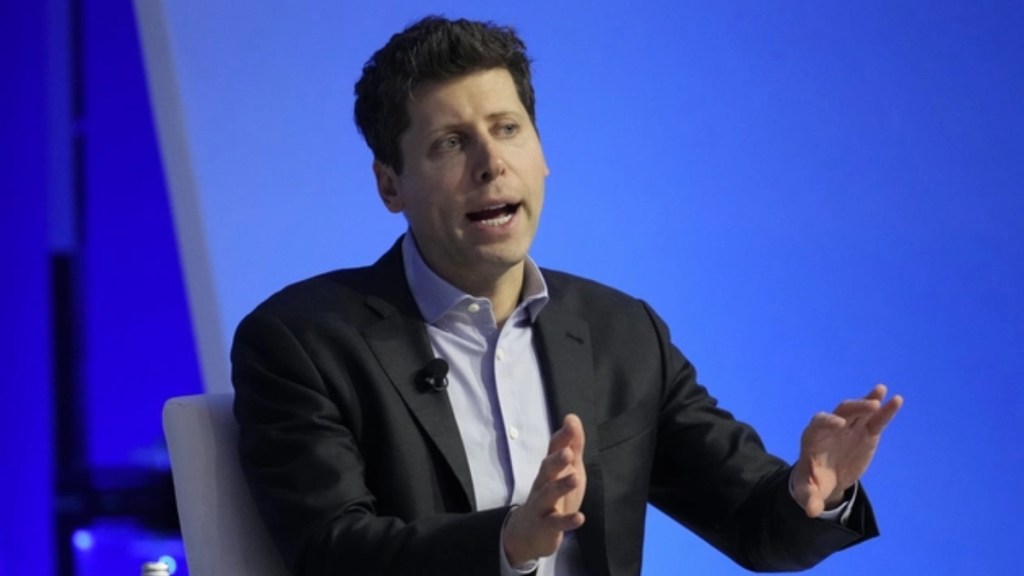

OpenAI will not go public this year as the artificial intelligence company focuses on addressing safety and alignment concerns around the technology, Chief Executive Officer Sam Altman said in an interview with Fortune.
When asked whether 2026 was off the table in favour of 2027, Altman told Fortune, “I would say not 2026. Yeah, we got a lot of stuff to do, like meeting this moment of what is going to be required for safety and alignment, and how the industry and governments can work together.”
Altman said this year would be an “ill-advised moment” for an initial public offering and indicated that OpenAI’s listing would not happen until next year.
“I think it is unacceptable to be taking like a 10% chance of killing everybody by the end of the decade,” Altman said. “I think in this moment we are entering a new era, and we’ll likely have to — as we’ve stepped into other eras in the past — act differently to ensure that we are doing something that will ensure the idea benefits all humanity, but also ensure that no one is taking risk anywhere close to that.”
The comments come as the heads of three major AI companies voiced concerns about the pace of AI development. Anthropic CEO Dario Amodei and xAI co-founder Elon Musk also called for a more deliberate approach to AI development on Saturday, where a rare moment of agreement among leaders of major competitors took place.
Safety concerns reshape OpenAI’s IPO timeline
Anxiety over the potential existential risks posed by AI has moved into the mainstream following warnings from researchers about the pace at which the technology is developing.
The concerns increased after a high-profile resignation by an Anthropic researcher who said the company was acting irresponsibly and warned that AI could “kill us all by the end of the decade.” A current Anthropic employee said the possibility of such an outcome is “>10% within the next decade” in a post on X.
“I think a key principle that we should all agree on is that we cannot take actions that would risk losing control of the future to AI,” Altman told Fortune. Altman also said that OpenAI and other leading AI companies may be close to announcing an agreement to slow AI development and work together on safety risks.
Anthropic CEO Dario Amodei separately urged AI companies to take a more deliberate approach to developing increasingly capable models.
“We must slow the pace at which we improve the capabilities of AI models,” Amodei wrote in an essay shared on X.
Altman later responded to Amodei’s post, saying, “I agree with Dario that we need to pace the frontier. This has been a primary topic of discussions we’ve had at OpenAI in recent weeks.”
OpenAI had already kept IPO timing open
OpenAI had confidentially filed its IPO prospectus with the US Securities and Exchange Commission in June, giving the company the option to go public while keeping the actual timing undecided.
OpenAI said on its website on June 8, “We recently submitted a confidential S-1. We expect it to leak so we’re just announcing it. We have not decided on timing yet; it may be a while because there are things we want to do that are likely easier as a private company. But it’s a complicated set of tradeoffs and this gives us the option to go public sooner if that ends up being best.”
The company’s position became clearer in August when CFO Sarah Friar told employees during an all-hands meeting that OpenAI “will be a public company in 2027,” while leaving open the possibility of an earlier debut if “our business continues to inflect.”
“The IPO is not a finish line, it is a milestone, another fundraise,” Friar told employees, according to CNBC. “We raised $122 billion in March, and that gives us flexibility.”
Friar’s comments indicate that OpenAI does not face an immediate need to raise capital through the public markets after its $122 billion funding round in March.
OpenAI’s confidential filing nevertheless gives the company flexibility over when to make its public debut.
Financial performance adds pressure
The decision to delay the IPO comes as investors are looking for greater clarity on OpenAI’s financial performance and its ability to justify an $852 billion valuation.
Friar told employees that OpenAI’s revenue run rate was up 35% quarter to date, while enterprise revenue run rate was up 50%. The company’s AI coding and work product had also reached 20 million weekly active users.
OpenAI told investors that revenue grew 18% quarter-on-quarter to $6.7 billion in the three months ended in June, compared with $5.7 billion in the first quarter.
Its operating loss, which includes stock-based compensation, increased from $9.3 billion to $12.3 billion. The increase in losses outpaced revenue growth and disappointed shareholders who had expected faster progress against Anthropic ahead of a potential IPO.
Anthropic moves ahead with its own IPO plans
OpenAI’s decision to push its IPO to 2027 does not mean its rivals are taking the same approach. Anthropic has also confidentially filed its IPO prospectus with regulators and has been holding early meetings with potential investors. The company is expected to begin marketing its IPO in mid-October at the earliest and could complete the listing days before the US midterm elections in November, according to CNBC.
Anthropic’s potential IPO could reportedly surpass SpaceX’s record-setting IPO earlier this year, which was worth $86.2 billion including the over-allotment option.
Disclaimer: This article provides factual analysis only and is not, and should not be construed as, an offer, solicitation, or recommendation to buy or sell securities. Investors must conduct their own independent due diligence and seek advice from a registered financial advisor in the respective jurisdiction.