


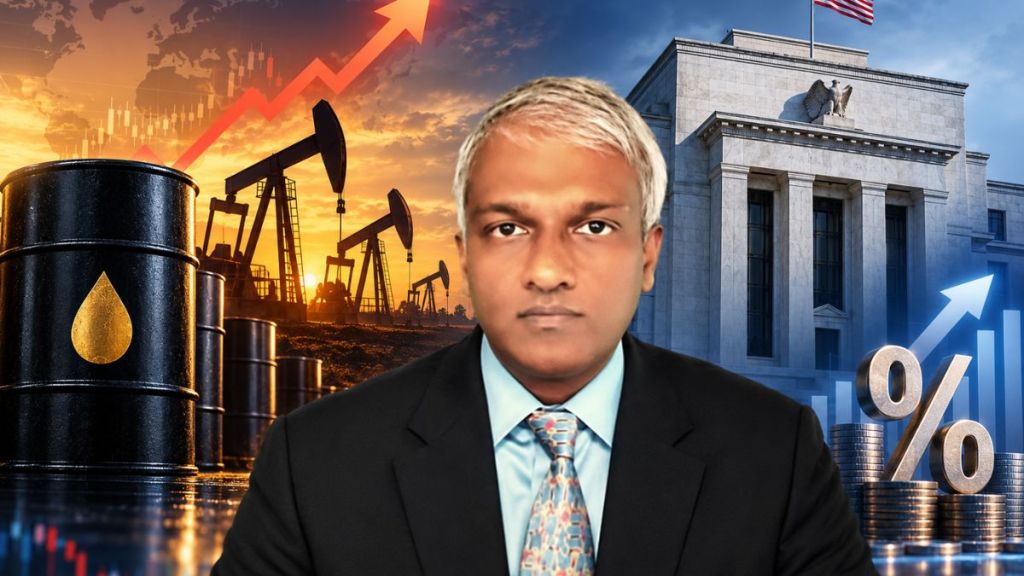

Dan Niles, founder of Niles Investment Management, has turned cautious on US equities. According to him, rising oil prices and higher bond yields are creating pressure on markets. Concerns over artificial intelligence safety are adding to the uncertainty. Investors are also awaiting the Federal Reserve’s upcoming policy decision.
Niles said he was watching three key developments this week, that includes the reaction of stocks to higher oil prices and interest rates, growing calls from AI executives to slow the development of advanced models, and the Federal Reserve’s September 16 policy decision.
“Last wk, oil +9% & ylds +11-26 bps across 2/30 curve w/ S&P/Nas/R2K -0.3%/-0.7%/-2.4%. This wk, I am watching reaction to 1) oil/rates, 2) calls to slow down AI development & 3) Fed on 9/16. I remain on the cautious side till US mid-terms on 11/3,” Niles wrote on X.
Last wk, oil +9% & ylds +11-26 bps across 2/30 curve w/ S&P/Nas/R2K -0.3%/-0.7%/-2.4%. This wk, I am watching reaction to 1) oil/rates, 2) calls to slow down AI development & 3) Fed on 9/16. I remain on the cautious side till US mid-terms on 11/3.
— Dan Niles (@DanielTNiles) September 13, 2026
This weekend, the CEO of…
The warning comes at a time when oil prices have moved above $107 a barrel. The increase in oil prices happened after fresh attacks on Saudi oil infrastructure and ships in the Gulf added to concerns over supply. The drone attack damaged the East-West oil pipeline, which is a key crude oil route. The developments have also strengthened expectations of a Fed rate increase this week. Markets are also preparing for what could be the first interest-rate increase by the Federal Reserve since July 2023.
Oil surge adds to inflation pressure
The disruption comes as the global oil market already has less room to absorb another major supply shock. Reuters reported that Saudi oil production fell to about 6.2 million barrels per day in August from 10.9 million barrels per day in February, before the conflict began. Oil is one of the biggest concerns for investors because a prolonged rise in energy prices could make it harder for central banks to bring inflation down.
In his post, he says that the Iran conflict could continue through the November 3 US midterm elections, keeping oil prices elevated for longer.
The latest US inflation data has already added to those concerns. Consumer prices accelerated in August, while the core consumer price index rose 0.3% from the previous month. The data increased expectations that the Fed could resume rate hikes.
Fed decision becomes the biggest market test
The Federal Reserve’s September 15-16 meeting has become the immediate focus for investors. Niles expects Fed Chair Kevin Warsh to raise rates by 25 basis points and maintain the hawkish tone he used at the Jackson Hole economic symposium.
“Price stability is not self-executing… 65 months of sustained, elevated inflation sits squarely with the Central Bank,” Warsh said at Jackson Hole, according to Niles.
Markets have moved significantly towards expecting a rate increase. Fed futures market anticipates a more than 90% probability of a 25 basis points rate hike next week. Goldman Sachs and JPMorgan have also moved towards expecting a September increase.
The US 10-year Treasury yield is already over 5%, a level investors have increasingly identified as a potential threat to equities. Niles therefore continues to follow his long-standing rule, “Don’t fight the Fed.”
In his post, he says he believes the market historically performs poorly during rate-hiking cycles, while the bond market is already pricing in further increases. Niles expects two rate increases by the end of the year and about three and a half increases by June 2027.
AI safety debate creates a new risk for tech stocks
The other major issue on Niles’ radar is the growing debate over whether the development of advanced AI models should slow down.
Anthropic CEO Dario Amodei recently called for AI companies to slow the development of increasingly powerful models, citing concerns about misuse, hacking and the possibility of AI systems becoming difficult for humans to control. OpenAI CEO Sam Altman and Elon Musk have also expressed support for parts of the proposal.
The debate has already started affecting AI-related stocks. Reuters reported Monday that Asian technology and semiconductor shares fell sharply after the calls from AI executives. SoftBank fell 13.2%, Kioxia dropped 9.8%, and Samsung Electronics lost 3.7%.
Niles, however, is sceptical about slowing AI development. In his post, he says that any slowdown by US companies could benefit foreign competitors, particularly China. He also believes there is a risk that restrictions could unintentionally protect the market positions of OpenAI and Anthropic, which are already among the leading companies in frontier AI.
Niles said he does not expect companies that are trying to catch up with the two leaders to voluntarily agree to measures that slow technological progress.
He does see a role for independent third-party evaluators that could assess AI systems and reduce companies’ legal and liability risks. He also believes the White House could eventually introduce an executive order addressing AI safety.
His preferred long-term outcome, however, is broader access to AI rather than a market controlled by a small number of companies.
“I hope the longer-term result of these actions is broadly distributed personal AI capabilities for all individuals versus having it become concentrated in the hands of a few companies,” Niles wrote.
Niles remains positive on selected technology companies that he believes can turn AI spending into actual revenue. Meta is one of them.
Meta launched its Muse personal AI agent last week. The product is designed to perform tasks across applications such as email, calendars, payments, shopping and travel. It is initially available in the US and is part of CEO Mark Zuckerberg’s push to build what he calls personal superintelligence.
The launch is significant because Meta is spending heavily on AI infrastructure and investors increasingly want evidence that those investments can produce returns.
Niles believes Meta’s enormous user base gives it an advantage. The company has billions of people using its services every day, creating a large potential audience for a successful AI product.
Meta is also exploring several ways to generate revenue from AI beyond advertising. Meta’s Muse ( personal AI agent) has a free version as well as paid plans, while the company is working to bring its AI capabilities to other products, including its smart glasses.
Niles believes this could eventually lead investors to value Meta more like other large technology companies. He estimates the stock could move from a valuation of around 17 times its calendar 2027 earnings towards the low-20s multiple assigned to some peers.
The company’s upcoming Meta Connect event on September 23 and 24 could provide another catalyst for the stock, according to Niles.
Apple’s foldable iPhone could drive a new upgrade cycle
Apple is another company Niles sees benefiting from the distribution of AI. As reported by Reuters, Apple shares gained around 4% last week following the company’s product launch, which included its first foldable iPhone, the iPhone Duo.
Reuters reported that the foldable device starts at $1,999 and comes with a much larger display designed to support multitasking. The company is positioning the product as a premium device that combines entertainment, productivity and AI capabilities. Niles expects the foldable iPhone to contribute to a major upgrade cycle next year.
He compared the opportunity with the launch of the iPhone 6. The change from the smaller 4-inch display to the 4.7-inch and 5.5-inch models helped Apple’s revenue growth accelerate sharply, according to figures cited by Niles.
Regulation and data centres add another risk
Niles is also watching regulatory pressure around the rapid expansion of AI data centres. The AI boom has triggered massive investment in data centres, chips and electricity infrastructure. Companies are spending heavily to build the computing capacity required to train and operate increasingly powerful models.
This spending has also attracted political opposition, particularly over electricity consumption, water use, land requirements and the impact of large data centres on local communities.
Niles believes bipartisan opposition to some data-centre projects could create near-term friction for the AI buildout.
The regulatory question is becoming increasingly important because the financial case for many AI-related companies depends on continued expansion of computing infrastructure. At the same time, policymakers are facing a difficult balance between limiting the risks associated with AI and maintaining US technological leadership.
Why Niles expects more volatility before midterms
Niles’ caution is based on the combination of monetary policy, oil prices, seasonal weakness, geopolitical tensions and elevated stock valuations.
September has historically been a difficult month for US stocks. Niles points to data showing the S&P 500 has fallen an average of 0.5% in September and has ended the month higher only 48% of the time since 1957.
He also points to the period leading up to US midterm elections as a historically volatile period for markets. According to Niles, S&P 500 drawdowns of about 10% between July 31 and November 9 have occurred during midterm years since 1990.
The current environment gives investors several reasons to be cautious. Oil is above $107, 10 and 30-year Treasury yields have crossed 5%, inflation remains above the Fed’s target, and geopolitical tensions continue to threaten energy supplies.
The AI sector is facing a separate debate over whether spending and development are moving too quickly. At the same time, investors are demanding evidence that the enormous amounts being spent on AI infrastructure will translate into profits.
The US stock market has so far remained resilient despite these risks. The S&P 500 is still up strongly for the year, supported by corporate earnings and continued optimism around AI. The concern for Niles is that the market may face a combination of risks at the same time.
“I believe in not fighting the Fed, the bond market or seasonality. I like the odds stacked in my favor, which should improve at least seasonally following the mid-terms,” he wrote.
The coming weeks, according to him, could therefore become a test of whether strong corporate earnings and the AI investment boom can continue to offset higher oil prices, rising bond yields and tighter monetary policy.
Disclaimer: This article provides factual analysis only and is not, and should not be construed as, an offer, solicitation, or recommendation to buy or sell securities. Investors must conduct their own independent due diligence and seek advice from a registered financial advisor in the respective jurisdiction.