


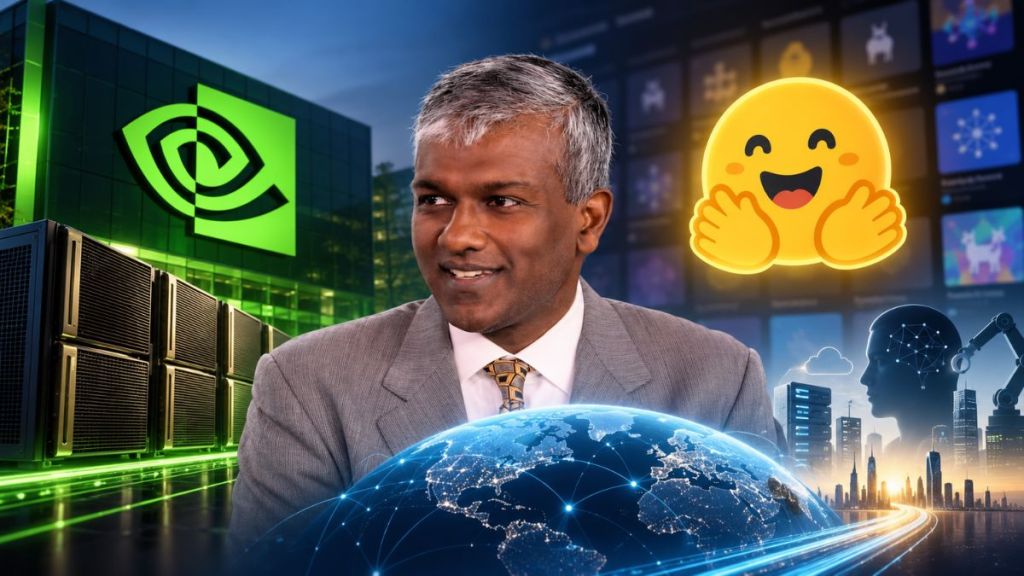

Nvidia’s $12.93 billion acquisition of Hugging Face, announced on September 3, 2026, could strengthen its position in the enterprise AI market as companies increasingly adopt open-weight AI models, according to investor Dan Niles. He is arguing that the deal gives Nvidia a stronger opportunity to give enterprises a complete AI stack ranging from models to chips.
In a post on his official X account on September 8, 2026, Niles said he expects the large language model market to increasingly split in favour of open-source and open-weight models as companies select AI systems based on the specific tasks they need to perform.
“My view is that LLMs increasingly bifurcate into 90%+ usage of open-source/ open-weight models in the future as companies optimize the right models for the right task,” Niles said on X. The change, according to Niles, comes as companies seek greater control over their AI spending, data and computing infrastructure.
Last wk despite WTI +10% & ylds +2-7 bps across the curve, S&P/Nas/R2K +0.1%/+0.4%/+0.1%. $NVDA acquisition of Hugging Face & $Meta release of Muse Spark 1.3 last wk make both names more attractive into year-end.
— Dan Niles (@DanielTNiles) September 7, 2026
My view is that LLMs increasingly bifurcate into 90%+ usage of…
Silicon Data token costs have fallen more than 50% since late May, while weekly usage of tokens across models on OpenRouter has increased 3.6 times over the same period, according to Niles.
The Hugging Face acquisition could place Nvidia in a stronger position to benefit from this changing AI market, particularly as enterprises look beyond relying entirely on closed frontier models and large cloud providers.
Enterprises seek greater control over AI data
A major reason behind the growing interest in open-source and open-weight models is the desire among companies to retain greater control over their proprietary information, Niles said. Enterprises are increasingly focused on ensuring their data does not leak when they use third-party closed frontier large language models. Hugging Face, one of the biggest collaborative platforms and repositories for open-source and open-weight AI, has more than 18 million developers.
Niles said the acquisition strengthens Nvidia’s ability to provide companies with an alternative AI ecosystem where they can have greater ownership over their data. “With this acquisition, Nvidia is in an even better position to sell enterprises a complete alternative AI stack (from the model to chips) where the customer will own their own data,” he wrote on X.
The deal could therefore expand Nvidia’s role beyond selling graphics processing units and other computing hardware to the world’s largest cloud companies. Nvidia could instead play a bigger role in helping enterprises build and operate their own AI infrastructure, using open models and Nvidia’s computing systems. Open-source and open-weight models could account for more than 90% of LLM usage in the future under this scenario, according to Niles.
Nvidia could increase its customer base
The Hugging Face acquisition could also help Nvidia address another concern that its heavy dependence on a relatively small number of customers. Niles pointed out that three customers accounted for 44% of Nvidia’s revenue over the past six months. “Nvidia has three customers that accounted for 44% of their revenues over the past six months and their largest customers are increasingly designing their own ASICs and in some cases selling them externally,” he wrote on X.
The biggest cloud companies have been among Nvidia’s most important customers during the AI spending boom. Some of those companies are also developing their own application-specific integrated circuits, or ASICs, creating a potential long-term challenge for Nvidia’s dependence on hyperscaler spending.
Niles said a massive base of enterprise customers could help Nvidia address both its customer concentration and the growing push by major technology companies to develop their own chips. A larger number of enterprises owning and operating their own AI infrastructure rather than renting all their computing capacity from large cloud providers could create another avenue for Nvidia to grow, he said. The Hugging Face deal could help Nvidia reach those customers by combining access to AI models and development tools with the company’s existing leadership in AI computing hardware. This strategy would allow Nvidia to offer an enterprise a complete AI stack rather than simply supplying chips.
Niles says Nvidia’s valuation remains compelling
Regardless of the sustainability of the AI spending boom, Niles said Nvidia’s valuation remains compelling relative to its expected growth.
“Valuation is also compelling. Nvidia trades at a 15x CY27 PE versus their own guidance for 70% revenue growth and the Big 3 public cloud service providers at 21-23x for 15-26% total revenue growth. The S&P trades at 19x for 9% revenue growth for comparison,” he said. Nvidia has guided for 70% revenue growth, while the three largest public cloud service providers are trading at higher valuation multiples despite much lower expected total revenue growth, according to the figures cited by Niles. He also compared Nvidia with the broader S&P 500, which he said trades at 19 times price-to-earnings for 9% revenue growth.
Niles had previously made a similar argument during a CNBC discussion on August 27. He said Nvidia was forecasting 70% revenue growth for calendar 2027 while trading at a mid-teens earnings multiple. “You look at Nvidia and you can say, well, you know what, they’re forecasting 70% revenue growth,” Niles said. He further added, “The S&P is trading at 19 times PE for ’27. Nvidia is trading at a mid-teens multiple and they believe they can grow at 70%. So it’s a pretty good risk/reward assuming you can balance that with other things.”
Nvidia shares were up “just” 24%, compared with a 66% gain in the Semiconductor Index, according to Niles. The company had also underperformed the index in the previous year, when Nvidia rose 39% compared with a 42% gain for the Semiconductor Index. Niles said Nvidia’s acquisition of Hugging Face and Meta’s release of Muse Spark 1.3 last week made both companies more attractive into year-end.
Meta returns to near-frontier status, Niles says
Niles also turned bullish on Meta, saying concerns over the company’s aggressive AI spending and its position in the AI model race had weighed heavily on the stock. Meta shares are down 7% year-to-date after rising just 13% last year, with investors concerned about two major issues, according to Niles. Whether the company could monetise its near doubling in AI capital expenditure beyond improving efficiency in its existing business, and whether Meta was falling behind competitors in the AI model race.
The launch of the Muse Spark 1.3 API last week, however, has changed that picture, Niles said. The launch “catapulted Meta back to near frontier status,” with Muse Spark 1.3 ranking among the top four models in the Artificial Analysis Intelligence Index out of 10 models, according to Niles. The model also comes with aggressive pricing, ranking among the bottom four in Cost per Task.
Niles said open-weight versions of the Muse Spark lineup are also coming soon, potentially giving Meta another way to monetise its aggressive AI capital expenditure. “This will give the company another way to monetize their aggressive capex plans,” he said. The Spark 1.3 launch also comes after Meta reached a settlement in late August with state attorneys general over its youth addiction trial, removing another overhang on the stock, according to Niles.
“Trading at 16x CY27 PE for 20% revenue growth is compelling with the settlement and Spark 1.3 launch as catalysts,” Niles said. Niles said the combination of the legal settlement and Meta’s renewed position in the AI model race has made the company more attractive heading towards the end of the year.
Niles urges caution ahead of US midterms
Despite his positive view on Nvidia and Meta, Niles said he remains cautious about the market between now and the US midterm elections. “From a broader market perspective, I recommend caution between now and the US mid-terms,” he said. Niles listed five reasons for his cautious outlook. The first is his view on the Federal Reserve. “Don’t Fight the Fed,” Niles said, adding that he believes a rate hike on September 16 is likely.
September has also historically been a difficult month for stocks. The market has declined by an average of 0.5% during the month and has risen only 48% of the time, according to the figures cited by Niles. Niles also pointed to the risk of significant S&P 500 declines in the run-up to US midterm elections, citing drawdowns of around 10%.
Another concern is the growing bipartisan pushback against data-centre expansion. The rapid construction of AI infrastructure has become increasingly controversial because of concerns over electricity costs, power availability, land use and pollution. Niles has previously described data centres as a growing political flashpoint, particularly as AI companies and hyperscalers continue to increase their spending on computing infrastructure. The fifth risk is the possibility of Iran prolonging hostilities through the US midterm elections.
Niles still sees an AI bubble
Niles’ bullish view on Nvidia does not mean he believes the AI investment boom is free from risks. In fact, he has repeatedly described the current AI buildout as a bubble. During his August 27 CNBC appearance, Niles compared the AI investment cycle with previous major infrastructure and technology booms. He recalled the internet buildout of the late 1990s and the subsequent collapse in technology stocks.
“The internet was obviously a very big buildout,” Niles said. “If you say it started with Netscape Navigator at the end of ’94, that buildout lasted till early 2000. And then we know NASDAQ went down 78% over 2 and 1/2 years.”
Niles said the AI buildout fits into a pattern seen during previous major industrial revolutions. “I think this AI buildout, there’s no question it’s a bubble, right?” He said major investment opportunities often attract a large number of companies because everyone wants to be among the eventual winners. The key question, according to Niles, is not whether the AI investment cycle has bubble-like characteristics but when that bubble could break. He stated, “Now, the question is, when does the bubble break? And I don’t think that happens at least for another year.”
Nvidia’s growth guidance faces risks
Niles has also warned that strong guidance should not automatically be treated as a guarantee of sustained growth. During the CNBC discussion, he pointed to the technology cycle of the early 2000s as an example. He recalled Cisco Systems forecasting strong sustainable growth during the technology boom before subsequently reporting years of negative revenue growth.
“You have to remember Sherry, it’s just guidance,” Niles said. “So, I’ve been doing this for a while and I remember in 2000 when Cisco Systems said, ‘Hey, we can grow 30 to 50% sustainably for the foreseeable future.’ And then about two years later, they had two years in a row of negative revenue growth.”
Niles said Nvidia’s guidance was encouraging in the near term because it showed what the company was seeing from customers. “The guidance is very encouraging from the near-term because it obviously implies what they’re seeing from their customers is very very bullish.” He also pointed to Nvidia’s comments that demand was running significantly ahead of its official growth forecast. Nvidia had said it was guiding for 70% growth based on what it was confident it could build, while demand was closer to 100%, according to Niles.
“They said demand is closer to double—so 100%, not 70. So, they feel like they’re being somewhat conservative based on that.” Niles, however, warned that demand from customers experiencing supply shortages can sometimes be difficult to interpret. He further said, “When your customers are in shortage situations—so Microsoft, Amazon, Google, etc.—and they haven’t been able to get all the chips that they’ve wanted for a very long time, they all double order,” he said. “They all order way more than they’ll ever need because they’re hoping maybe they get half of whatever they requested and then they can move forward from that,” Niles added.
Disclaimer: This article provides factual analysis only and is not, and should not be construed as, an offer, solicitation, or recommendation to buy or sell securities. Investors must conduct their own independent due diligence and seek advice from a registered financial advisor in the respective jurisdiction.