



Michael Burry, the investor known for predicting the 2008 housing crash has once again renewed his criticism of Palantir Technologies, saying the artificial intelligence company may not be the traditional software business investors believe it is.
Burry says Palantir has ‘AI FOMO’. He says companies are rushing to use Palantir because they fear missing out on the AI boom, even as the company’s business model looks more like a consulting business than a subscription software company.
Palantir provides software to government agencies, defence organisations and businesses. Its main platforms include Gotham, Foundry, Apollo and its Artificial Intelligence Platform, or AIP.
Burry believes Palantir’s accounting numbers raise questions about how strong its business really is. He has focused on the company’s accounts receivable, customer concentration and deferred revenue.
In his post on X, Burry wrote, “The facts have not changed. Yes, FOMO is pushing companies to hire Palantir for now, but its competitive position gets more dire almost by the day.”
Burry raises questions about Palantir’s unpaid bills
One of Burry’s biggest concerns is Palantir’s accounts receivable, or AR. Accounts receivable is money a company’s customers owe it for goods or services delivered on credit. Burry says Palantir’s AR has grown faster than its revenue in nine of the last 12 quarters through the fourth quarter of 2025.
He says this is unusual for a traditional subscription software company. In his view, it could mean customers are taking longer to pay, Palantir is giving customers longer payment terms, or the company may be recording sales before it should. “Rising AR with growth yes, but rising DSO requires investigation,” Burry wrote on X.
DSO, or days sales outstanding, measures how long it takes a company to collect money from customers. Burry points out that Palantir’s average DSO increased from 35 days in 2020 to 66 days in 2025. Its year-end DSO rose from 52 days to 85 days during the same period.
He also says in his post that one unnamed customer, which he calls Customer A. The customer accounted for 26% of Palantir’s total AR in 2024, even though it represented less than 10% of Palantir’s revenue. The customer still accounted for 25% of AR in 2025.
Burry says this gives the customer significant bargaining power because Palantir could face a large financial hit if the customer fails to pay. He also says the situation could force Palantir to offer better prices or longer payment terms when contracts are renewed.
Burry compares Palantir with consulting companies
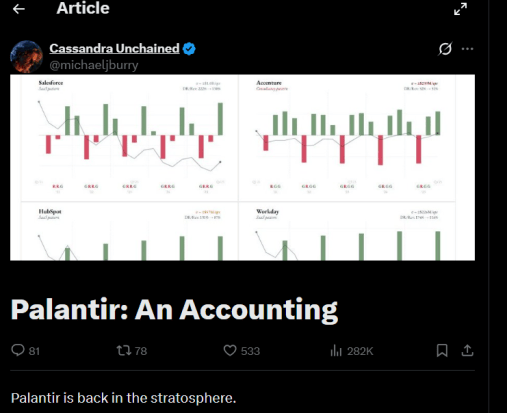
Burry’s claim is that Palantir does not behave like a typical software subscription company. He compares Palantir’s financial patterns with companies such as Salesforce and ServiceNow, which sell annual software subscriptions, and Accenture, which provides consulting and technology services.
A software company generally receives money for a subscription before providing the service. The money is initially recorded as deferred revenue and is then recognised as revenue over the length of the subscription. This creates a pattern in which deferred revenue rises when new annual subscriptions are signed and then falls as revenue is recognised during the year.
Burry says Palantir does not show the same pattern as most software companies. It looks more like Accenture, where revenue is generated through individual projects and ongoing work.
Burry says that Palantir may be delivering labour and expertise to customers and billing them before the work is completed. “Palantir is clearly doing this, delivering labor and expertise on an ongoing basis, and billing ahead of completion,” he wrote. He says Palantir’s deferred revenue-to-revenue ratio is also much closer to Accenture’s than to major SaaS companies.
Burry says AI excitement is helping Palantir grow
Burry believes the current AI boom is helping Palantir attract customers. He compares the situation with technology consultancies that benefited from the internet boom in the late 1990s.
His claim is that companies are rushing to adopt AI and may be hiring Palantir because they do not want to be left behind. Burry compares Palantir with two companies from the dot-com era, DiamondCluster and Razorfish. Both companies benefited from strong demand for internet consulting services in the late 1990s. Their businesses and share prices later collapsed when the technology boom ended.
Burry believes Palantir could follow a similar path if AI demand weakens. “I do believe today’s AI Consultancy arc will play out in similar fashion,” he wrote.
Burry questions Palantir’s stock-based compensation
Burry also criticised Palantir’s use of stock-based compensation, or SBC. SBC allows companies to compensate employees with shares or stock options instead of paying the entire amount in cash. Palantir adds a large amount of SBC back when it calculates its adjusted earnings. Burry is of the opinion that shareholders still bear the cost because issuing shares can dilute their ownership.
Burry questions Palantir’s tax position
Burry also noted Palantir’s federal net operating losses, or NOLs. NOLs can allow companies to reduce future taxable income by using losses or certain tax deductions from earlier periods. According to Burry, Palantir had $9 billion in US federal NOLs in 2025, up from $5.5 billion, even though the company reported $1.6 billion in pre-tax GAAP income.
Burry says the increase was largely connected to tax deductions related to stock-based compensation. He estimates that Palantir could generate another $4 billion to $6 billion in SBC-related tax deductions in 2026 if its stock price remains high. Palantir also had state and UK NOLs, according to the figures cited by Burry.
Burry says the tax benefits are another reason why Palantir’s high stock price matters to the company’s business. “With $PLTR, in so many ways, the stock price is the business model,” he wrote.
Burry questions Palantir’s spending on private aircraft
Burry also pointed to Palantir CEO Alex Karp’s use of a private aircraft. Palantir reported $17.2 million in expenses related to the executive aircraft in 2025, compared with $7.7 million in 2024.
Burry says that the spending as unusually high. He cited an estimate from Jefferies analyst Brent Thill, who calculated that $17.2 million could represent roughly 1,147 to 2,457 flight hours depending on the aircraft’s operating cost. Burry said the figure was also much higher than private-aircraft expenses reported for some other technology CEOs.
Burry questions Palantir’s software mode
Burry also discussed comments he says came from former Palantir employees. He said several former employees contacted him after his earlier criticism of the company. He could not independently confirm that all of them had worked at Palantir.
Burry ultimately claims that Palantir is being valued like a high-growth software company even though he believes its business is closer to consulting. He says investors who believe Palantir deserves very high revenue multiples need to explain why its financial patterns look more like Accenture than companies such as Salesforce and ServiceNow.
“Palantir is a consultant riding a bubble of AI FOMO demand,” Burry wrote. He believes Palantir’s market value could eventually fall below $100 billion. In his view, revenue could shrink over time and the company could eventually be acquired at a much lower valuation.
Financial Express (Digital) has reached out to Palantir for comment on Burry’s views and is yet to receive a response.
Dan Ives on Palantir
Though Michael Burry has a strongly bearish view of Palantir, Wedbush Securities’ Dan Ives has maintained a positive outlook on the company and its stock.
In a discussion with CNBC on August 27, 2026, Ives described Palantir as the “gold standard” for artificial intelligence use cases. He said his firm’s research suggests that Palantir could ultimately be involved in 70% to 80% of artificial intelligence use cases.
Ives also said he expects Palantir to become a trillion-dollar market capitalisation company over the next two to three years. He pointed to the company’s United States commercial business as a key driver of its future growth.
“I think US commercial business is really what I view as it could be an 80 90 old 100% grower,” Ives said during the discussion.
He expects the company’s United States commercial business, which he said was around $250 million to $500 million, to reach a trajectory of around $1 billion over the next 12 months.
Ives also added that the company’s future cash flow growth could help justify its high valuation. He said Palantir could potentially increase free cash flow from around $2 billion to $3 billion currently to $7 billion to $8 billion over the next few years.
He also explained the growing importance of Palantir’s commercial business, noting that commercial operations account for around 45% of the company’s sales. Ives has also been publicly bullish on Palantir on social media.
On his official X handle on May 5, 2026, he wrote, “Palantir’s strong results validate accelerating AI demand, with government spending, enterprise adoption and cybersecurity trends driving a sustained bull market in tech.” He further added, “Palantir showed yet again its AI dominance in the software world and the massive commercial and federal growth path ahead.”
Disclaimer: This article provides factual analysis only and is not, and should not be construed as, an offer, solicitation, or recommendation to buy or sell securities. Investors must conduct their own independent due diligence and seek advice from a registered financial advisor in the respective jurisdiction.