


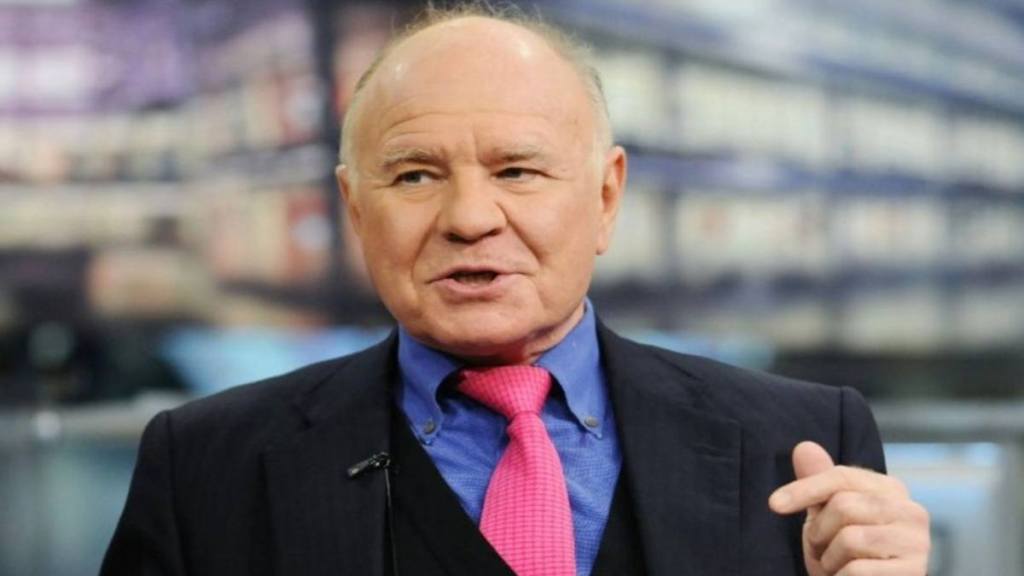

One of those seasoned investors whose predictions continue to carry significant weight among stock market investors since the 1980s is Marc Faber, publisher of the “Gloom, Boom & Doom” report.
Known for his candid views on the state of global markets, Faber predicted the October 1987 crash, the Japanese economic bubble of 1990, the collapse of US gaming stocks in 1993, the Asia-Pacific financial crisis of 1997, and the bursting of the dot-com bubble in 2000.
And Faber continues to voice his opinions and make predictions even today.
In a recent post on Gloom, Boom & Doom, Faber talks about the “Devastating financial crisis incoming, People should prepare for this”, where Faber, on YouTube, talks about various ongoing issues, from the stock market bubble to a sovereign debt meltdown to expanding global conflicts. According to Faber, the US political leadership is fueling the perfect storm for a once-in-a-lifetime crisis.
His overarching message, prepare for a prolonged financial reckoning that hits asset holders hardest.
Gold Is Still A Rounding Error In Most Portfolios
Faber starts his talk with his views on gold, saying that while investors do hold gold in their portfolio, compared to other assets, the percentage of gold holding is small, roughly 1% of global asset allocation, with mining companies making up less than 1% of S&P 500 market capitalisation.
Even after gold and silver’s sharp rally this year, he argues most investors hold far less bullion than they think when weighed against their real estate or tech stock exposure.
His advice: hold more, not less, calling metals a way to “lose the least money” as risk assets face a broader deflation in valuations. “I suppose that gold and mining stocks would go down less than, say, the investor’s favorite like SpaceX and Tesla and Nvidia and the micro technology,” says Faber.
Is The Stock Market Bubble Ready To Pop?
Faber described US equity valuations as ‘overblown’ and expects a meaningful deflation relative to the size of the economy, even as major indices keep hitting record highs despite two active wars. But he isn’t pinning the current environment to an imminent bubble burst, since the credit event that usually triggers one hasn’t happened yet.
He believes bubbles typically burst through a credit event rather than central bank tightening, and singled out Treasury Secretary Scott Bessent’s bond buyback programme as an intervention he expects to backfire over time. “This seems like a mess. How could this all end? Could we see a legitimate sovereign debt crisis? And could that be the pin that pops the stock market bubble as well?” a question Faber raises in the post.
Bond Yields Are Sending A Warning On Debt
With 10-, 20-, and 30-year Treasury yields above 5% and Japanese yields at historic levels, Faber sees a genuine risk building in sovereign debt markets. He was critical of using Treasury buybacks to suppress yields artificially. “I think it’s complete nonsense what he’s doing, and it’s not going to help in the long run. Actually, it will make things worse in the long run. Like every intervention into a free market worsens conditions in the long run, the worst bond market return has been over the last 10 years in the history of the US bond market. Why? Because they (US Fed) kept interest rates artificially low for too long. And by doing so, they laid the groundwork for future inflation.”
What Two Wars Mean For Commodity Prices
On the Strait of Hormuz closures and the wider Iran-Israel conflict, Faber does not see a quick resolution, arguing neither side has an obvious exit point and regional powers are unwilling to see the US or Israel control the strait.
He expects the war to persist, with China and Russia content to see US military resources stretched thin. On Ukraine, he expects Putin to hold out for the eastern territories rather than withdraw, since the war is likely to continue as long as Western financing keeps flowing. Wheat, soybean, corn and sugar, he noted, remain cheap relative to the rest of the commodity complex and could see further upside.
His Playbook For This Environment
Asked how he’d position a portfolio today, Faber recommended diversification across real estate, equities, precious metals, commodities, and different sectors within the market.
Faber also puts a lot of weight on geographic diversification, holding some assets outside one’s home country and, where possible, outside the custody chain of large US institutions.
The Bottom Line
Faber’s overall message is stark: he expects a prolonged, painful adjustment for asset holders, driven by unresolved government debt, loose monetary policy dressed up as tight policy, and geopolitical conflict that shows no sign of resolving soon.
His prescription is defensive: own more precious metals, diversify broadly, and hold at least some assets beyond your home country’s borders.
Disclaimer: This article provides factual analysis only and is not, and should not be construed as, an offer, solicitation, or recommendation to buy or sell securities. Investment in foreign securities involves significant risks, including currency fluctuations, different financial reporting standards, and varying regulatory environments. Readers are advised to consult a qualified financial advisor before making any investment decisions. Financial Express Digital does not take responsibility for any losses arising from actions taken based on this content.