


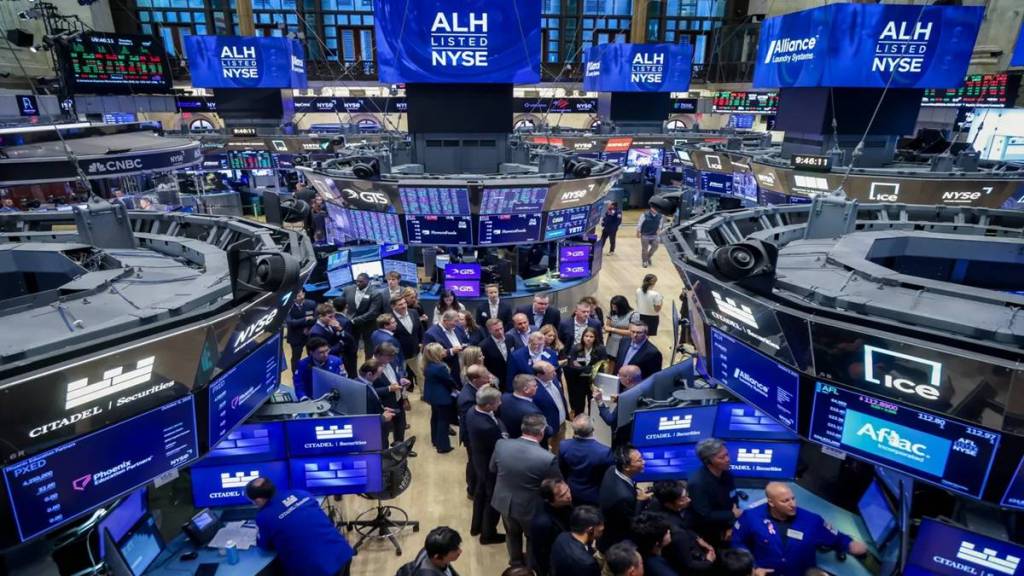

US markets are at a high with all leading indices, S&P 500, Dow-30 and Nasdaq-100, near their all-time peaks. But, despite the headwinds, the frontline US stocks are holding on.
Overall, the US equities are looking dangerously poised. What is weighing on them? Equity markets faced pressure from high oil prices, raising inflation concerns and expectations for a more hawkish interest-rate outlook. Treasury yields rose to multi-decade highs due to anticipated Federal Reserve tightening and increasing worries about government debt.
At the center is the Iran conflict. Investors are keeping a close eye on developments in the Middle East. Oil prices rose as President Donald Trump rejected Iran’s latest proposal to reopen the Strait of Hormuz, while Tehran refused to drop its demands for reopening the key waterway. Oil trades above $106, up by nearly 18% in the last month.
Mark Haefele, Chief Investment Officer, Global Wealth Management, UBS, in a report says,” We believe the equity rally will continue over the next six to 12 months. Of course, rate hikes will not produce more oil or chips, and rising US government debt will complicate the outlook.
But we have learned over the years that investors should not automatically assume that geopolitical shocks will cause lasting market weakness or that debt challenges will affect every asset negatively. With earnings growth still strong and lower inference costs stimulating AI adoption, we believe the fundamental supports for the rally remain intact.”
Haefele identifies four pressing concerns faced by investors today: all-time highs and valuations, the AI investment cycle, government debt and interest rates, and the war in Iran and its impact on oil prices.
UBS believes the equity rally will continue over the coming six to 12 months for five reasons.
Growth is on solid footing
UBS says the global economy remains on solid footing. US factory activity has stayed in expansion for eight consecutive months, while the Eurozone manufacturing PMI for August marked the strongest reading in over four years. A solid growth backdrop means markets should be able to tolerate higher yields, UBS says.
Rate hikes are not yet a worry
UBS thinks Fed and ECB hikes in the context of resilient growth should not yet be of major concern to equity market investors. Historically, the time to be concerned about market performance after rate hikes is when growth starts to falter. UBS expects just one more 25-basis-point hike from the Fed. The Fed’s own model suggests the two hikes would reduce economic growth by only a few tenths of a percentage point.
Earnings stay in the driver’s seat
According to UBS, earnings remain the central market driver. At the end of 2Q26, US nominal GDP was growing at 6.6% year over year, broken down approximately into 2.1% real GDP growth and a 4.4% increase in the GDP deflator.
UBS says this economic backdrop offers a favorable environment for companies to grow revenues and generate profits. Stronger manufacturing activity provides evidence that growth is broadening beyond a narrow technology story.
AI spending is a powerful tailwind
With second-quarter results validating both growing demand for and returns on AI infrastructure investment, UBS believes strong AI-related spending should continue to support earnings and economic growth, as well as investor confidence.
Overall, UBS forecasts S&P 500 earnings to grow 25% this year, followed by a 14% increase in 2027. Such robust earnings mean stocks should continue to perform well despite the 10-year yield closing in on levels that weighed on risk appetite in previous episodes.
Oil and inflation are risks, but manageable
UBS’s base case is for relatively limited energy disruption and an inflation shock that does not become sufficiently broad or persistent to derail growth. If the conflict de-escalates on a sustained basis and energy production and refining conditions improve, the Fed may need to tighten only modestly more from here.
Other sources of US inflation appear relatively balanced, with limited pressure from wages and housing only offset by rising costs for select inputs linked to the AI capital-spending cycle, notably memory chips.
What could change UBS’s view
UBS says none of this means it expects a straight-line rally. Greater caution would be justified if inflation were to reaccelerate, prompting a more prolonged tightening cycle, or if oil disruption intensifies to a point that threatens growth. More prolonged tightening could also create access-to-capital concerns for parts of the AI ecosystem where external financing has become more relevant.
Another negative AI shock, such as a slowdown in capex momentum versus expectations, would also make UBS more cautious. A further risk is that long-term yields rise to a level that sharpens concerns about the affordability of government debt and undermines liquidity and investor confidence.
The bottom line
But for now, UBS thinks the balance of evidence favors staying invested while diversifying and managing concentration risk.
In addition to UBS, BlackRock’s latest global market outlook also highlighted that despite challenges such as higher borrowing costs, rising bond yields, and potential Fed rate hikes, investors may be misaligned in their focus. The firm, managing $15.34 trillion in assets, maintains an optimistic stance on US stocks.
Disclaimer: The views and forecasts in this article are for information only and are not an offer, a solicitation, or a personal recommendation to buy or sell any investment. All forecasts and opinions are subject to change without notice, and past performance is no guarantee of future results. Readers should consult a qualified financial adviser before making any investment decision.