




A year ago, memory chips were the boring part of the semiconductor story. Everyone was busy talking about Nvidia and GPUs. Memory was just… memory. The chip that sits quietly next to the processor, doing unglamorous work.
That story has flipped entirely, and the returns make the point better than any explanation could.
The returns, upfront
- Micron and SK Hynix, the two biggest names in this space, have each delivered returns of more than 600% over the past year and have both crossed $1 trillion in market cap.
- SanDisk has returned roughly 4,000% since spinning off from Western Digital in February 2025, going from about $38.50 a share to north of $2,000.
- Seagate is up in the region of 400% in the last year, driven by demand for its enterprise hard drives.
- Western Digital is up well over 100% year to date, on some measures closer to 250%, though it has also been one of the more volatile names in the group.
- The Roundhill Memory ETF (DRAM), the first fund built specifically around this theme, is up 176.3% year to date.
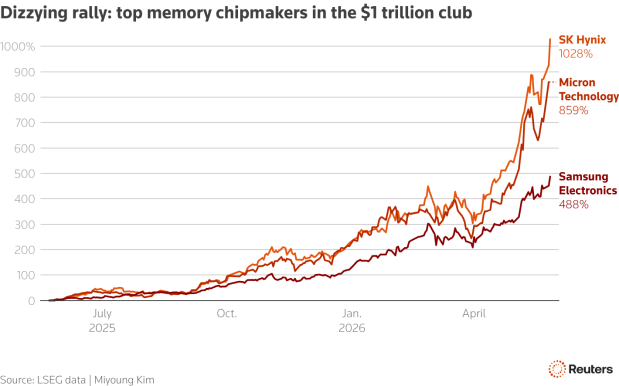
These aren’t exaggerated numbers. This is what happens when a historically cyclical, low-margin industry suddenly finds itself sitting at the centre of the most capital-intensive infrastructure build-out in tech history.
Why memory suddenly became the AI trade
Memory has always been cyclical. Prices rise, manufacturers rush to add capacity, supply overshoots demand, prices crash, manufacturers cut capacity, and the cycle starts again. That’s how it worked for three decades. It’s also why the 2022-2023 downturn saw Samsung, SK hynix and Micron all cut back hard on capex, since the previous glut had punished anyone who overbuilt.
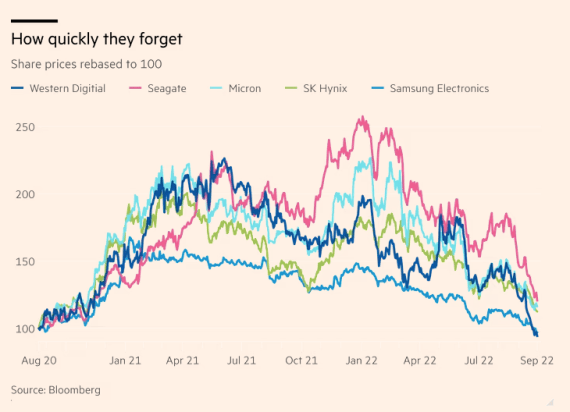
That caution turned out to be badly timed. AI training and inference workloads arrived needing memory that sits directly on the chip package, called High Bandwidth Memory or HBM, which physically stacks multiple DRAM dies on top of each other.
It’s a completely different manufacturing process from ordinary DRAM, and producing one HBM stack eats up roughly three times the wafer capacity of a standard DRAM chip, according to Micron’s own disclosures. So every wafer a manufacturer commits to HBM is a wafer taken away from the everyday DRAM that goes into laptops, phones and regular servers.
The scale of the shift is the real story here.
As recently as 2022, data centres accounted for somewhere between 20% and 30% of global DRAM consumption. IDC now expects that figure to hit roughly 70% in 2026 (TrendForce, using a stricter wafer-capacity measure, puts AI’s specific share closer to 20%, but every research house agrees on the direction: a large and fast reallocation toward AI).
Either way, three companies, Samsung, SK hynix and Micron, control about 90% to 95% of global DRAM production, and all three have been redirecting capacity toward HBM and high-capacity server DDR5, because those products carry margins three to five times richer than commodity memory.
The result has been startling price moves. DRAM contract prices rose somewhere in the range of 80% to 95% quarter on quarter in early 2026 alone, based on TrendForce data, and some DDR5 categories have moved even further. IDC currently projects 2026 DRAM supply growth of only about 16% year on year, well below the 20% to 30% growth that used to be normal, simply because building a new fab takes two to three years and the current wave of capex, however large, can’t show up any faster than that.
That’s also why almost every executive and analyst tracking this cycle keeps landing on the same word: structural, not cyclical. Micron’s CEO Sanjay Mehrotra told analysts on the company’s June 24 earnings call that demand continues to significantly exceed industry supply, and that he expects tight conditions to persist beyond calendar 2027. Most independent forecasts put the earliest meaningful relief somewhere in late 2027 or 2028, when the new fabs currently under construction finally start shipping in volume. Even then, most analysts expect a higher new normal for memory prices rather than a full return to pre-AI levels.
Two things could genuinely upend this story faster than expected: a pullback in AI infrastructure spending by the big hyperscalers, or a genuine breakthrough in AI efficiency that meaningfully reduces how much memory a given model needs. Neither has happened yet, and both are worth watching, but for now, this is the backdrop against which the five stocks below are trading.
The five names driving the memory trade
1. Micron: the American face of the memory boom
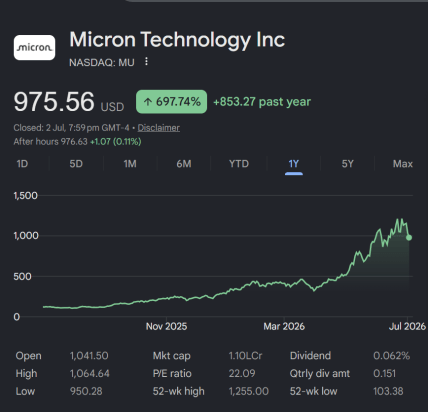
It is trading around $975, market cap $1.23 trillion, trailing P/E of 23.37x.
Up more than 800% over the past year.
Micron just posted one of the most extraordinary quarters in its history.
Revenue for its fiscal third quarter came in at $41.5 billion, up almost 4.5x from a year earlier, comfortably beating Wall Street’s $35 billion estimate.
Earnings per share came in at $25.11 against an expectation of roughly $20.20.
Net income landed at $28.2 billion, with profit margins expanding to 68% from just 20% a year ago.
The company’s guidance for the current quarter is roughly $50 billion in revenue, up from $11.3 billion in the same quarter last year.
Micron has also crossed the $1 trillion market cap mark, and has signed a multi-year deal to become a primary memory supplier for Anthropic’s AI infrastructure.
Despite the run up in the stock, the trailing P/E sits around 23x, which is not outrageous for a company growing earnings at this pace. Management itself has flagged that supply shortages in memory are expected to persist through at least 2027.
Memory has always been a boom and bust business. If capacity additions from Micron, Samsung and SK hynix all land around the same time, pricing power could fade faster than the market currently expects.
2. SK Hynix: the HBM king with a DDR5 side hustle
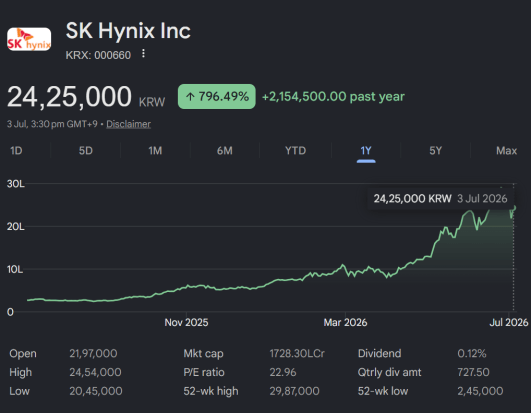
SK hynix is trading around 2.34 to 2.42 million won (roughly $1,700 to $1,870 in dollar terms), down sharply from its intraday record high of 2.99 million won hit on June 26. Market cap has crossed the $1 trillion mark. Up more than 790% over the past year.
SK hynix is the single biggest supplier of high bandwidth memory, or HBM, the specialised chip that sits directly on AI accelerators like Nvidia’s GPUs. Depending on which data provider you check, its HBM market share sits somewhere between 50% and 62%.
Its first quarter FY2026 revenue came in at roughly 52.6 trillion won (about $34.5 billion), up 198% year on year, with net profit of 40.3 trillion won. Operating margins have crossed 70%, extraordinary numbers for a company that used to compete in what was essentially a commodity business.
Here’s the interesting bit. SK hynix recently chose to slow down its ramp of next generation HBM4 chips, and instead redirect some of that capacity toward conventional DDR5 DRAM, where operating margins are reportedly approaching 90%.
DDR5 prices have jumped 90% to 95% quarter on quarter in early 2026 due to a genuine supply crunch. That’s a company optimising for near-term profit over racing to be first with the next chip generation.
SK hynix also briefly overtook Samsung’s market cap in South Korea in June, before both stocks corrected sharply the next day on reports that Nvidia might trim GPU production. The company is also planning a Nasdaq ADR listing, which could open it up to a much wider pool of global investors who currently can’t easily buy Korean-listed shares.
SK hynix is heavily dependent on Nvidia’s order book. Any slowdown in AI accelerator demand hits this stock disproportionately hard, and the Korean won’s movement against the dollar adds another layer of volatility for foreign investors.
3. Samsung Electronics: the giant fighting to reclaim the crown
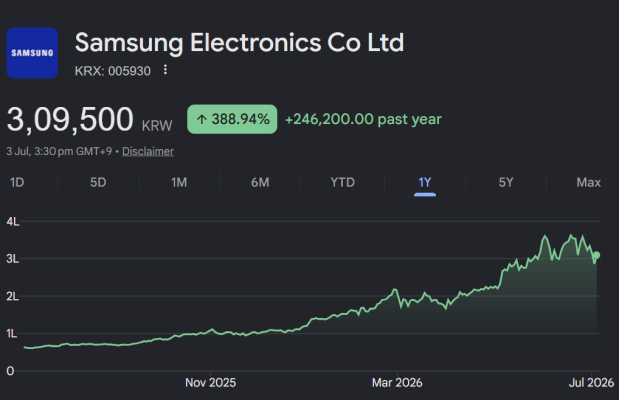
Samsung is trading around 339,500 won, down about 9% from its all-time high of 374,500 won hit on June 19.
Samsung actually reclaimed the top spot in DRAM market share in the first quarter of 2026, with 38% share against SK hynix’s 29%. It also became the first company to mass produce HBM4 chips, hitting speeds of 11.7 Gbps, about 46% faster than the previous industry standard.
Its first quarter results beat expectations by a wide margin: revenue of 133.9 trillion won against a consensus of 126.3 trillion won, and earnings per share of 7,120 won against an estimate of 6,150 won. The company’s memory division posted an all time high in both quarterly revenue and operating profit.
Samsung is a more complex investment than a pure memory play, since it also has a smartphone business, a display business, and a foundry business, each moving on its own cycle. The memory recovery is clearly the dominant driver of sentiment right now, but it’s worth remembering the other divisions are along for the ride too.
The risk: Samsung’s foundry and mobile businesses have both had a rocky few years, and a memory-driven rally can mask weakness elsewhere in the conglomerate if you’re not paying attention to segment-level numbers.
4. SanDisk: the NAND story that’s gone almost vertical
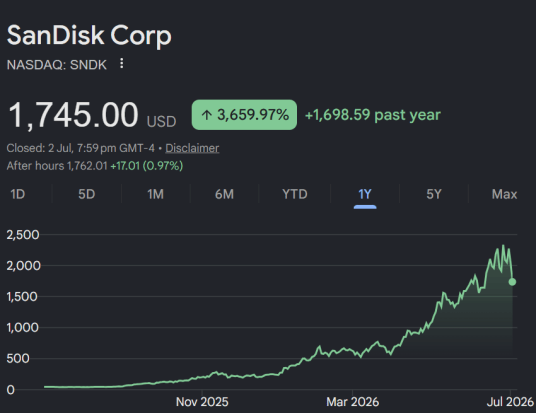
SanDisk is trading around $1,762, market cap $288.85 billion, trailing P/E of about 70.6x. Its 52-week range is an almost unbelievable $40.10 to $2,354.39. Up roughly 4,000% since its February 2025 spinoff.
If you want a single chart that captures how extreme this memory cycle has been, look at SanDisk. The company spun off from Western Digital in February 2025 at around $38.50 a share. By June 2026, it had touched levels north of $2,000.
SanDisk makes NAND flash, the memory technology used in SSDs and enterprise storage rather than DRAM. Its fiscal third quarter 2026 revenue soared 251% year on year to $5.95 billion, driven by a 233% surge in its Data Center business alone. The company says its entire 2026 production capacity is already sold out, with reported new contracts worth at least $42 billion.
But this is also the stock in this list showing the most volatility. Shares have swung by double digit percentages within single trading sessions on both good and bad news, as investors debate whether a supply glut is coming or whether the shortage genuinely persists into 2027. The company’s trailing twelve month net income is still negative, at roughly negative $1.6 billion, even as revenue and forward guidance look strong. That gap between current profitability and the stock’s valuation is worth sitting with.
The risk: At a trailing P/E north of 65x, SanDisk’s valuation is pricing in a lot of good news continuing to arrive on schedule. Any hint that NAND supply is catching up to demand could trigger a sharp re-rating.
5. Western Digital and Seagate: hard drives are (unexpectedly) back
Western Digital has been extremely volatile even by this group’s standards, recently pulling back about 18% to around $490 after a strong run, putting it on a forward P/E of roughly 29x, and is up well over 100% year to date. Seagate is up about 500% year to date, trading at a P/E in the mid-60s to mid-70s.
Hard disk drives were supposed to be a slowly fading technology, gradually replaced by solid state storage. Instead, AI data centres need enormous amounts of cheap, high capacity storage for the data they generate and retain, and HDDs remain the most cost effective way to store that at scale.
Western Digital’s fiscal third quarter revenue came in at $3.34 billion, up 45% year on year, with adjusted earnings per share of $2.72 against an estimate of $2.39. Gross margin crossed 50%. The company raised its dividend by 20%, announced a $4 billion buyback, and says its HDD production capacity is fully committed for 2026, backed by multi-year agreements with hyperscale customers running through 2028 and 2029.
Seagate tells a similar story. Its fiscal third quarter 2026 revenue came in at $3.11 billion, up 44% year on year, driven largely by its nearline data center drive business. Capacity is booked through 2027, and margins are at record levels, though the stock’s valuation has stretched well ahead of its historical range, alongside some notable insider selling worth keeping an eye on.
The risk: Forward P/E multiples on both HDD makers have expanded well beyond their historical averages. A lot of future earnings growth is already baked into the current share price.
If picking single stocks feels like a gamble, there are ETFs too
Given how binary some of these outcomes can be (a single supply chain hiccup or a lost qualification can hit a stock hard), a few ETFs have emerged that let you buy the whole memory theme in one trade.
Roundhill Memory ETF (DRAM) is the first ETF built specifically around this theme. It holds 15 global memory chip companies, with Micron as its top holding at 27.57% weight, SK hynix close behind at 26.87%, SanDisk at 5.52% (fifth spot), and Seagate at 4.27% (seventh spot). The fund has assets under management of $21.85 billion, charges a 0.65% expense ratio, and is up 176.3% year to date.
Tuttle Capital Concentrated Memory Stack ETF (HBMX) takes a broader approach, spreading across 24 companies across the whole memory ecosystem, not just the chipmakers themselves but also packagers, equipment makers and materials suppliers behind HBM, DRAM and NAND. It’s a much smaller fund, with net assets of $22.16 million, and carries a higher 0.95% expense ratio. It’s up a comparatively modest 26% year to date, largely because it’s more diversified into the supporting cast rather than concentrated in the two or three stocks that have done most of the running.
The trade-off is straightforward. DRAM gives you concentrated exposure to the biggest winners, which has worked spectacularly so far, but also means the fund lives and dies with Micron and SK hynix. HBMX spreads the bet wider across the ecosystem, which should, in theory, smooth out the ride, though the numbers so far suggest that diversification came at the cost of missing much of the rally.
So what’s the common thread?
Strip away the individual stock stories and one thread runs through all five. Structural demand for AI infrastructure has run straight into a memory industry that spent the last decade underinvesting in new capacity, since the previous cycle punished anyone who overbuilt. That mismatch, three companies controlling nearly all of global DRAM supply and deliberately reallocating it toward AI, is why prices, margins and stock prices have all moved together so sharply.
The counterargument is equally simple. Memory has never permanently escaped its cyclical nature. Every company on this list is now spending aggressively to add capacity, and that capacity eventually shows up, typically around 2027 to 2028 based on current guidance. When it does, pricing power tends to fade, sometimes quickly, exactly the way it has every other time memory makers over-invested in response to a boom.
None of this is investment advice. Valuations across this group range from reasonably priced (Micron, on a trailing earnings basis) to genuinely expensive (SanDisk, Seagate). If you’re looking at this space, the earnings reports over the next two quarters, particularly around capacity utilisation and forward pricing commentary, will tell you a lot more than the stock charts currently do.
Sonia Boolchandani is a seasoned financial writer. She has written for prominent firms like Vested Finance, and Finology, where she has crafted content that simplifies complex financial concepts for diverse audiences.
Disclosure: The writer and her his dependents do not hold the stocks discussed in this article.
The website managers, its employee(s), and contributors/writers/authors of articles have or may have an outstanding buy or sell position or holding in the securities, options on securities or other related investments of issuers and/or companies discussed therein. The content of the articles and the interpretation of data are solely the personal views of the contributors/ writers/authors. Investors must make their own investment decisions based on their specific objectives, resources and only after consulting such independent advisors as may be necessary