


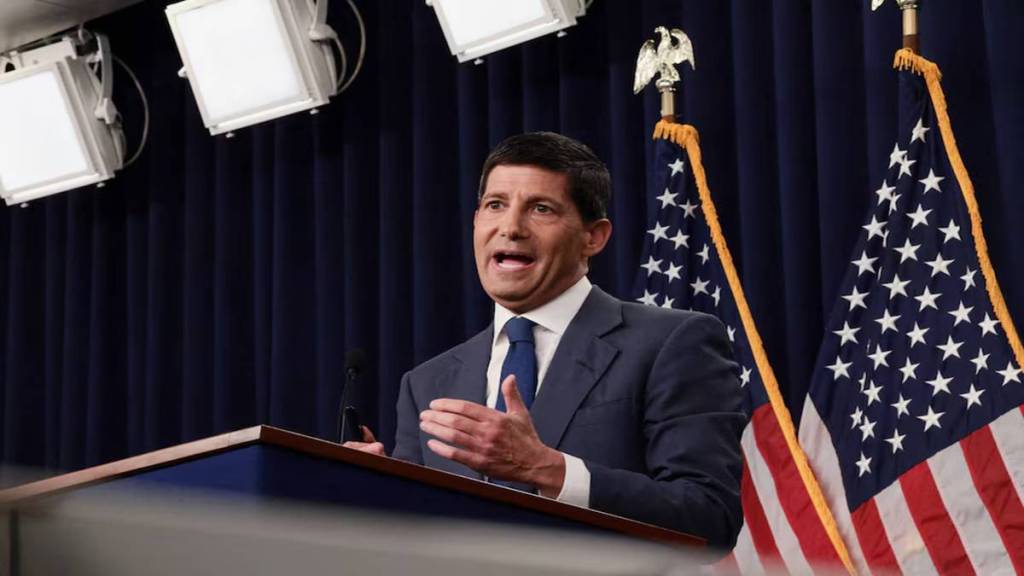

The US Federal Reserve raised interest rates by 25bps on Wednesday, taking the target range to 3.75%-4%, in the first rate hike of Kevin Warsh’s tenure as Fed chair. The decision was unanimous, with the Federal Open Market Committee voting 12-0.
However, rate decision was only the beginning. Warsh then faced journalists for a press conference that, unlike some of the lengthy post-meeting briefings that can stretch well beyond an hour, wrapped up in around 30 minutes. In that relatively short window, he gave a glimpse into how the Fed leadership is thinking about inflation, employment, financial markets, Treasury yields, geopolitical risks and the growing capital demands of the artificial intelligence boom.
Fed believes inflation is still too high, the US economy has strengthened and policymakers are not yet convinced that underlying price pressures are moving towards the central bank’s 2% goal quickly enough.
“We must be confident that underlying inflation is moving to our objective, clearly and at sufficient speed,” Warsh said in his opening remarks. “Today, the FOMC decided that this standard has not been satisfied.”
The decision marks the first US rate hike since July 2023 and comes at a time when policymakers are confronting a complicated combination of persistent inflation, a relatively resilient economy and rising costs linked to geopolitical tensions.
A decision driven by the economy, not markets
Warsh made it clear that the Fed did not raise rates because of what financial markets expected it to do. “We made this decision today based on our assessment of the situation, based on our assessment of the trajectory for employment, based on our judgment on the strength of the economy,” he said. Markets, he added, can try to anticipate the central bank’s actions, but that does not determine the Fed’s decision.
“Sometimes the market tries to prejudge our outcomes. I’ll observe market prices and see what they have to say. But today was our decision,” Warsh said. Warsh repeatedly resisted attempts to provide a detailed roadmap for future policy decisions, stressing that each decision would depend on the economic data available at the time.
Asked about the path of interest rates, he was particularly direct. “I’m not in the forward guidance business,” he told reporters. Warsh also added Wednesday’s decision as a “sober”, “serious” and “responsible” one, but said he would not prejudge what the FOMC might do at future meetings. “I’m not going to prejudge any future decisions we make,” he said. “I committed to a discipline, a set of principles … That’s what we did today.”
Inflation remains the Fed’s central concern
The Fed continues to operate under its dual mandate of maximum employment and price stability, Warsh made clear that inflation is currently receiving greater attention.
“Our predominant focus is on the price stability side of our mandate,” he said. “The plain fact is that inflation is too high, and has been for too long.”
Warsh said inflation has been above the Fed’s target for more than five years. Recent CPI and PPI readings, he added, had not provided enough evidence that underlying price pressures were easing quickly enough.
“This summer’s inflation readings do not tell me that underlying trends have meaningfully improved,” he said, pointing to several categories in recent inflation data that continued to show increases above 3%.
The Fed’s objective is not simply to see inflation fall eventually. Policymakers want to be confident that it is moving towards the 2% target at a sufficient pace.The September decision therefore explained the committee’s judgment that this standard had not yet been met.
The Fed’s official statement similarly said inflation remained elevated and that the latest policy action would support a “timelier return” to its 2% goal.
The economy has strengthened since July
The decision to raise rates comes against a backdrop that is not one of an economy in obvious distress. Warsh said incoming data since the Fed’s July meeting pointed towards a strengthening economy. “There’s been a pretty wide ranging set of data, including the labor markets, that the economy has strengthened … It’s a judgment that I have and the committee has,” he said.
In his opening remarks, Warsh pointed to several indicators. “Our decision comes at a time when the American economy appears to be strengthening,” he said. “New hiring, private sector earnings, business capital investment – each of these markers has improved in recent months and is pointing in a good direction.”
The FOMC statement also described economic activity as expanding at a solid pace. Domestic spending remained resilient despite elevated uncertainty, while productivity growth was strong and capital investment was robust. The labour market, meanwhile, appeared relatively steady. The Fed said job gains had kept pace with workforce growth and that the unemployment rate had changed little.
Warsh said the labour-market side of the Fed’s mandate was in “good shape”. This has allowed policymakers to put greater emphasis on inflation without, in their assessment, ignoring a rapidly deteriorating employment picture.
The Fed cannot control the price of oil or food
One of the more revealing exchanges during the press conference concerned the limits of monetary policy. With energy prices and geopolitical developments contributing to price pressures, Warsh was asked whether smaller rate hikes could address inflation caused by energy supply shocks.
Warsh said, “We cannot affect any individual price, whether it be oil prices, whether it be foodstuffs at the grocery store.” The Fed cannot directly determine the price of oil, food or other individual goods. Its role is instead to prevent a change in relative prices from spreading into inflation.
“But what we can do and will do is ensure that any change in relative prices don’t broaden out, don’t have second and third order effects in the economy,” Warsh said. “That’s what we’re tasked to do, and that’s what we will do.” The distinction could become increasingly important if geopolitical tensions continue to push commodity prices higher.
Warsh said geopolitical developments had changed the Fed’s assessment of the outlook. He cited stubborn inflation readings and changing geopolitical conditions as factors behind the unanimous rate hike. “Summer trends weren’t passing the test. I’ve seen very little information since that would make me reverse that decision. So I’ve stuck with it,” he said. “And our judgment about what is the most likely or least likely of the geopolitical situation has changed.” “All three of those things lend themselves, to a firm unanimous decision today,” Warsh added.
Treasury yields are being pushed higher by more than the Fed
The rate decision also came as US Treasury yields have climbed sharply this year. The 10-year Treasury yield crossed 5% earlier in the week, reaching its highest level since 2007. Warsh pointed to three major forces behind the increase, including a stronger economy, greater competition for capital and geopolitical tensions that have pushed commodity prices higher.
The competition for capital is particularly interesting in the context of the AI boom. “The economy has strengthened. Competition for capital has rushed upward, spurred in large part by the major capital needs of the AI hyperscalers that are ‘out in the market raising funding,’” Warsh said.
The enormous investment requirements of major AI companies and infrastructure providers are therefore becoming part of the financial conditions confronting the economy. Large technology companies and AI infrastructure businesses are seeking substantial amounts of capital to fund data centres, computing infrastructure and other investments. The demand can affect the broader market for capital and, in turn, influence borrowing costs and Treasury yields. At the same time, geopolitical tensions have pushed commodity prices higher, increasing costs for businesses and consumers. Warsh said those higher commodity prices were feeding into the cost of goods across the US economy.
Global central banks face their own inflation pressures
The Fed chair also acknowledged that monetary policy does not operate in isolation. Asked about other central banks, Warsh said advanced economies were also dealing with price pressures and that decisions made by one central bank could affect other economies.
“When the Federal Reserve makes a policy choice, it matters not just to the U.S. economy, but it spills over to the rest of the world. To a lesser extent, that’s true for them too,” he said. “When foreign central banks make decisions where they’re confronted with higher prices and they choose consistent with their remit to raise rates, then they’re helping to quash inflation in their countries and there’s spillovers and spill backs in both directions.” However, Warsh declined to speculate on what other central banks might do at their upcoming meetings.
A 2% inflation rate could mean more than just price stability
Warsh also framed the Fed’s inflation target in terms of household incomes. He argued that stable prices could help workers see more meaningful increases in their real purchasing power.
“Stable prices, an environment where inflation is running consistent with our 2% objective, offers good news because that way, when they get their wages, they can put their head above water and deliver real take-home pay increases,” Warsh said. Warsh said those who are least well off could ultimately have the most to gain from a durable economic expansion, a solid labour market and stable prices.
“Those who are least well off have the most to gain from a durable expansion, a solid labour market, and stable prices,” he said. He noted that many of these Americans do not own financial assets or have equity in their homes and are living paycheck to paycheck. The Fed, Warsh said, must assess whether the economy is operating more or less at full employment before turning its attention more heavily towards the price-stability side of its mandate.
“That doesn’t mean that individuals aren’t searching for a job, but in aggregate, we’re running more or less at full employment,” he said.
The dot plot points to another hike
The Fed’s latest projections showed that policymakers still see the possibility of further tightening. Twelve of the 18 officials expect one more 25-basis-point rate hike this year, while four see two additional hikes and two see no more hikes. At the same time, the projections suggest that policymakers could remain on hold through 2027, with easing potentially coming later. Warsh, however, did not submit his own interest-rate projection to the Fed’s dot plot.
“This afternoon, you also received the summary of economic projections — it reflects the views of my colleagues on the committee,” he said. “But as in June, I’ve not offered a projection of my own. But like in June, I said I would faithfully discharge the summary of their projections.” This leaves investors to interpret the committee projections without a separate rate path from the Fed chair himself.
Fed independence becomes another key theme
The political dimension of monetary policy also surfaced during the press conference. Asked about his discussions with President Donald Trump, who has repeatedly called for lower interest rates, Warsh declined to comment. “I’ve got nothing for you on a discussion with the president,” he said.
At another point, he added: “I’m not a Wall Street newsletter.” Warsh instead emphasised the principle of central bank independence. “Part of the independence of the Federal Reserve is we stay in our lane,” he said.
“Independence is a two-way street. We let people that do trade policy and fiscal policy stay in their lane too. That’s how we can stand up here and call them the way we see them.” The comments show that Warsh sees the Fed’s role as distinct from decisions on trade and fiscal policy, even though those policies can have significant consequences for inflation and economic growth.
The Fed also changes how it manages its balance sheet
The September meeting also brought changes to the Fed’s operational framework. The central bank said it would continue maintaining ample reserves in the banking system. The New York Fed’s Open Market Desk was directed to conduct operations necessary to maintain the federal funds rate within the 3.75%-4% target range.
The Fed raised the interest rate paid on reserve balances to 3.90%. It also set the overnight reverse repurchase agreement offering rate at 3.75%, with a per-counterparty limit of $160 billion a day, while the standing overnight repo facility was set at 4%.
Under the new framework, the Fed will roll over at auction all principal payments from its Treasury securities holdings. Principal payments from agency securities will be reinvested into Treasury bills.
The central bank also said it could increase its holdings through purchases of Treasury bills and, if necessary, other Treasury securities with remaining maturities of three years or less in order to maintain an ample level of reserves. Separately, the Board unanimously approved a 25-basis-point increase in the primary credit rate to 4%, effective September 17. Seven Federal Reserve banks had requested the increase.
A new Fed chapter begins with a deliberately cautious message
The first rate hike of the Warsh era therefore carries a message that extends beyond the 25-basis-point move itself. The Fed sees an economy that has strengthened, a labour market that remains relatively steady and productivity and capital investment that are supporting activity. It also sees inflation that has remained above target for too long and recent readings that have not provided sufficient confidence of a rapid return to 2%.
Geopolitical tensions and commodity prices add another layer of uncertainty, while the capital requirements of the AI boom are increasing competition for funding. Warsh’s response has been to emphasise discipline rather than promise a predetermined path.
“I’m not in the forward guidance business,” he said. Though the Fed’s projections point towards the possibility of another hike, the chair has made clear that future decisions will depend on how the economy, employment and inflation evolve.