


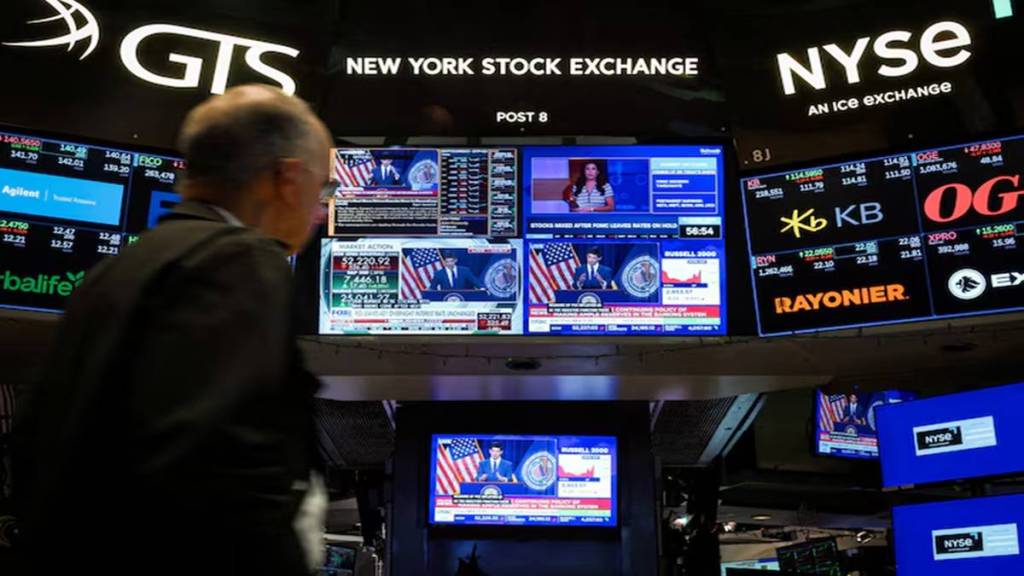

US stocks are fast becoming a favourite with Indian investors. The numbers show it. Many international platforms and discount brokers offer Indian investors a route to global stocks. That includes shares listed on the Nasdaq and those in the S&P 500 index. But the route comes with a price tag.
Buying US stocks is not as simple as buying Indian shares. There are a few extra steps. The main one is turning rupees into dollars, at the foreign exchange rate on the day of the transaction.
Here are a few key charges you need to know about, typically with any discount broker and even with an international brokerage platform.
Does opening a US trading account cost anything?
When you sign up, your broker opens a trading account for you with its US partner. Before you start, check the costs. Find out how much the broker charges for account opening and the annual maintenance charge.
How do you add dollars to your account?
You pay in rupees from your bank. Your bank converts them into dollars and deducts the INR amount, which includes its exchange rate, taxes, and any convenience fee. Ask the broker you are opening the account with for the full breakdown.
Forex markup is usually the biggest cost
The INR-USD exchange rate published by the RBI is the best rate available. Your bank, however, sells you dollars at a slightly different rate, and the gap is its margin. Banks typically mark up 1–1.5%, but it could be even higher with some banks.
It looks small, but it repeats. Keep an eye on this cost, as you pay it each time you buy or sell foreign stocks.
Zerodha: Brokerage, Exchange rate and conversion charges
| Charge | How Much |
| Currency conversion markup | 0.5 to 1.2% above the RBI reference rate |
| Brokerage | 0.10% (Minimum $0.01, Maximum $10); Buy and sell |
| Integrated Goods and Services Tax (IGST) | 18% on brokerage amount; Buy and sell |
| International Financial Services Centres Authority (IFSCA) turnover fee | 0.005% on trade value; Buy and sell |
| Securities and Exchange Commission (SEC) fee | 0.00206% on trade value; Sell only |
| Financial Industry Regulatory Authority (FINRA) fee | 0.0195% multiplied by sell quantity*; Sell only |
| GST | 18% on brokerage amount |
| *The FINRA Trading Activity Fee (TAF) is paused from 1 October to 31 December. | |
| A minimum charge of 1 cent ($0.01) applies to SEC, FINRA, and IFSCA fees. | |
Source: Zerodha website
Why does the bank charge a remittance fee?
Buying dollars to fund your US stock purchase is an outward remittance under the RBI’s LRS rules. Each such transfer carries a bank service charge plus GST. Since the fee is per transfer, funding in fewer, larger chunks costs less than many small ones.
What is TCS, and do you get it back?
Money sent abroad under the RBI’s Liberalised Remittance Scheme (LRS, up to $250,000 a financial year) attracts tax collected at source (TCS). It is nil up to Rs 10 lakh in a financial year and 20% above that.
Here is the math. A Rs 12 lakh remittance pays TCS only on the extra Rs 2 lakh, which is Rs 40,000.
TCS is not a fee. It is an advance tax you can claim back when you file your return. It can still tie up cash for a while. This is a regulatory requirement and is similar across all brokers.
Groww: Brokerage, Exchange rate and conversion charges
| Charge | How Much |
| Currency conversion markup | As per bank rates |
| Account Opening Charges | zero |
| Maintenance Charges | zero |
| Brokerage | 0.1% of the executed order value or $1 per executed order, whichever is higher. |
| SEC fee | 0.00206% of trade value, on sells only |
| FINRA fee | $0.000195 per share (maximum $9.79), on sells only. |
| CAT fee | $0.000003 per share, on buys and sells |
| GST | 18% on brokerage amount |
Source: Groww website
How much does the broker charge?
Brokerage is the fee a platform or broker charges for executing your buy or sell orders. It may be a percentage of the transaction value, a fixed amount per order, or another pricing structure.
Brokerage is another important factor to consider, and it varies from broker to broker. With some, it could be 0.1% of the order value or $1 per executed order, whichever is higher. A $1,000 buy costs $1. A $200 buy costs $1 too, which is 0.5%. Small orders feel it the most. Brokers add 18% GST on this brokerage, so $1 becomes $1.18.
US regulatory fees come on top
In addition to the above charges, there are US regulatory fees, including the SEC fee, FINRA fee and CAT fee, that go to US regulatory bodies. There could also be International Financial Services Centres Authority (IFSCA) turnover fees as possible extras.
All charges show up on your order statement
All the charges show up on your order statement, which gives you a better picture of the total cost. Check it after your first trade, and compare brokers on all these costs, not just brokerage.
Disclaimer: This article provides factual analysis only and is not, and should not be construed as, an offer, solicitation, or recommendation to buy or sell securities. Investment in foreign securities involves significant risks, including currency fluctuations, different financial reporting standards, and varying regulatory environments. The historical performance of US stocks is not a guarantee of future returns, and gains should not be viewed as an offer or solicitation to buy. Investors must conduct their own independent due diligence and seek advice from a SEBI-registered financial advisor. Financial Express is not responsible for any decisions made based on this information.