




Bond yields continue to climb, and the AI boom is getting part of the blame. The 10-year US Treasury yield climbed as high as 5.34%, its highest since 2002, while the 30-year yield spiked to a 24-year high of 5.69%.
First, a quick refresher. Bond yields move opposite to bond prices. So when investors sell bonds, prices fall and yields rise. A rise in yields also brings in the expectation of a higher-rate scenario. That is not good news. It is not looked upon favourably for the economy, corporates and borrowers. Why? Higher rates make loans costlier and squeeze growth.
So what is behind the surge? The big question is, what is driving US yields higher: sticky inflation and possibly more Fed hikes, rising US fiscal burden, or something else?
Industry experts blame a sell-off in US Treasury bonds, linked to AI. So how does AI come into the bond market story?
The simple explanation is this. Capital is limited. AI companies are raising funds and offering higher rates to investors. For an investor, that changes the math. Holding US Treasury bonds is not attractive enough compared to holding AI debt. So money moves out of Treasuries and into AI paper. Treasury prices fall, and yields rise. That is one view.
ING, Merrill and PIMCO’s Christian Stracke each have an answer, and the answers differ. Here is how they stack up.
Is AI Really Behind a Fifth of the Yield Jump?
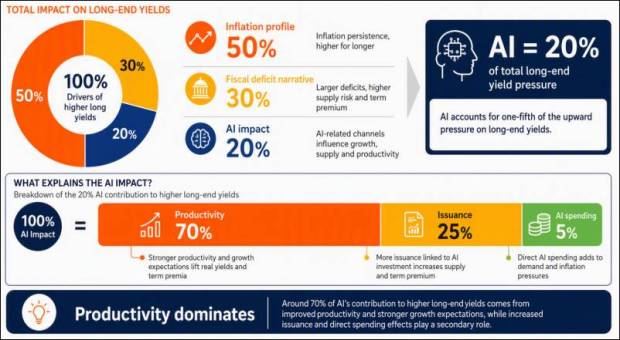
A recent note from ING strategists reports that inflation and fiscal deficits remain the biggest drivers of higher long-dated yields. AI accounts for about one-fifth of the recent rise, ING estimates.
Much of the debate so far has focused on Big Tech’s borrowing spree. It has forced companies to compete with governments for investor money. ING says that is only part of the story.
ING does not rule out inflation as a reason behind rising yields. Separately, Federal Reserve Chair Kevin Warsh had highlighted the AI investment boom as a major source of price pressure during his testimony before the House Finance Committee. He noted the rapid development of data centers and the increasing demand for AI software and equipment as key aspects of the current US economy.
Growth Hopes, Not Borrowing, Drive Most of AI’s Push
Where does AI’s push come from, then? ING estimates that roughly 70% of AI’s impact on long-dated yields comes from expectations that the technology will boost productivity and long-run economic growth. Only about 25% comes from higher AI-related corporate debt issuance.
The logic is simple, according to ING. If AI makes businesses more productive, investors expect companies to borrow and invest more. That pushes up expectations for long-term interest rates. Those expectations can lift real bond yields even before productivity gains show up in economic data, the strategists wrote. In ING’s view, a rise for productivity reasons reflects good news, not bad.
Impact of AI on Bond Yields
Source: ING
Why Big Tech Bonds Are Crowding Out Treasuries
Merrill’s Chief Investment Office offers a different lens in its Capital Market Outlook. Its fixed income strategy team says the largest technology companies have issued nearly $280 billion of debt year-to-date to fund AI-related spending, citing Bloomberg data as of September 9.
JPMorgan Chase estimated in June that $4.1 trillion in AI-related debt will be issued through 2030, reported CNBC.
Many of these issuers carry high credit ratings and have been selling longer-maturity bonds. As a result, Merrill says, they are competing with long-dated Treasuries for the same pool of money.
That pool includes insurance companies, pension funds, sovereign wealth funds and other investors focused on long-duration bonds. Merrill calls it a crowding-out effect among high-quality fixed income.
The wider picture is similar. Merrill says investment-grade corporate issuance is running roughly 40% above last year and is on pace for a record, citing Bloomberg data as of September 8.
Borrowing Adds to the Pressure
The US government’s worsening fiscal position is adding to the woes. Merrill says net interest expense has passed $1 trillion a year and now rivals total US defence spending. It adds that the Congressional Budget Office projects the fiscal 2026 shortfall to widen to roughly $2.1 trillion.
So investors are being asked to absorb new supply from the Treasury and from corporate America at the same time, according to Merrill. The 30-year Treasury yield moved above 5.3% in August, a level not seen since 2007.
Merrill says fiscal worries likely played a role. But it also says heavy supply, sticky inflation, reduced Fed demand and competition for investor capital were equally important.
But is debt alone the answer? Merrill also notes that debt alone does not set interest rates. Between 2007 and 2020, US debt rose sharply even as the 10-year yield fell from roughly 5% to below 1%. Recent Treasury auctions, it adds, have drawn demand in line with historical norms.
PIMCO’s Stracke Goes Further: Is It All AI?
PIMCO President Christian Stracke is also of the view that AI spending, not inflation, drove yields higher, according to a Bloomberg report. Stracke says capital demand from hyperscalers and the wider AI ecosystem is competing for a finite pool of capital. That, he argues, is lifting real rates and bond yields.
The Verdict: Yes, But the Size Depends on Who You Ask
So, is AI pushing yields higher? The short answer is yes, but the size of the push depends on who you ask.
ING puts AI’s share at about one-fifth of the recent rise, mostly driven by growth hopes rather than borrowing. Merrill sees AI-related debt as one part of a much bigger supply wave, alongside Treasury issuance. Stracke goes furthest, naming AI capital demand as the driver.
Disclaimer: This article is for informational purposes only and should not be treated as investment advice. Readers should consult a qualified financial advisor before making investment decisions.