


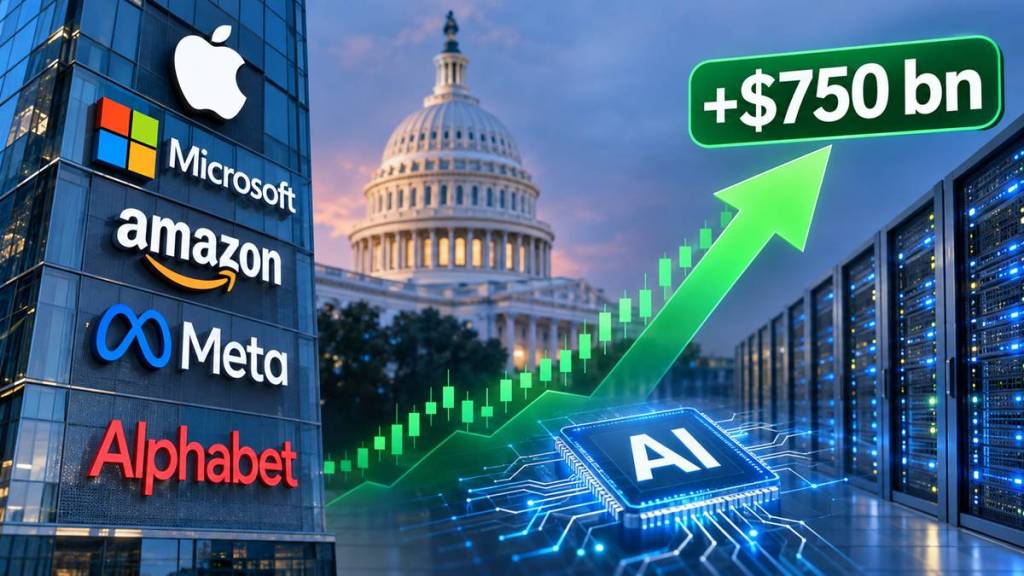

US tech giants’ shares jumped sharply on Wednesday after Democrats swept the midterm elections in both the House of Representatives and the Senate.
The Nasdaq Composite jumped 1.44%, thanks to big gains in some top US technology stocks. Amazon shares rose 6.12% to a three-month high. Meta, Alphabet and Microsoft climbed between 2% and 6.68%. The gains helped lift the wider market after several days of selling. That selling was driven by worries over the high cost of the AI boom.
Apple hits a record despite chip cost pressure
Apple (AAPL) climbed almost 7% to the intra day session before closing at $349.51, up by 5.31%. This came even as the company faces rising memory chip costs driven by surging AI demand. Apple has largely steered clear of the huge AI investments made by other major tech firms.
Why would data centre limits cheer investors?
Investors are betting that possible limits on new data centres could help the biggest companies keep control of scarce computing power. Such limits could also reduce the heavy spending that has been straining their cash.
Big Tech Stocks Set for a $750 Billion Rally?
These five major technology companies are poised to collectively increase their market capitalisation by more than $750 billion if their latest stock gains continue, reported Reuters.
The rally represents a significant turnaround for major cloud providers, whose shares had come under pressure following quarterly earnings reports. It’s worth noting that Microsoft stood out from its peers, reporting cash flow of $18.6 billion.
Those results highlighted the growing financial burden of the AI infrastructure race, with companies that previously maintained strong cash positions and relatively low debt now committing substantial funds to expansion, increasingly supported by borrowing.
Recovery Amid Questions Over Data Centre Expansion
The recovery in technology stocks came amid major Democratic victories in the US midterm elections, including in Texas, where several political leaders have expressed opposition to large-scale data centre developments.
The election results could intensify resistance to new facilities, which face growing criticism over their substantial electricity and water consumption, as well as noise pollution.
These infrastructure projects are essential to the expansion of artificial intelligence but are becoming increasingly controversial among communities located near proposed developments.
Market strategists believe the political developments could introduce delays and obstacles to future data centre construction. However, a slower expansion could also benefit established technology companies by limiting excessive infrastructure development and reducing the risk of oversupply.
Art Hogan, chief market strategist at B. Riley Wealth told Reuters, “Conceptually, post-election, there may be a bit of a slowdown or some bumps in the road for future data-center build-out.” He further added, “the hyperscalers (large tech companies) already have data centers, so those assets are more valuable now because there’s not going to be an overbuild of data centers. Also, if there’s a slower pace of data-center build-out, then there’s going to be a slower pace of CapEx spending. That certainly would impact the hyperscalers.”
Existing data centre assets may consequently become more valuable, while a moderation in construction activity could help major technology companies rein in capital expenditure.
Texas Emerges as a Key Concern for AI Investors
Texas has become a particularly important market for the AI infrastructure industry, accounting for an estimated 25% to 30% of planned data centre power capacity.
Consequently, the possibility of stricter restrictions or a slower approval process in the state has emerged as a major concern for technology investors.
However, a more gradual pace of construction may not necessarily be negative for the broader industry. Investors could view a controlled expansion cycle favourably, as it may prevent excessive infrastructure spending, reduce the risk of oversupply and improve the long-term economics of existing data centre investments, the report said.
AI Infrastructure Companies Face Growing Pressure
Smaller data centre operators also experienced significant losses. CoreWeave, a major neocloud computing provider that has become a focal point of investor concerns over the industry’s growing reliance on debt to finance AI expansion, saw its shares tumble 9.9%. Other companies in the sector also recorded steep losses, with Nebius declining 6.7% and Iren falling 11.2%.
The sell-off spread across the broader AI infrastructure segment. Comfort Systems dropped 15.1%, while Vistra shed 13.8%. Memory chipmaker Micron Technology also came under pressure, with its stock losing 7%.
Investors are concerned that tighter restrictions and potential delays in data centre construction could undermine these companies’ expansion strategies, particularly given their dependence on debt financing.
Unlike established technology giants, several smaller operators have been committing spending amounts multiple times greater than their existing revenues to fulfil rapidly growing customer order backlogs.
Any slowdown in infrastructure development could therefore create additional financial pressure and make it harder for them to meet their expansion commitments.
“The biggest worry of the night for tech investors and the AI trade was around the state of Texas, where ~25%-30% of data-center gigawatts and capacity will come from,” Dan Ives, senior managing director and tech analyst at Yorkville Ives told Reuters. “Now it will happen at a more measured pace, which is likely a good thing in the eyes of many investors,” Ives added.
AI Infrastructure Spending Continues to Surge
Despite the emerging challenges, leading technology companies are pursuing aggressive infrastructure expansion plans to support growing AI demand.
The industry’s biggest players are expected to spend more than $740 billion this year, compared with approximately $400 billion last year.
This enormous investment highlights the scale of the AI infrastructure race and places major technology companies well ahead of smaller cloud computing competitors such as CoreWeave and Nebius.