


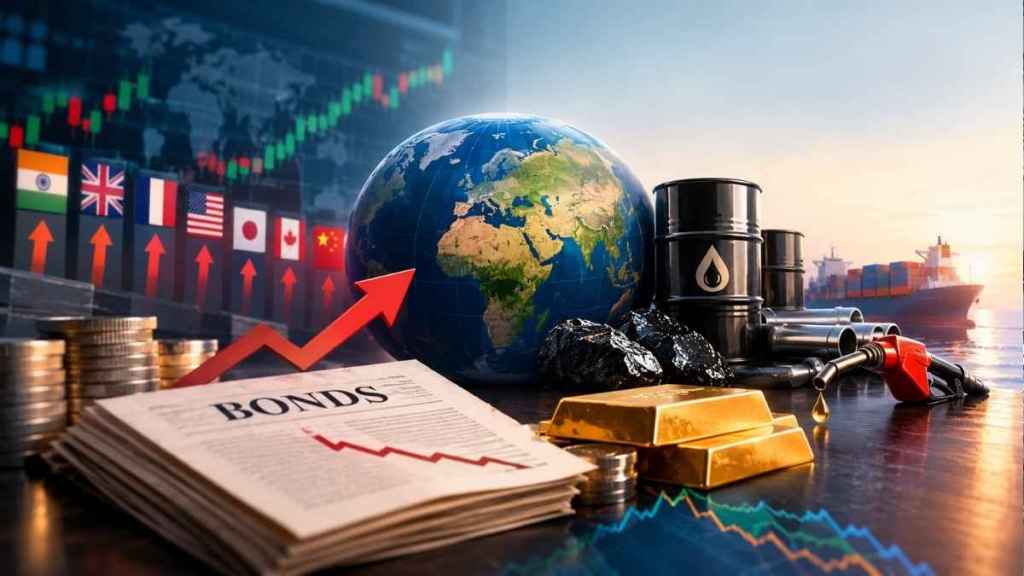

The rise in bond yields is global. US markets have made the biggest headlines. But bonds are selling off everywhere else too. The ten-year yield in India has risen from 6.7% in June to 7.3% today. Over the same period, bond yields in France have risen a full percentage point. The UK’s yield has risen a similar amount to India’s. The story is similar in Japan, Canada, and other large economies. The only exception to this trend is China. China’s ten-year yield is roughly unchanged in recent months.
What can we learn from this? For one, this is not a US specific phenomenon. It is not a case of investors losing faith specifically in US markets. Another important piece of data is stock returns. In the same countries where bond markets are down, stock markets have performed well. Or at least, they have not crashed. India is an exception to this, with its stock market performing poorly.
If stocks are rising but bonds are falling, this could mean one of two things. Either investors expect higher inflation, or they expect higher growth. It also means that a recession or major slowdown is unlikely. If it were, stocks would be down too. So, what is the market telling us? Will growth be higher, or is inflation going to rise?
Why Energy Markets Matter
The final piece of this puzzle is commodity markets. Oil prices are up over the last four months. But more importantly, the price of refined fuel is up even more. The spread between diesel and gasoline relative to crude oil has hit record highs. The West Asia conflict has increased shipping costs and reduced refining capacity. Earlier this week, US and European governments agreed to release diesel stocks due to anticipated shortages.
The commodity market movements are clearly inflationary. Supplies are down while prices are up. This is not a story supporting higher growth. Thus, the three markets together point in one direction: inflation is going to rise. The source of the inflation is the commodity market shock. The effect is visible in rising bond yields and stock markets that remain stable. The reason stock markets have not crashed is that stocks are a good inflation hedge. Higher inflation means that firm revenues and profits rise in nominal terms. Their stock prices keep pace.
Investors have sold out of bond markets because they are worried about inflation. Bonds pay a fixed nominal return. Higher inflation reduces the real return from owning bonds. As a result, bond prices have dropped and yields have risen.
Navigating the Inflationary Shift: A Portfolio Strategy
The normal advice for an investor hedging inflation is to buy gold. Unfortunately, gold has underperformed this year. While most of us assume gold will rise with inflation, that is not necessarily the case. Instead, what matters is the source of the inflation. If inflation is driven by central banks lowering interest rates and increasing the money supply, gold benefits. If inflation is driven by supply shocks in the commodity markets, gold does poorly. For energy importing countries like India, foreign exchange reserves shift toward higher energy costs rather than gold.
What then should an investor do? At some point, bonds will become attractive. Prices are low and future returns are higher than ever before. When investing in stocks, look for companies that can more easily absorb the inflation and energy shocks. Those will be the firms that can pass on higher inflation to their customers without affecting their bottom line.
As always, it makes sense to be diversified. Include all asset classes in your portfolio. Hold on to gold even though it has underperformed this year. If the inflation shock starts affecting economic output, central banks will act. They will ease monetary conditions, and gold prices will perform well.
The same holds true for bonds. Though they have underperformed, they could just as easily recover. A major factor in portfolio returns over the next year is the outcome of the West Asia conflict. If it ends or slowly peters out, these inflationary pressures will subside. Bonds will go back up. Stocks will go up even further. Overall, more money will be made the sooner the conflict ends.
If the conflict intensifies further, expect more of the same. Falling bonds and rising energy prices. Stock prices that go back and forth. Inflation that rises further. For now, we should expect inflation to go up. That is already priced into bond markets and will materialize over the next year. For an investor, it pays to be well diversified at all times.
Disclaimer:
Note: The purpose of this article is to share interesting charts, data points and thought-provoking opinions. It is NOT a recommendation. If you wish to consider an investment, you are strongly encouraged to consult your advisor. This article is for strictly educative purposes only.
Asad Dossani is an assistant professor of finance at Colorado State University. His research covers derivatives, forecasting, monetary policy, currencies, and commodities. He has a PhD in Economics. He has previously worked as a research analyst at Equitymaster, and as a financial analyst at Deutsche Bank.