



India’s power equipment cycle is entering a stronger phase as utilities step up transmission spending, renewable capacity expansion and surge in electricity demand. JPMorgan expects domestic ordering activity to improve, with transformer capacity additions, high-voltage transmission projects and renewable-energy integration creating opportunities across the sector.
Within its India power equipment coverage, JPMorgan has identified GE Vernova T&D India, Hitachi Energy India Ltd. and Siemens Energy India Ltd. India as key names to watch. The brokerage sees different growth triggers for each company, ranging from transformer demand to HVDC projects, while raw-material costs and pricing remain important variables for margins.
Based on the latest price-target entries shown in the report, Hitachi Energy India has the highest implied upside at 24.2%, followed by GE Vernova T&D India at 20.9% and Siemens Energy India at 10.7%.
GE Vernova T&D vs Hitachi Energy vs Siemens Energy: Target price and upside
JPMorgan’s power equipment thesis is built around a pickup in domestic orders after a period when transformer capacity constraints had limited the pace at which utilities could execute projects.
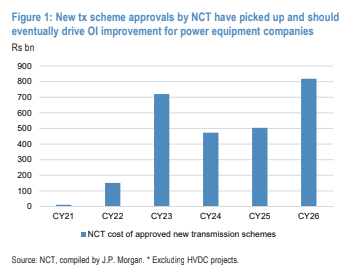
The brokerage expects tendering activity, National Committee on Transmission approvals and tariff-based competitive bidding awards to provide support to the order pipeline.
“Leading indicators of domestic order inflow (NCT approvals, tendering pipeline, TBCB awards) are showing a pickup, and with transformer capacity constraints easing, the demand for further energy security coming over the next 12-18 months, domestic order inflow for power equipment companies is likely to pick up,” JPMorgan said.
| Stock | Target price | Upside |
| Hitachi Energy India | Rs 40,500 | 24.2% |
| GE Vernova T&D India | Rs 5,200 | 20.9% |
| Siemens Energy India | Rs 3,600 | 10.7% |
The target-price entries are from JPMorgan’s price-history tables in the report and are not presented as fresh targets issued on the report’s dissemination date.
GE Vernova T&D India: Transformer cycle and domestic orders
JPMorgan expects GE Vernova T&D India to benefit as domestic power equipment ordering picks up.
Transformer manufacturing is central to the brokerage’s sector thesis because rising generation capacity and grid expansion require additional transformation capacity. JPMorgan expects capacity additions in transformer manufacturing to help ease supply constraints while allowing companies to cater to higher order volumes.
The brokerage also sees renewable-energy additions supporting transmission investment, as generation increasingly needs to be connected to demand centres through new grid infrastructure.
GE Vernova T&D India’s exposure to transformers and transmission equipment gives it a direct link to this spending cycle, according to JPMorgan.
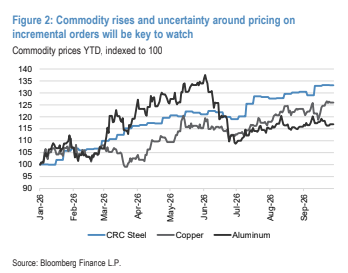
At the same time, the brokerage is watching the cost of CRGO steel, copper and aluminium, which are key inputs for transformers and switchgear.
“Key raw material costs rising: The prices of CRGO steel (laminations), copper (wiring) and aluminium (the main commodities in transformer and switchgear manufacturing) have moved higher recently,” JPMorgan said.
Hitachi Energy India: HVDC opportunity sets it apart
Hitachi Energy India has a different part of the transmission opportunity, with JPMorgan focusing on high-voltage direct current, or HVDC, projects.
The technology becomes increasingly relevant as renewable generation expands and electricity needs to be transmitted over longer distances. JPMorgan expects India’s grid expansion to create additional requirements for high-voltage equipment.
The brokerage, however, expects a temporary pause in HVDC ordering before the next set of projects progresses.
“HVDC ordering will likely take a pause following the Barmer order win by GVTDI, as new HVDC-CEC projects are at the approval stage with NCT. However, management has highlighted potential capacity-led HVDC projects (similar to the Mumbai HVDC recently commissioned by Hitachi) that are under consideration and could be ordered in CY28,” JPMorgan said.
The timing of these projects is therefore an important part of Hitachi Energy India’s order-growth outlook.
Siemens Energy India: Grid spending remains the main driver
Siemens Energy India is exposed to the same broader transmission spending cycle, with JPMorgan pointing to grid expansion, renewable integration and higher electricity demand as the main sources of equipment demand.
The company also benefits from its access to global technology and its presence in high-voltage equipment, according to the brokerage.
JPMorgan’s view on the sector is not limited to conventional transmission expansion. The report also points to electrification, decarbonisation and rising power requirements as structural drivers of electricity infrastructure spending.
As renewable generation increases, the grid requires additional transmission capacity, transformers and other equipment to connect projects and maintain system reliability.
JP Morgan on three stocks, different triggers
While the three companies operate within the same broad power equipment cycle, JPMorgan’s report points to different near-term factors for each.
| Stock | Main growth trigger | Key issue to monitor |
| GE Vernova T&D India | Transformer demand and domestic order pickup | Raw-material costs and pricing |
| Hitachi Energy India | HVDC and transmission projects | Timing of new HVDC orders |
| Siemens Energy India | Grid expansion and high-voltage equipment demand | Input costs and pricing |
For GE Vernova T&D India, the focus is on the conversion of the improving tender pipeline into orders and the availability of transformer capacity.
For Hitachi Energy India, the next leg of growth depends more heavily on the timing of HVDC and other high-voltage transmission projects.
For Siemens Energy India, JPMorgan sees the broader grid investment cycle as the main source of demand, alongside the company’s high-voltage equipment capabilities.
Raw materials could determine margin expansion
The improvement in orders does not automatically translate into higher margins. JPMorgan is also tracking the movement in CRGO steel, copper and aluminium prices.
These materials form a significant part of the cost structure for transformers and switchgear. If input costs rise faster than equipment prices, the benefit from higher volumes can be partly offset.
The brokerage therefore expects incremental pricing and margin performance to remain important as the sector moves through the next phase of the order cycle.
The report also points to exports and global technology capabilities as additional advantages for companies with established international parentage.
Renewable expansion adds to transmission demand
India’s growing renewable generation base is another source of transmission investment identified by JPMorgan.
Renewable projects are often located away from major consumption centres, increasing the requirement for transmission lines, transformers and high-voltage systems. This creates demand beyond the immediate addition of generation capacity.
JPMorgan also identifies electrification and rising electricity consumption as broader reasons for continued investment in power infrastructure.
For the three companies, the common thread is a larger requirement for transmission equipment. The difference lies in where each company is positioned within that spending cycle and how quickly orders translate into revenue and margins.
Disclaimer: This article is based solely on the JPMorgan research report on India’s power equipment sector. The target prices, upside calculations, company views, industry outlook and other analytical views attributed to JPMorgan are its own and have not been independently verified by the publication. The upside percentages are calculated using the price and target-price entries shown in the report and should not be treated as live market calculations. Actual financial and operating results may differ from brokerage estimates because of order execution, raw-material prices, pricing conditions, capital expenditure, regulatory developments and broader market factors. This article is intended for informational purposes only and should not be construed as investment advice or a recommendation to buy or sell any security.