


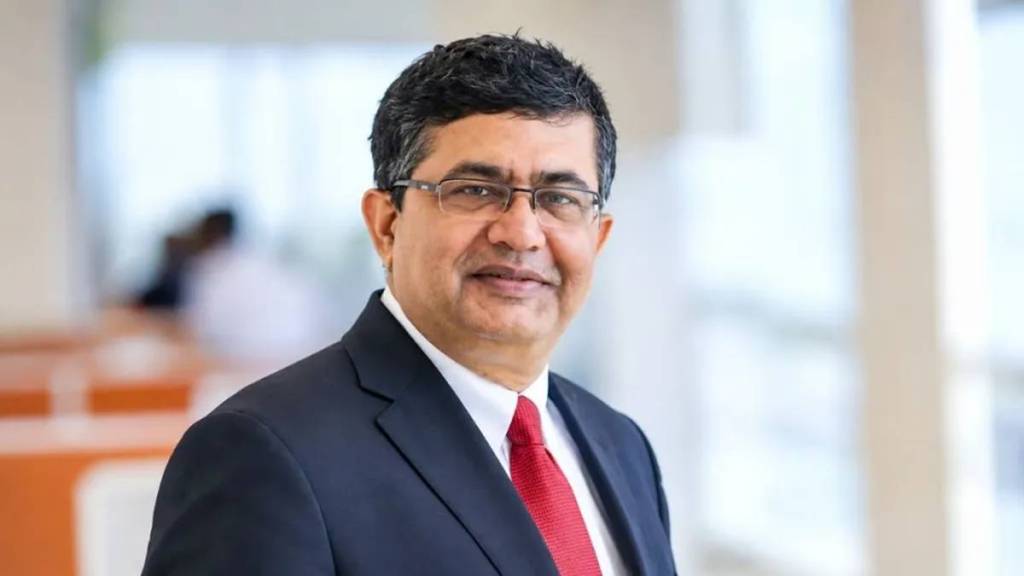

On Thursday morning, Ashishkumar Chauhan returned to familiar ground in an unfamiliar role. The man who spent a decade leading BSE was at its listing ceremony to take its fiercest rival, the National Stock Exchange, into the public market.
The symbolism was hard to miss. Chauhan had helped build NSE in the 1990s, left to pursue a career that took him to the top job at BSE, and returned to NSE in 2022 as managing director and chief executive.
And there was a final flourish: NSE listed on BSE.
Chauhan presented the exchange as more than a commercial enterprise. “There is nothing else that represents the aspirations of India’s future more than NSE,” he said. Calling it “a proxy for India’s growth”, he tied the exchange’s fortunes to the country’s economic progress. “What is good for India is good for NSE.”
After business school and a stint at IDBI, Chauhan joined NSE’s founding team in 1993, working on everything from its equities and derivatives markets to its technology architecture, satellite communications network and clearing infrastructure. IIM Calcutta’s profile describes him as the “father of modern financial derivatives in India”.
That distinction has acquired an awkward edge as regulators seek to curb excessive retail speculation in options. It captures Chauhan’s unusual position: he is both an architect of the market’s expansion and the executive responsible for steering its dominant institution through tighter oversight.
After leaving NSE in 2000, he worked with the Reliance group and was associated with the Mumbai Indians in the cricket franchise’s early years, before joining BSE as deputy CEO in 2009 and becoming chief executive in 2012. During his decade there, BSE upgraded its technology, built new distribution platforms, launched India International Exchange at GIFT City and, in 2017, became India’s first listed stock exchange.
His return to NSE put him on the other side of Dalal Street’s rivalry. Chauhan has called the role the greatest honour and privilege of his 35-year career, one that would “never be surpassed”.
The listing is his most visible milestone. NSE’s Rs 22,562-crore initial public offering, among India’s largest, was subscribed 5.7 times. Its shareholder base swelled from roughly 200,000 before the issue to 3.6 million, after more than 3.4 million retail investors received allotments. Existing investors, Chauhan said, were so reluctant to exit that NSE had to request some of them to sell shares in the offer.
But the ceremony marked a beginning as much as an ending. NSE’s listing had been delayed for nearly a decade by regulatory scrutiny and legal disputes. The exchange must now answer not only to regulators, trading members and issuers, but to millions of shareholders.
Chauhan’s case is that little will change: NSE has effectively behaved like a listed company for four-and-a-half years, publishing quarterly results, disclosing material developments and holding investor calls. Yet he acknowledged that listing demands “new alertness”, sharper thinking and stronger execution. His promise to give stakeholders as much information as possible will now be tested by the market.
So will his optimism about derivatives. Regulatory measures to discourage risky retail options trading have hit volumes and profits at an exchange that dominates the segment globally. Chauhan, however, rejects the idea that tighter rules will permanently slow participation. “People think the market will slow down, but historically it never does,” he said, pointing to India’s “huge runway” of potential investors.
The next task is to diversify NSE without weakening its core franchise. The exchange is expanding across cash equities, data, indices, commodities and international markets at GIFT City. Subsidiaries could eventually be listed if regulators require it, as happened with NSDL.
Chauhan describes capital markets as “markets of trust” and the essence of a well-functioning society. That may be the sternest test of this act: NSE must grow while protecting small investors, satisfy shareholders without compromising its role as market infrastructure, and accept tougher oversight without losing commercial momentum.
Chauhan has spent his career constructing the rails on which Indian capital travels. Taking NSE public has made those rails investible. He must now prove that an exchange valued as a proxy for India can be governed, diversified and trusted like one.