




Coforge and Persistent Systems are entering the next phase of their growth stories with different operating strengths. Coforge has built a $2.23 billion executable order book and expanded through Encora, while Persistent has delivered 25 consecutive quarters of sequential revenue growth and is preparing for the Nagarro transaction.
Both companies are investing heavily in AI-led engineering, data, cloud and enterprise modernisation. The financial payoff will depend on whether those investments translate into incremental revenue, larger contracts, delivery productivity and margin expansion, rather than simply reducing the effort needed to deliver existing work.
Persistent leads on consistency as Coforge scales up
Persistent Systems reported Q1 FY27 revenue of $452.4 million, up 16.1% year-on-year and 3.76% sequentially in constant currency terms, extending its run of sequential revenue growth to 25 quarters. Its EBIT margin stood at 16%, while PAT margin was 11.2%. The company had 28,640 employees as of June 30, 2026.
Coforge also reported a 16% EBIT margin in Q1 FY27, with standalone EBIT margin at 16.7%. Its 12-month executable order book stood at $2.23 billion, up 44% year-on-year. The company said 86% of revenue came from AI-led engineering, data and cloud services.
| Metric | Coforge | Persistent Systems |
| Q1 FY27 EBIT margin | 16% | 16% |
| Key growth indicator | $2.23 billion executable order book | 25 consecutive quarters of sequential revenue growth |
| Major acquisition | Encora | Nagarro |
Uttam Kumar Srimal, Deputy Head of Fundamental Research at Axis Direct, said Coforge’s pre-Encora organic growth was already strong, but it still needs to demonstrate the same consistency that Persistent has shown.
“Coforge’s pre-Encora organic growth was already strong, suggesting the underlying business can sustain above industry growth. However, matching Persistent’s consistency in the mid teens organically is still something Coforge needs to report. FY28 will therefore be a key test of the sustainability of its growth trajectory,” Srimal added.
The distinction is important because Coforge’s recent growth profile combines organic expansion with the contribution from acquisitions, while Persistent has built a longer reported record of sequential growth.
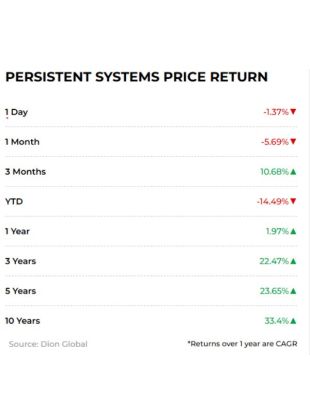
Persistent Systems share price performance
Coforge’s order book gives it near-term revenue visibility
Coforge’s $2.23 billion executable order book gives it a significant pool of contracted business for the coming year. The company has also pointed to a strong large-deal pipeline and continued execution after the Encora acquisition.
Persistent, meanwhile, reported quarterly total contract value of $1.15 billion in Q1 FY27, alongside its ACV and new ACV disclosures. Its order wins point to continued client demand and large, longer-duration engagements.
Rajiv Berlia, IT Services Research Analyst at JM Financial Institutional Securities, said executable order book is a more direct measure of near-term revenue visibility than quarterly TCV, although Persistent’s ACV and new ACV provide additional information.
“Executable order book is a better metric to assess near-term revenue visibility versus quarterly TCV trends. However, Persistent also reports overall ACV and new ACV, which provide additional visibility into the near-term growth trajectory,” Berlia said.
Srimal also pointed to the difference in the two indicators, “Coforge has an advantage in near term revenue visibility given its $2.23 bn executable order book, which provides substantial coverage for the next 12 months. Persistent’s $1.15 billion quarterly TCV, however, highlights strong client relationships and includes very large, long-duration engagements. From a next 12-18 months perspective, conversion and deal duration will determine the real strength of both companies. ”
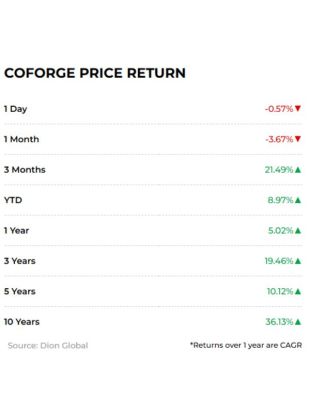
Coforge share price performance
AI could lift productivity but pressure IT pricing
AI is becoming a larger part of both companies’ service portfolios, but the revenue implications are less straightforward.
Coforge said 86% of its revenue now comes from AI-led engineering, data and cloud services and that it invested $58 million in AI innovation in FY26. It has more than 11,000 Data & AI practitioners, more than 22 AI assets and over 100 reusable agent archetypes. Its AgenticOps platform had 160-plus clients on the journey, with 37 clients live, according to the company.
Persistent is also building around AI-led digital engineering and enterprise modernisation, with capabilities spanning digital engineering, cloud, data and agentic AI. The company said it had more than 9,450 external AI/ML/GenAI certifications and more than 24,850 partner certifications.
Berlia said most contracts coming up for renewal are likely to include AI components, making overall revenue growth more useful than looking at AI revenue in isolation.
“Most deals coming up for renewal will likely include some AI-related components, in our view. Hence, we believe overall revenue growth remains more important than looking at AI-related growth in isolation,” he added. .
The pricing question is also becoming more important as AI improves delivery productivity.
“AI is here to stay, and most IT companies will adopt AI and pass on a portion of the productivity benefits to clients, as has been the case historically. At the same time, IT companies indicate that they should be able to retain some portion of these benefits,” Berlia highlighted.
He added that competitive intensity is increasing, with contracts carrying higher productivity commitments despite limited evidence of equivalent productivity gains.
“Net-net, contract realisation is already under pressure,” Berlia pointed out .
Coforge and Persistent take different AI routes
Coforge is positioning AI around enterprise autonomy and the automation of business processes. Its presentation cites examples across vehicle inspection, title processing and mortgage tax operations, with the company reporting lower processing costs, higher operating capacity and greater automation in those deployments.
Persistent’s approach is centred on digital engineering, cloud, data and enterprise modernisation, with AI embedded across those services. Its presentation also points to an AI-led platform strategy and growing certification depth among its workforce and ecosystem.
The difference is less about whether either company is pursuing AI and more about how that investment feeds into client spending, deal sizes, delivery efficiency and margins.
Srimal said both companies have strong positions, with Coforge showing margin expansion and Persistent having a strong digital-engineering franchise.
“Coforge currently has a strong margin-expansion trajectory, while Persistent has a strong digital-engineering positioning. So it’s difficult to decide as both the companies are agile. Ultimately, market will value the company that captures more of the productivity benefit rather than passing it entirely to clients,” he added. .
Margins will show who keeps the AI gains
Both companies entered FY27 with EBIT margins at 16% in the first quarter. That leaves revenue growth and the ability to retain productivity benefits as important operating variables.
Coforge’s presentation points to a long-term revenue CAGR of 21.9% over nine years through FY26 and describes FY26 as its third year of industry-leading growth. The company has also linked its AI strategy to higher productivity and outcome-based commercial models.
Persistent reported FY26 revenue of $1.65 billion, up from $1.41 billion in FY25 and $1.19 billion in FY24. Its EBIT margin increased from 14.4% in FY24 to 14.7% in FY25 and 15.6% in FY26 before reaching 16% in Q1 FY27.
For both companies, the margin question is tied to the commercial terms of AI adoption. If clients capture a large share of delivery savings through lower pricing, revenue can grow without the same degree of benefit flowing through to operating margins. If service providers retain part of the productivity gains, margins can expand even as delivery becomes more efficient.
Encora and Nagarro raise the integration stakes
Coforge’s Encora acquisition has added scale, technology capabilities and exposure to new verticals and geographies. Amit Chandra, Research Analyst – Institutional Equities, HDFC Securities, said Coforge’s acquisitions had historically started growing strongly after integration and described Encora as complementary to the existing business.
“They have turned around all the acquisitions. And the acquisitions have also started to grow very fast after the integration,” Chandra said.
On Encora, he said, “This Encora is mostly complimentary and they are entering into new verticals as well. So they are adding, apart from travel, BFSI, they are also into healthcare vertical as well. So they are adding to new verticals as well and new geographies. So that is a more holistic kind of a growth plan.”
Chandra also pointed to Coforge’s large-deal trajectory and TCV as a continuing source of strength.
“If you see their large deal win trajectory, if you see their TCV, they are still pretty strong. And that is the strength of Coforge that they have been delivering on that,” he said.
Persistent’s next major transaction is Nagarro. The company said Nagarro brings 18,003 employees, including 16,429 engineering professionals, across 38 countries, with approximately €1 billion in revenue. Persistent has secured about a 21% stake, while the minimum acceptance threshold of 50% plus one share was met during the initial acceptance period. The transaction is expected to close in Q4 CY26 or Q1 CY27, subject to the required conditions and process.
The size of the transaction makes integration execution important for Persistent’s growth and margin profile. Manav Medewala, Research Analyst at Mirae Asset Sharekhan, said the Nagarro deal creates both an opportunity and an execution requirement.
“Persistent’s 25-quarter growth streak is impressive, but its premium valuation now rests on flawlessly integrating Nagarro, a large complex acquisition. Any execution slip there (cost overruns, margin dilution, client attrition, slowdown in revenue growth) could compress the rich multiple the market has given it for near-perfect delivery. So Persistent’s biggest growth catalyst is also its biggest re-rating risk,” Medewala said.
Organic growth is the key test after Encora
Coforge’s ability to sustain organic growth alongside Encora will remain a central operating metric. Chandra said Coforge’s acquired businesses had grown at around 15% organically over five years before slowing to around 8-9% in the previous year, while still remaining above the broader industry growth rate.
He said the company’s longer-term growth ambition assumes continued organic expansion.
“The $5 billion target that they have set in FY20–30, that incorporates 15–20% kind of a CAGR number. And that is equivalent to 4–5% QOQ number on an organic basis,” Chandra added.
He added that the company had delivered 4-5% sequential organic growth in the past and expected the deal-win trajectory to support continued growth.
Srimal said organic constant-currency revenue growth is the key Coforge metric to monitor over the next four quarters.
“For a 2-3 years horizon, we will choose Coforge primarily because the recent correction which has created a more favourable risk-reward relative to its growth potential. Coforge offers the potential combination of organic growth, Encora synergies, cross-selling and margin expansion. The key metric to track over the next four quarters is organic constant currency (CC) revenue growth,” he pointed out.
Medewala similarly pointed to organic CC growth for Coforge, while identifying Nagarro integration and post-integration organic growth as the key metrics for Persistent.
Coforge governance remains on investors’ radar
Coforge’s governance concerns have also formed part of the stock’s recent narrative. Srimal said the governance discount remains justified until the concerns are fully addressed and management rebuilds investor confidence.
Medewala took a more reassuring view, saying the stock’s roughly 9% fall was followed by a recovery within days and that the company had said the issue was limited to the internal disclosure of the board report, with no impact on financial results, operations or FY27 guidance. He also noted the completion of an internal audit and changes to board committees.
Berlia said the appointment of two independent directors and the absence of further escalation are key monitorables.
“Appointment of two independent directors and no further escalation are key monitorables,” he said.
The governance issue therefore remains separate from the operating metrics that will determine Coforge’s growth trajectory. Organic constant-currency growth, Encora’s contribution, order-book conversion and margins provide the clearest financial indicators.
Conclusion
Coforge enters the next few quarters with a large executable order book, a sizeable Encora contribution and the need to sustain organic growth alongside acquisition-led expansion. Persistent brings a 25-quarter record of sequential growth, but its next phase includes the integration of Nagarro and the task of maintaining its operating performance as the business gets larger.
AI is likely to influence both revenue growth and delivery economics, while competitive pricing could limit how much of the productivity benefit reaches margins.
Disclaimer: This article is for informational purposes only and should not be construed as investment advice, a recommendation to buy, sell or hold any security, or a solicitation to transact in any financial instrument. The views and opinions cited are those of the respective analysts and do not necessarily represent the views of Financial Express or the author. Investors should conduct their own research and consider their financial objectives, risk tolerance, investment horizon and the latest company disclosures before making any investment decision. Past performance and historical growth do not guarantee future returns, and corporate transactions discussed in this article remain subject to applicable conditions and completion requirements.