


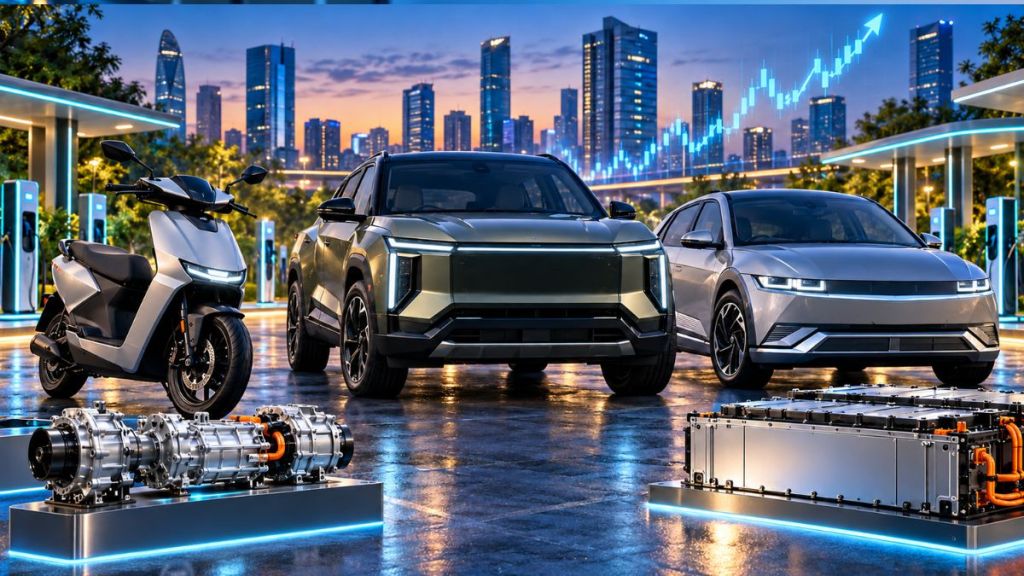

Automobile companies with a higher exposure to electric vehicles (EVs), competitive EV products, and an established EV technology are better positioned than traditional incumbents with a predominantly ICE-led portfolio, according to Japanese brokerage house, Nomura.
The adoption of EVs in India has accelerated after the West Asia crisis. The penetration of EVs has also been supported by improving product options and quality, EV-supportive policies by the government, and an improvement in breakeven points to buy such vehicles, Nomura said.
The brokerage said “stock returns over the next few years will likely depend on the EV penetration of OEMs as a key variable.”
Key stocks to benefit from higher EV adoption
As EV penetration across the country increases, Nomura has picked three original equipment manufacturers, Ather Energy, Mahindra & Mahindra, and Hyundai Motor as its preferred stocks. It also expects Tata Motors PV to gain market share in case EV penetration is faster than expected.
“Auto suppliers in general should benefit from rising EV penetration given the higher price points and scope to increase content,” Nomura said, adding that it prefers Sona BLW Precision Forgings and Exide Industries within suppliers.
EV Penetration in India
Nomura said EV penetration in passenger vehicles has risen to 7.9% by September 2026 from 4% in FY26. EV penetration in two-wheelers has increased to 11.6% from 6.5%. “Delhi, Telangana and Odisha lead PV adoption at 21.9%, 21.0% and 17%, respectively, while Odisha, Karnataka and Goa lead 2W EV adoption at 23.0%, 19.3% and 17.5% ,” the brokerage said.
It expects that EV penetration within scooters has reached 25% in September, led by states such as Madhya Pradesh, Odisha, and Rajasthan. “We believe that the underlying data suggests that EV penetration is at an inflection point across segments; LCVs (light commercial vehicles) could also see a marked jump in EV penetration, in our view,” it added.
EV two-wheelers: Breakeven period
Nomura said the breakeven period to own an EV scooter over an ICE scooter has reduced to around 2.4 years. In fact, a two-wheeler consumer can get nearly full payback on the capital value of an EV vehicle in 8.8 years. This assumes no resale value, which may be additional, it said.
For EV cars, the breakeven period over petrol SUVs has dropped to 3 years for compact SUVs, 2.5 years for mid-sized SUVs, and 2 years for large SUVs. “Consequently, EV penetration has risen rapidly at higher price points. BMW India is getting 30% of its bookings from EVs which has led to 2-3 month waiting period.”
India’s dependence on oil imports
Nomura believes the government’s focus on electrification is likely to continue given the country imports 89% of its crude oil and 50% of its gas. “India has crossed 50% of its cumulative electric power installed capacity, with 29% of power generation from non-fossil fuel sources. Indian government targets to take non-fossil power generation to 50% by 2030,” it said. The brokerage added the carbon footprint of EVs being sold will continue to reduce over time.
Since December 2025, petrol, diesel, and CNG prices have risen by 8%, 9%, and 13%, respectively. Nomura expects further price hikes of around Rs 5-7 if crude oil prices sustain at current levels. “Further increase in fuel prices will be incrementally positive for EV adoption, in our view.”
EVs to drive returns in coming years
The West Asia crisis amplified India’s reliance on oil and gas imports. With the adoption of EVs rising and more products becoming available with time, original equipment manufacturers with higher exposure to EVs and an established position are likely to benefit more.
Disclaimer: This article is based on research reports from one or more brokerage firms and is for informational purposes only. The views, target prices, and recommendations expressed are those of the respective brokerage firms and do not reflect the official policy or position of Financial Express. This should not be construed as an offer, solicitation, or recommendation to buy or sell securities. Investors must conduct their own independent due diligence and seek advice from a SEBI-registered financial advisor before making any investment decisions.