



India’s hospital sector is facing a fresh regulatory test after the Supreme Court questioned steep mark-ups on medicines and medical consumables sold through private hospitals. The immediate market reaction has been sharp, but the bigger debate is about how much of a potential margin hit hospitals can absorb and whether they can recover some of the pressure through procedure charges, package pricing and other revenue streams.
Hospital sector stocks in focus: Earnings outlook amidst tighter regulation concerns
The four research houses covering the development have arrived at different conclusions. Jefferies continues to see strong earnings growth across its hospital coverage despite estimating a 2-5% potential EBITDA impact from tighter price controls.
Goldman Sachs sees a wider 2-7% range under its no-mitigation scenarios, but says pricing and package billing could cushion the effect. Emkay Research expects limited earnings damage, while Nomura is more concerned about what tighter regulation could mean for hospital valuation multiples.
The issue centres on non-scheduled medicines. Scheduled medicines already carry a 16% retail margin under the Drugs (Prices Control) Order, 2013, while roughly 80-82% of medicines fall outside the current price-control framework. The Supreme Court has sought the government’s response, with the next hearing scheduled for October 12, 2026.
Goldman Sachs on hospitals: Package pricing cushions medicine-margin pressure
Goldman Sachs also remains constructive on Indian hospitals, with ‘Buy’ ratings on Max Healthcare Institute, Krishna Institute of Medical Sciences, Apollo Hospitals Enterprise and Manipal Health Enterprises. Fortis Healthcare Ltd. carries a ‘Neutral’ rating.
The global investment banking firm has modelled the possible effect of a uniform 16% retail margin on medicines using three existing mark-up assumptions of 20%, 25% and 30%. If hospitals take no action to recover lost income, the resulting EBITDA reduction ranges from 2% to 7%.
Goldman Sachs said, “In all the three scenarios we assume no mitigatory actions on part of the Hospitals to recoup margins. The sensitivity implies approximately 2% to 7% potential EBITDA cuts based on existing mark-ups. We, however, would like to highlight two potential mitigants apart from the industry pushing back on any such litigation.”
One possible offset is pricing. Goldman Sachs estimates that a 1-2% increase across other revenue categories could largely compensate for the loss on medicines.
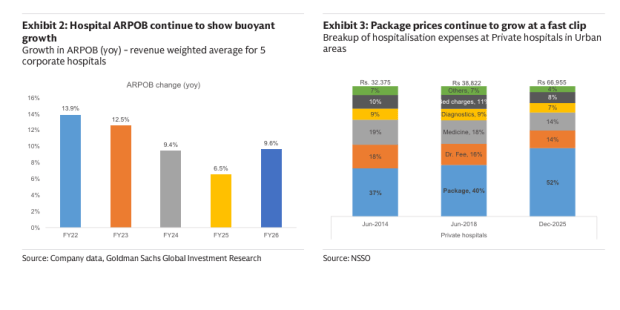
The brokerage also points to the growing use of package pricing. Package pricing accounted for 52% of private hospitalisation expenses in December 2025, compared with 40% in June 2018 and 37% in June 2014. The contribution of medicines, meanwhile, fell to 14% from 18% in June 2018 and 19% in June 2014.
Goldman Sachs’ hospital ‘Buy’ calls
| Company | Rating | Target price | Implied upside |
| Max Healthcare | ‘Buy’ | Rs 1,200 | ~29% |
| Krishna Institute of Medical Sciences | ‘Buy’ | Rs 1,000 | ~34% |
| Apollo Hospitals Enterprise | ‘Buy’ | Rs 9,700 | ~19% |
| Manipal Health Enterprises | ‘Buy’ | Rs 865 | ~22% |
Goldman Sachs expects EBITDA compound annual growth between FY26 and FY28 of 22% for Max Healthcare, 38% for Krishna Institute of Medical Sciences, 25% for Apollo Hospitals Enterprise and 24% for Manipal Health Enterprises.
The brokerage’s data also shows continued growth in average revenue per occupied bed at five long-standing corporate hospitals, with growth of 9.6% in FY26 following 6.5% in FY25, 9.4% in FY24 and 12.5% in FY23.
Jefferies on hospital sector: Earnings absorbing a 2-5% price-cap hit
Jefferies remains constructive on Indian hospitals, despite the fresh regulatory concerns. The brokerage estimates that a potential 16% margin cap on oncology medicines and a 5% margin on consumables could reduce hospital EBITDA by around 2-5% if companies are unable to recover the lost margin elsewhere.
The global investment banking firm estimates oncology medicines account for around 4-6% of a patient’s hospital bill, while non-oncology medicines contribute 10-15% and consumables another 12-15%. It believes hospitals have several ways to offset some of the pressure, including changes in procedure pricing and cost management.
Jefferies said, “We estimate 2-5% impact on hospital EBITDA: Assuming margin caps of 16% on oncology drugs and 5% margin for consumables (high-ticket consumables like stents and implants under price controls since 2017), we estimate ~2-5% hit to EBITDA. Multiple levers to negate impact of price cuts: Nearly a decade ago, prices for cardiac stents and orthopaedic knee implants were reduced by a remarkable 70-85%.”
The brokerage points to the earlier regulation of cardiac stents and orthopaedic implants as a precedent. Hospitals responded by increasing procedure charges and rationalising costs, allowing operators to recover much of the initial pressure on profitability.
Jefferies also expects hospital earnings to remain strong over the next few years. Its estimates show EBITDA compound annual growth of 20% for Apollo Hospitals Enterprise, 17% for Fortis Healthcare, 18% for Max Healthcare, 19% for Manipal Health Enterprises, 22% for Medanta and 23% for Dr Agarwal’s Healthcare between FY26 and FY29.
Jefferies’ hospital ‘Buy’ calls
| Company | Rating | Target price | Upside |
| Apollo Hospitals Enterprise | ‘Buy’ | Rs 10,350 | 27% |
| Fortis Healthcare | ‘Buy’ | Rs 1,125 | 46% |
| Max Healthcare | ‘Buy’ | Rs 1,260 | 36% |
| Manipal Health Enterprises | ‘Buy’ | Rs 870 | 23% |
| Medanta | ‘Buy’ | Rs 1,660 | 22% |
| Dr Agarwal’s Healthcare | ‘Buy’ | Rs 600 | 25% |
Jefferies’ target prices imply upside ranging from 22% for Medanta to 46% for Fortis Healthcare.
BofA Securities sees regulatory concerns easing if action stays manageable
BofA Securities believes the recent regulatory news flow has put pressure on hospital stocks, but says previous episodes show that such corrections can be short-lived when the eventual regulatory action remains limited.
The global investment banking firm estimates drugs and consumables account for around 25-30% of a tertiary-care hospital bill. However, it notes that a large portion of pharmacy medicines already operates under regulated margins of 16-20%. Growing insurance penetration has also increased the use of package and bundled pricing for procedures, reducing the importance of individual product or service margins.
BofA Securities said, “As seen in the past (February 2024), regulatory news flow driven correction tends to be short lived with stocks re-rating quickly particularly if the risk from such actions remains limited or manageable (for example, implant/stent price cap in past).”
The brokerage estimates institutional sales to hospitals and dispensaries account for less than 15% of total pharmaceutical sales in India. It also notes that margins for such medicines may not be materially higher because several products have faced price controls in the past.
The latest Supreme Court proceedings followed questions around a hospital pharmacy mark-up on an unnamed cancer medicine. BofA Securities noted that the bench sought a uniform 16% mark-up across medicines, including patented medicines, with the next hearing deferred to October 12.
BofA Securities’ hospital calls
| Company | Rating | Target price | Upside |
| Apollo Hospitals Enterprise | ‘Buy’ | Rs 10,600 | 22% |
| Fortis Healthcare | ‘Buy’ | Rs 1,070 | 30% |
| Max Healthcare | ‘Neutral’ | Rs 1,100 | 12% |
BofA Securities values Apollo Hospitals Enterprise’s hospital business at 24.6 times FY28-FY29 enterprise value to EBITDA. Its Rs 10,600 target price also factors in the company’s other healthcare businesses.
For Fortis Healthcare, the Rs 1,070 target price is based on a sum-of-the-parts valuation of its hospitals business and its diagnostic subsidiary. For Max Healthcare, BofA Securities uses a valuation of 27 times FY28-FY29 enterprise value to EBITDA, resulting in a Rs 1,100 target price.
The brokerage sees faster margin expansion, quicker ramp-up of new hospitals and stronger growth from Apollo Hospitals Enterprise’s HealthCo business as potential positives. For Fortis Healthcare, it points to mergers and acquisitions, hospital margin improvement and a faster turnaround of acquired assets. Max Healthcare could benefit from faster new-bed ramp-up, stronger average revenue per occupied bed and improved performance at Kalinga and its greenfield Gurugram hospital.
Emkay sees limited earnings pressure from pharmacy regulation
Emkay Research takes a more measured view of the immediate financial effect of a pharmacy margin cap. Its discussions with hospital chains suggest pharmacies account for 15-20% of overall revenue and generally operate at margins of 20-25%.
The brokerage also distinguishes between cash-paying patients and those covered by insurance or public health schemes. Insurance and government-scheme patients generally use pre-negotiated package rates rather than headline maximum retail prices, which can reduce direct exposure to medicine mark-up changes.
Emkay said, “Based on our discussions with hospital chains, we see limited impact on earnings for our Healthcare universe, as pharmacies contribute 15-20% of the overall revenue, along with a margin profile of 20-25%. Additionally, this margin cap is likely to affect cash-patient margins, as insurance and public health schemes patients already take recourse of pre-negotiated package rates (discounted rack rates versus tariffs) rather than headline maximum retail prices, thus further insulating hospital chains from any significant earnings hit, in our view.”
The brokerage also questions the practicality of applying a uniform margin framework to the entire non-scheduled medicine universe. It points to radiopharmaceuticals used in oncology, where specialised handling and short shelf lives can substantially increase procurement costs.
Some radioactive medicines have shelf lives of only 30-100 minutes and have to be administered within a narrow window. Emkay estimates that effective handling and procurement costs can therefore reach 6-8 times the headline invoice price in certain cases.
Emkay Research’s hospital ‘Buy’ calls
| Company | Rating | Target price | Upside |
|---|---|---|---|
| Krishna Institute of Medical Sciences | ‘Buy’ | Rs 850 | 14% |
| Park Medi World | ‘Buy’ | Rs 375 | 37% |
Emkay Research also has ‘Add’ ratings on Global Health, Max Healthcare and Rainbow Children’s Medicare.
Nomura focuses on valuation pressure as regulation comes under scrutiny
Nomura takes a more cautious view of the hospital sector. It rates Apollo Hospitals Enterprise and Fortis Healthcare ‘Neutral’ and does not carry a ‘Buy’ rating on the hospital companies discussed in its October 1 report.
The brokerage says the immediate earnings impact of potential price controls remains uncertain. Its greater concern is what tighter regulation could mean for hospital valuation multiples after a substantial re-rating over the past five years.
Nomura said, “Earnings impact uncertain; but concerns on price caps likely to adversely impact valuation multiples. Indian hospitals have re-rated significantly versus international peers over the past five years.”
Nomura’s data shows the average valuation multiple of Indian hospitals increased 81% between December 2019 and September 2026. Over the same period, the average valuation multiple of international hospital companies declined 30%. Indian hospitals, which traded at a discount of around 22% to international peers before the pandemic, were trading at a premium of around 121% by September 2026.
The brokerage also points to rising bargaining power among insurers, increasing competition from private equity-backed hospital platforms, higher doctor costs and the capital required to add beds as pressures for the sector. Private insurance accounts for around 30-50% of hospital revenue, according to Nomura.
Nomura’s hospital coverage
| Company | Rating | Target price |
|---|---|---|
| Apollo Hospitals Enterprise | ‘Neutral’ | Rs 7,570 |
| Fortis Healthcare | ‘Neutral’ | Not stated |
Nomura’s target price for Apollo Hospitals Enterprise is based on a sum-of-the-parts valuation of its business segments, with a December 2026 target of Rs 7,570. The brokerage identifies adverse regulatory action, including price controls, as a downside risk to its valuation.
Why the medicine price issue may not translate into the same earnings hit for every hospital
The potential impact of price regulation depends heavily on the composition of a hospital’s revenue and how much of its billing comes through negotiated packages.
BofA Securities notes that increasing insurance penetration has led to greater use of package and bundled pricing, where individual products and services do not carry separate margins. The brokerage also points to the February 2024 episode, when regulatory concerns caused a correction but hospital stocks subsequently recovered as the perceived risk remained manageable.
Jefferies points to the earlier price controls on cardiac stents and orthopaedic implants, when hospitals responded by changing procedure charges and rationalising costs. Nomura also cites Apollo Hospitals Enterprise’s experience following the 2017 stent price regulation. The company saw quarterly revenue and EBITDA compression of around Rs 10 crore in FY18, but recovered the impact by the end of FY19.
Goldman Sachs sees package pricing as another avenue for hospitals to protect profitability. Its data shows package billing has steadily increased its share of private hospitalisation expenses, while medicines have become a smaller component.
Emkay’s analysis adds payer mix to the equation. Cash-paying patients account for around 40% of hospital revenue across the sector, although the proportion varies significantly between companies. Medanta has a 56% cash-patient contribution, followed by Aster DM Healthcare at 55% and Krishna Institute of Medical Sciences at 53%. Park Medi World is at 30%.
Drugs and consumables are important, but they are not the entire hospital bill
BofA Securities estimates drugs and consumables together account for around 25-30% of a tertiary-care hospital bill. It also notes that a large portion of pharmacy medicines already carries regulated margins of 16-20%.
Jefferies estimates doctor fees account for 25-30% of a patient’s bill, non-oncology medicines for 10-15%, consumables for 12-15%, diagnostics for 8-12%, operating theatre charges for 10-15% and bed charges for 5-8%. Oncology medicines contribute 4-6%.
This mix leaves several other components of a hospital bill through which operators could potentially respond to lower medicine-related margins, although the extent of any such adjustment would depend on competition, insurance contracts and the final regulatory framework.
Goldman Sachs’ data provides another indication of the changing billing mix. Package pricing accounted for 52% of private hospitalisation expenses in December 2025, while medicines accounted for 14%.
Room tariffs and insurance add to the regulatory questions
The medicine mark-up issue is not the only regulatory concern facing the hospital sector.
BofA Securities also discusses the relationship between hospitals and insurers, including periodic suspensions of cashless services. It says the Insurance Regulatory and Development Authority of India’s draft proposal to cap commissions paid by insurance companies could help address high insurance premiums, with limited impact on hospitals in its assessment.
The brokerage also refers to an August recommendation by the Parliamentary Standing Committee to cap hospital room tariffs at the average tariff for a three-star hotel room in the vicinity. BofA Securities’ discussion with a hospital expert pointed to implementation difficulties because hospital pricing includes doctor fees and infrastructure differences that are not easily standardised.
BofA Securities therefore views the room-tariff recommendation as a lower-probability risk, while the medicine and consumable mark-up issue has had a more immediate effect on hospital stocks.
October 12 hearing becomes the next key date for hospitals
The regulatory question remains unresolved. The Supreme Court’s September 29 observations followed a petition seeking tighter price controls on medicines and medical consumables administered in hospitals. The court questioned the large difference between procurement prices and prices charged for certain medicines, while the government sought time to consult relevant departments before presenting its response.
The next hearing is scheduled for October 12, when the government’s position and the possible scope of any regulatory response could become clearer.
BofA Securities also notes that Maharashtra’s Food and Drug Administration had raised concerns over high mark-ups on hospital consumables such as syringes and catheters, with the Centre seeking a report from the National Pharmaceutical Pricing Authority.
The brokerages are therefore assessing the same regulatory issue through different lenses. BofA Securities is looking at past regulatory episodes and the changing hospital revenue model. Jefferies and Goldman Sachs are quantifying the possible EBITDA effect and the scope for mitigation. Emkay Research is focusing on pharmacy exposure and negotiated package rates, while Nomura is paying greater attention to valuation multiples.
Hospital sector views across brokerages
| Brokerage | Hospital ‘Buy’ calls | Main sector view |
|---|---|---|
| BofA Securities | Apollo Hospitals Enterprise, Fortis Healthcare | Regulatory-led weakness could be short-lived if eventual measures remain limited or manageable |
| Jefferies | Apollo Hospitals Enterprise, Fortis Healthcare, Max Healthcare, Manipal Health Enterprises, Medanta, Dr Agarwal’s Healthcare | 2-5% potential EBITDA impact, with scope for mitigation |
| Goldman Sachs | Max Healthcare, Krishna Institute of Medical Sciences, Apollo Hospitals Enterprise, Manipal Health Enterprises | 2-7% potential EBITDA impact without mitigation; pricing and package billing could provide offsets |
| Emkay Research | Krishna Institute of Medical Sciences, Park Medi World | Limited earnings impact due to pharmacy mix and negotiated package rates |
| Nomura | None among hospital companies covered | Earnings impact uncertain, with greater concern around valuation multiples |
The eventual effect on hospital earnings will depend on the scope of any pricing framework, the medicines and consumables covered and how hospitals adjust their billing and cost structures. The October 12 hearing is the next important date for the sector as the regulatory debate moves towards its next stage.
Disclaimer: This article is based on research reports and analysis provided by BofA Securities, Jefferies, Goldman Sachs, Emkay Research and Nomura, and represents the respective research houses’ views, estimates, ratings, target prices and assumptions at the time of publication. The information presented, including potential EBITDA impacts, earnings growth estimates, valuation multiples, target prices, regulatory assessments and historical comparisons, is sourced from those reports and should not be interpreted as independently verified facts or as a guarantee of future performance. The potential impact of medicine and medical consumable price controls discussed by the research houses is scenario-based and will depend on the final regulatory framework, the products and services covered, the manner and timing of implementation, and the ability of individual hospitals to respond through pricing, package rates, cost management, payer mix and other operating measures. References to previous regulatory actions, including price controls on cardiac stents and orthopaedic implants, are historical examples cited by the research houses and may not necessarily indicate how hospitals will respond to any future regulation. Target prices and ratings are subject to change and may be revised as company results, market conditions, regulatory developments, interest rates, healthcare demand, insurance arrangements and other assumptions change. Any upside or valuation figures mentioned in the article are based on the respective research reports and are not forecasts of actual market prices. Past share-price movements, earnings performance, margin recovery or valuation changes should not be taken as an indication of future results. The article does not constitute investment advice, a solicitation, an offer to buy or sell securities, or a recommendation to act on any particular research view. Readers should consider their own financial circumstances, investment objectives, risk tolerance and time horizon and seek advice from a qualified financial adviser before making any investment decision.