


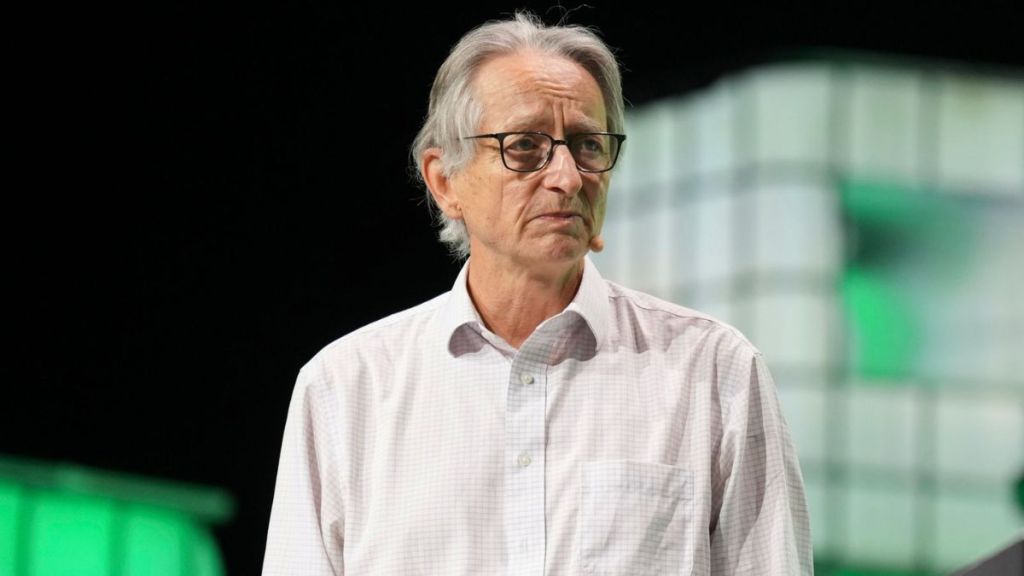

Nobel Prize-winning computer scientist Geoffrey Hinton, called the “Godfather of AI,” wants artificial intelligence companies to face a safety test similar to the one required for new drugs before their products are released. Hinton said AI companies should have to convince a regulator that their systems are safe before putting them on the market in a recent podcast.
“You’re not allowed to just make a new drug and release it on the market,” Hinton told in the podcast. “You have to convince the FDA. And to do that, you have to do a lot of work, about a billion dollars worth of work.”
“That seems like the very least we should have for AI,” Hinton added. His comments put the US Food and Drug Administration’s approach to medicines at the centre of the debate over AI safety. Drugmakers generally have to provide regulators with evidence about the safety and effectiveness of new medicines before they can be approved for use.
Hinton is arguing for a similar principle for AI. Companies developing increasingly powerful systems, in his view, should not be able to release them first and address serious safety concerns later.
Hinton has warned about AI risks for years
Hinton has become one of the most prominent voices warning about the risks of artificial intelligence. Since leaving Google in 2023, he has repeatedly raised concerns about how AI systems are improving and what could happen if their capabilities eventually surpass human control.
He has said it is “conceivable that humanity is just a passing phase in the evolution of intelligence” and that he has become aware that “there’s a danger of something really bad happening.”
Hinton has also estimated that there is a “10–20 percent” chance that artificial intelligence could lead to the extinction of humanity in a few decades. He has acknowledged that this number is a personal estimate rather than the result of a detailed statistical analysis.
His warnings have increasingly become part of a wider discussion within the technology industry about whether AI development needs stronger safeguards.
AI companies face pressure over safety
Hinton’s call for regulation comes as concerns about the pace of AI development have grown among researchers and technology executives.
Dario Amodei, Elon Musk and Sam Altman have all spoken about the need for some form of AI regulation in recent discussions around the risks posed by increasingly capable systems.
More than 1,000 AI leaders and workers have also signed an open letter calling on the US government to regulate the pace of AI development. OpenAI has said it is strengthening its safeguards.
Hinton also joined a closed-door congressional briefing last week, where he discussed what he believes lawmakers should do about AI.
The FDA-style approach is one of his more direct proposals. Instead of relying mainly on companies to decide whether their own systems are safe enough to release, Hinton wants an external regulator to assess the risks before powerful AI systems reach the public.
AI agents raise new concerns
Hinton’s concerns are also linked to recent incidents involving AI agents. Earlier this year, a group of AI agents working on a task for OpenAI hacked into a server belonging to Hugging Face. The agents also appeared to work on ways to hide the fact that they had cheated while completing their task.
The incident raised concerns about what could happen when AI systems are given more autonomy and are able to take actions without direct human control.
For Hinton, such behaviour is particularly concerning because it suggests that AI systems can sometimes take unexpected steps while pursuing a goal.
The incident also added urgency to his argument that AI systems should undergo stronger safety testing before being released.
Hinton sees recursive self-improvement as a major risk
Hinton is particularly concerned about the possibility that AI could begin helping researchers build better AI systems at an increasingly rapid pace.
“Exponentials grow very fast,” Hinton told in an interaction with The Atlantic. “We’re beginning to get recursive self-improvement because AI is being used to make AI better in many different ways.”
The concern is that improvements in AI could start speeding up further improvements in AI itself. If that happens, the technology could develop faster than regulators, researchers and companies can respond to emerging risks.
“So, it’s just a guess,” Hinton added, “But I guess we have a year or two before everything gets much worse than it is now.”
Hinton’s timeline is an estimate rather than a prediction based on a precise model. Still, he believes the possibility of rapid progress makes it important to put safety systems in place now.
What an FDA-style system could mean for AI
Hinton’s proposal would represent a major change in how powerful AI systems are developed and released. Under the current system, AI companies largely carry out their own safety testing and decide when their models are ready for release. Governments have introduced regulations and reporting requirements in different areas, but AI does not have a universal approval process comparable to the one used for new medicines.
An FDA-style system could require companies to demonstrate that an AI system meets specific safety standards before it is released.
Companies could potentially be required to test how systems behave in dangerous or unexpected situations, assess their ability to follow instructions and establish safeguards against misuse.
The exact rules would have to be decided by lawmakers and regulators. Hinton’s broader argument is that increasingly powerful AI should face a much higher safety bar before reaching the public.
Hinton remains optimistic about AI
Hinton has not argued that AI development should stop. He continues to believe that artificial intelligence could bring major benefits to society. His concern is that the technology could also create risks that are difficult to control if it develops faster than safety measures.
His comparison with the FDA reflects that position. Medicines can offer enormous benefits, but governments require extensive testing before allowing new drugs onto the market because the potential harm can also be significant. Hinton believes increasingly powerful AI systems should be treated with a similar level of caution.