


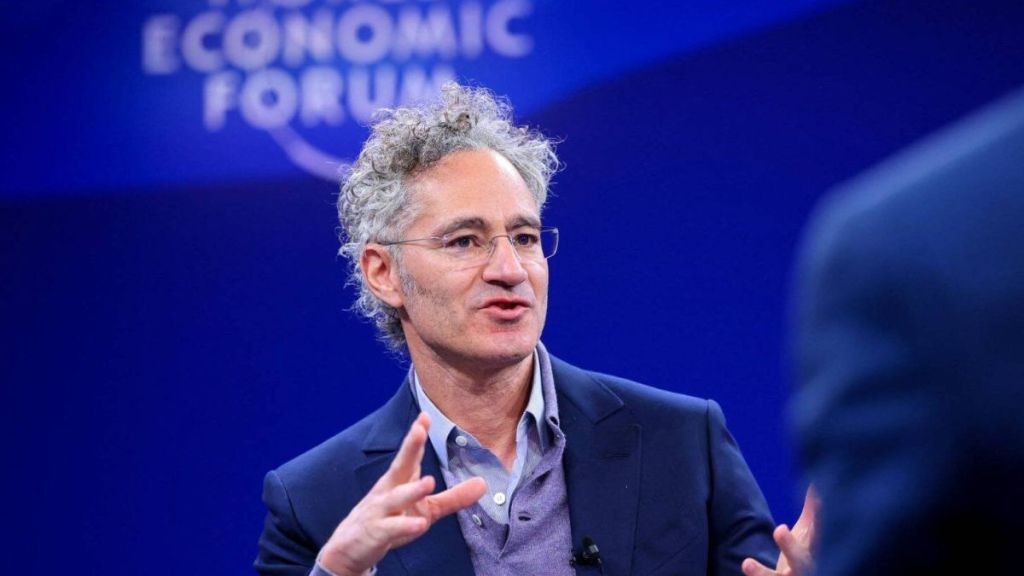

Palantir CEO Alex Karp has joined the growing debate over how far the artificial intelligence industry should go to control the risks from powerful AI systems.
Speaking to CNBC’s “Squawk on the Street” on Thursday, Karp said he supports “reasonable guidelines” for the industry that are actually enforced. He placed the primary emphasis on holding AI companies and their executives responsible through civil and criminal liability when their systems cause harm, rather than treating new regulatory bodies or a deliberate industry-wide slowdown as the first line of defence.
Karp said accountability should be the first line of defence, rather than creating new government bodies to oversee the industry.
Palantir’s Alex Karp backs AI guardrails
On the question of nationalisation, Karp did not present it as his own preferred policy. Instead, he argued that the current approach of some frontier labs, especially the absorption of proprietary business data into training models, creates such extensive liability exposure that those companies may ultimately push for government protection.
He said the only institution capable of providing the severe liability protection that model would require is the US government, which could lead to nationalisation. “The view that I believe they have is, these businesses have to be nationalised because if you don’t nationalise it every single one of my clients is going to sue,” Karp told CNBC
His concern is linked to Palantir customers who allegedly discovered that competitors had gained access to proprietary business information after that information was apparently absorbed into AI training data.
Karp argued that such cases could lead to more lawsuits against AI companies. In his view, that legal pressure could eventually encourage frontier AI companies to seek government protection from liability.
Amodei calls for slower AI development
The latest debate began with Anthropic CEO Dario Amodei’s roughly 4,000-word essay, “We Must Pace the Frontier”, published on September 12.
Amodei argued that AI companies should deliberately slow the pace at which they improve their most advanced models. He said safety and alignment work needs more time to keep up with the rapid development of AI.
He pointed to risks including loss of control over AI systems, cyberattacks, bioterrorism, and economic disruption.
As part of his proposal, Anthropic said it would give independent third-party evaluators permanent, employee-like access to its AI systems. The aim would be to allow outside experts to check whether the company’s safety claims hold up.
“I believe that if slowing down bought us even an extra year or two before models reach critical levels of capability… we could greatly reduce the risk that something goes seriously wrong,” Amodei wrote.
Altman and Musk back Amodei
Amodei’s proposal instantly drew support from some of Anthropic’s biggest competitors. Elon Musk responded on X with three words: “Dario is right.”
OpenAI CEO Sam Altman also said he agreed that the industry needed to pace the frontier. OpenAI said it would match Anthropic’s commitment to give independent evaluators access to its systems.
Google DeepMind CEO Demis Hassabis also supported the broader idea, although he did not make the same specific commitments as Anthropic, Musk or Altman.
Microsoft CEO Satya Nadella later took a more middle-ground position. He welcomed the idea of pacing AI development and using outside evaluators, but said the evaluation process should also include international and academic voices.
Nadella also argued that open-source AI models and companies’ ability to control their own proprietary data should remain part of the discussion.
Huang and Zuckerberg oppose slowing AI
Other major technology leaders have pushed back against the idea that AI development should be slowed.
Nvidia CEO Jensen Huang has argued that the US should continue moving quickly in AI while managing the risks. He has also framed the issue as part of the bigger competition between the US and China.
Meta CEO Mark Zuckerberg has taken a similar position. He has argued that AI companies should focus on trust and alignment rather than relying on government intervention.
“Any lab that doesn’t focus on alignment will fall behind,” Zuckerberg said. President Donald Trump has also rejected calls for slowing down AI development.
Speaking from Dublin a day after Amodei published his essay, Trump said, “Whoever wins AI wins” and warned against allowing China to gain an advantage.
In another heated exchange a few days later, Trump joined a live event where Huang was appearing on a panel. Trump dismissed people calling for a slowdown, saying they were being used by “a lot of people that don’t want to see it happen.”
“It’s a hoax,” Trump said. Huang replied: “You’re right. We’re not going to let that happen, sir.”
China’s state-run Global Times, meanwhile, described Amodei’s proposal as part of a wider strategy to contain China’s AI development.