




Meta has removed a provision from its commercial terms after legal experts raised concerns that it could allow the company to collect website content, including news articles, for artificial intelligence (AI) training.
The change followed criticism over copyright, data ownership and website owners’ ability to control how automated tools access their content.
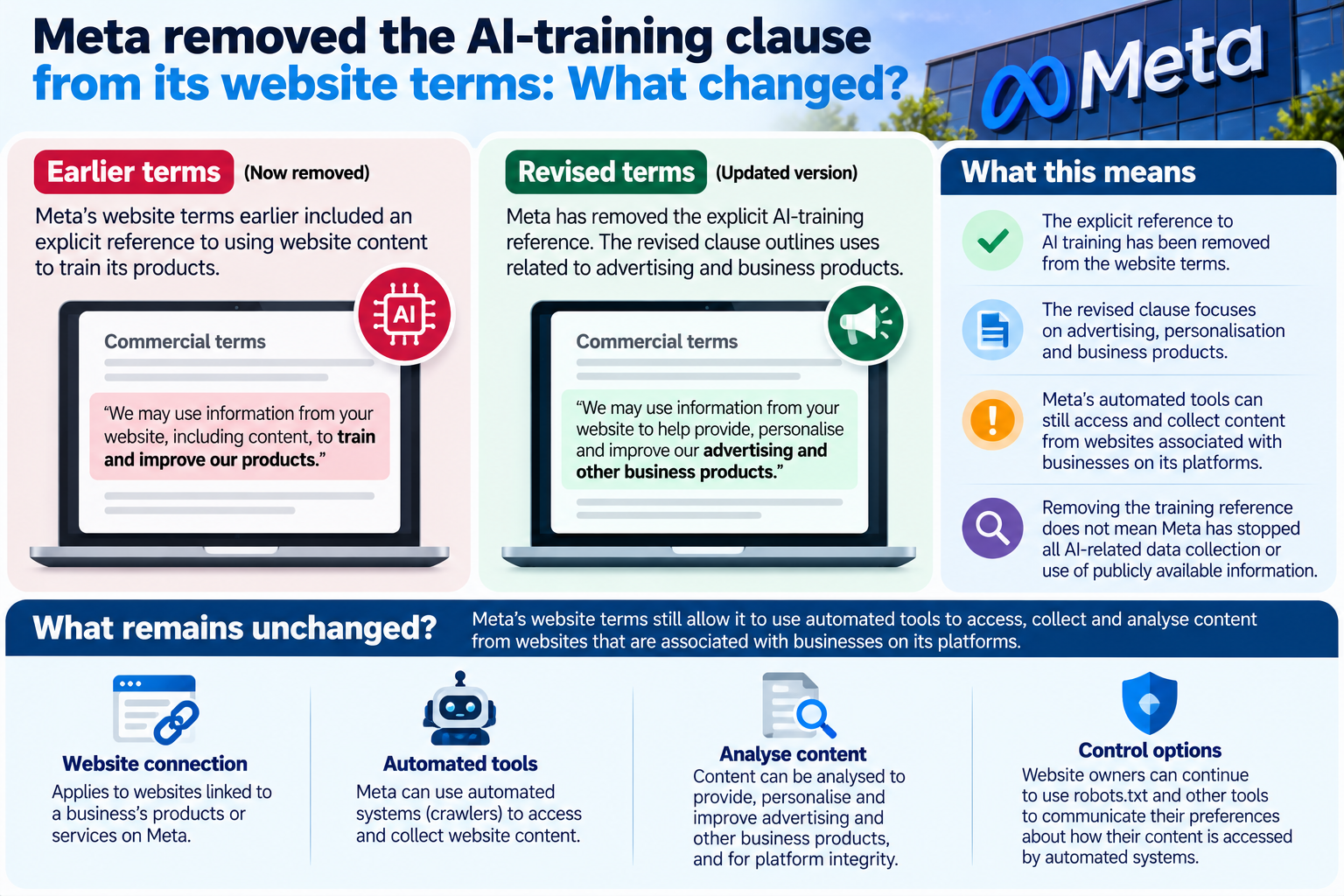
Meta removed the provision on October 17. The deleted wording said the company could use content collected from specified websites, web pages and URLs to “provide, develop, improve, research, train, and maintain the integrity of” its products and services, reported The Indian Express.
The clause appeared in Meta’s commercial terms governing businesses that use its products and services. Legal experts warned that its broad wording could be interpreted as allowing the company to collect website content and use it for AI development without compensating publishers.
Meta disputed that interpretation. A company spokesperson said the provisions applied to advertising and business products and did not represent a new effort to scrape news websites for AI training.
“We’ve heard you and want to clarify: the crawling terms we consolidated only applied to our ads and business products, and we’ve clarified that in the terms themselves,” the spokesperson said, as reported by The Indian Express.
The company also said the revision did not change its web-crawling practices and that website owners could continue using “robots.txt” to communicate their preferences.
Legal experts, however, cited by Nieman Journalism Lab remained concerned that the revised terms still allowed Meta to collect website content to develop and improve advertising and business products, categories they said could potentially include AI-related tools.
The dispute comes as technology companies face growing scrutiny over the material they use to develop AI systems.
For news publishers, the issue has commercial implications. Original reporting, photographs and analysis require resources to produce, and publishers want clarity on whether companies can reuse that material without permission or compensation.
Why did Meta remove AI training clause?
The row centred on language that appeared to give Meta broad permission to collect content from websites associated with businesses and use it for various purposes, including developing, improving and training its products.
The provision referred to automated tools such as web scrapers, bots, robots, spiders and crawlers. These tools collect information from websites without requiring someone to open each page manually. Search engines use crawlers to discover and index pages, while businesses may use automated tools to analyse websites and retrieve information.
According to The Indian Express, legal experts cited by Nieman Journalism Lab and Cornell digital and information law professor James Grimmelmann questioned whether the clause could allow Meta to collect website content without paying for it. They also raised concerns about whether its wording could conflict with website owners’ instructions restricting automated access.
Meta removed the explicit reference to training on October 17. The revised language instead linked the stated purposes of collecting website content to advertising and business products, as well as the security and integrity of its services.
However, references to automated collection remained. The revised terms continued to describe the use of bots and crawlers to access, index, analyse, collect and retrieve website content and obtain updates.
That distinction matters because removing the word “train” does not necessarily resolve whether collected material could be used to develop AI-related business products.
Matt Topic, a media and intellectual property lawyer at Loevy & Loevy, told Nieman Journalism Lab, “I think publishers should remain concerned.”
Topic said that the revised terms still allowed Meta to use collected material to develop business products. Because the term was not tightly defined, he said, it could potentially cover AI products. He also argued that the word “develop” could be broad enough to include training.
Meta rejected the suggestion that the revision granted it new rights over publishers’ content. The company said the changes clarified the scope of existing terms rather than altering its crawling practices.
The wording of the terms does not, by itself, establish that Meta used material collected under the provision to train a particular AI model. Nor does the revision settle every copyright question involving publicly available content.
Can website owners stop Meta from collecting their content?
Website owners can use “robots.txt” to communicate instructions to compatible automated crawlers. The file sits on a website’s server and specifies which areas of the site a crawler should or should not access.
Meta said publishers could continue using the file to signal their preferences and that the revised terms did not grant the company new rights overriding those instructions.
However, “robots.txt” is not a legal agreement or a technical security barrier. It communicates a website operator’s preferences, but compliance depends on whether a crawler respects them. Website owners may need additional technical or legal measures to address unwanted access.
The issue is particularly relevant to news publishers, which often use Facebook Pages, Instagram profiles, Threads accounts and WhatsApp channels to distribute stories and communicate with readers. They may rely on Meta’s platforms to reach audiences while seeking greater control over how their websites’ content is collected and reused.
Nieman Journalism Lab reported that the revised terms were scheduled to take effect on October 30 and that business accounts did not have an option to opt out before that date. Publishers should check the current terms applicable to their accounts and services, as well as the rules governing access to their websites.
They can review Meta’s commercial terms, check their crawling instructions and seek legal advice if they believe their material has been used without permission. The appropriate response will depend on the type of content, how it was collected, the applicable contractual terms and relevant copyright law.
Technology companies need data to develop and improve AI systems, while publishers, artists and researchers want clarity on how their work is collected and whether they can restrict its commercial use.
The Indian Express cited an earlier dispute involving WeTransfer, which revised its terms in July 2025 after criticism over wording that appeared to allow uploaded files to be used to improve machine-learning models. The company subsequently removed references to AI and machine learning from the disputed wording.
Meta’s decision similarly shows how public scrutiny can prompt companies to revise controversial terms. But removing a specific clause does not automatically resolve questions about consent, copyright, compensation or control over online content.
For website owners, the key issue is whether the remaining terms clearly define what Meta can collect, how it can use that material and what rights content owners retain. Meta says the revision does not change its crawling practices.