



Binance is working with the US Federal Bureau of Investigation (FBI) and the United States Secret Service (USSS) after hackers moved an estimated $6.3 billion worth of cryptocurrency from wallets controlled by the exchange. The investigation involves law enforcement agencies and private-sector partners working to trace and recover the affected assets.
The FBI said it was aware of the incident and was working with public and private partners to assess its impact and coordinate investigative steps. The US Secret Service said its investigators were working with companies, including stablecoin issuer Circle, to identify, freeze, trace and recover the stolen funds. The agency added that the investigation remained in its early stages.
Blockchain intelligence firms TRM Labs and Chainalysis have attributed the attack with high confidence to North Korea. According to TRM Labs, most of the funds moved across 10 blockchains within about 20 minutes. Binance has described the breach as a complex attack involving multiple points of entry and said its investigation found no evidence of a wallet private-key leak.
Several cryptocurrency companies have frozen assets linked to the incident. Tether froze nearly $1.57 billion, while Circle froze more than $800 million. Ripple also froze around $200 million, according to Binance co-founder Yi He. Binance said its partners had frozen around $3 billion worth of affected assets on-chain.
Binance has said it will cover customer losses through its company funds and Secure Asset Fund for Users (SAFU). Co-CEO Richard Teng said: “We NEVER use any customer funds, so they are not impacted.” The exchange also said deposits remained open while it temporarily suspended withdrawals for security checks.
The incident has drawn attention to the security of cryptocurrency holdings, including assets kept on exchanges and in personal wallets. Investors can reduce some of these risks by taking precautions when storing digital assets, securing account access and approving transactions.
What should crypto investors do to protect their money?
1. Avoid keeping all cryptocurrency on one exchange
Investors should avoid storing their entire crypto holdings on a single exchange. A security breach, technical failure, withdrawal suspension or regulatory action could prevent them from accessing their assets.
The Binance incident illustrates this risk. The exchange suspended withdrawals while conducting security checks. Although Binance said customer funds remained safe, users could not move their assets freely during the disruption.
Investors can consider keeping only the amount needed for regular trading on an exchange and storing longer-term holdings in a separate wallet. This, however, depends on their experience and ability to manage private keys securely.
Moving assets to a personal wallet does not eliminate risk. Such wallets can also be compromised, lost or damaged. The objective is to avoid depending on a single platform for access to all crypto holdings.
2. Consider a cold wallet for long-term holdings
A cryptocurrency wallet does not actually store digital coins. It holds the private keys that allow users to access and transfer assets on a blockchain.
Investor.gov broadly classifies crypto wallets into two categories – hot wallets and cold wallets.
A hot wallet connects to the internet and may take the form of a mobile app, desktop programme or web application. It makes transactions convenient but can expose users to online threats.
A cold wallet, by contrast, generally refers to a device that remains disconnected from the internet. It can reduce exposure to remote cyberattacks and may be suitable for investors planning to hold cryptocurrency for longer periods.
However, cold wallets carry their own risks. A device can be lost, damaged or stolen. Investors who lose their private keys or recovery phrases may permanently lose access to their assets.
Before transferring funds to a cold wallet, investors should understand how to set it up, back up their recovery information and restore access. They should also buy hardware wallets from trusted sources and avoid devices that may have been tampered with.
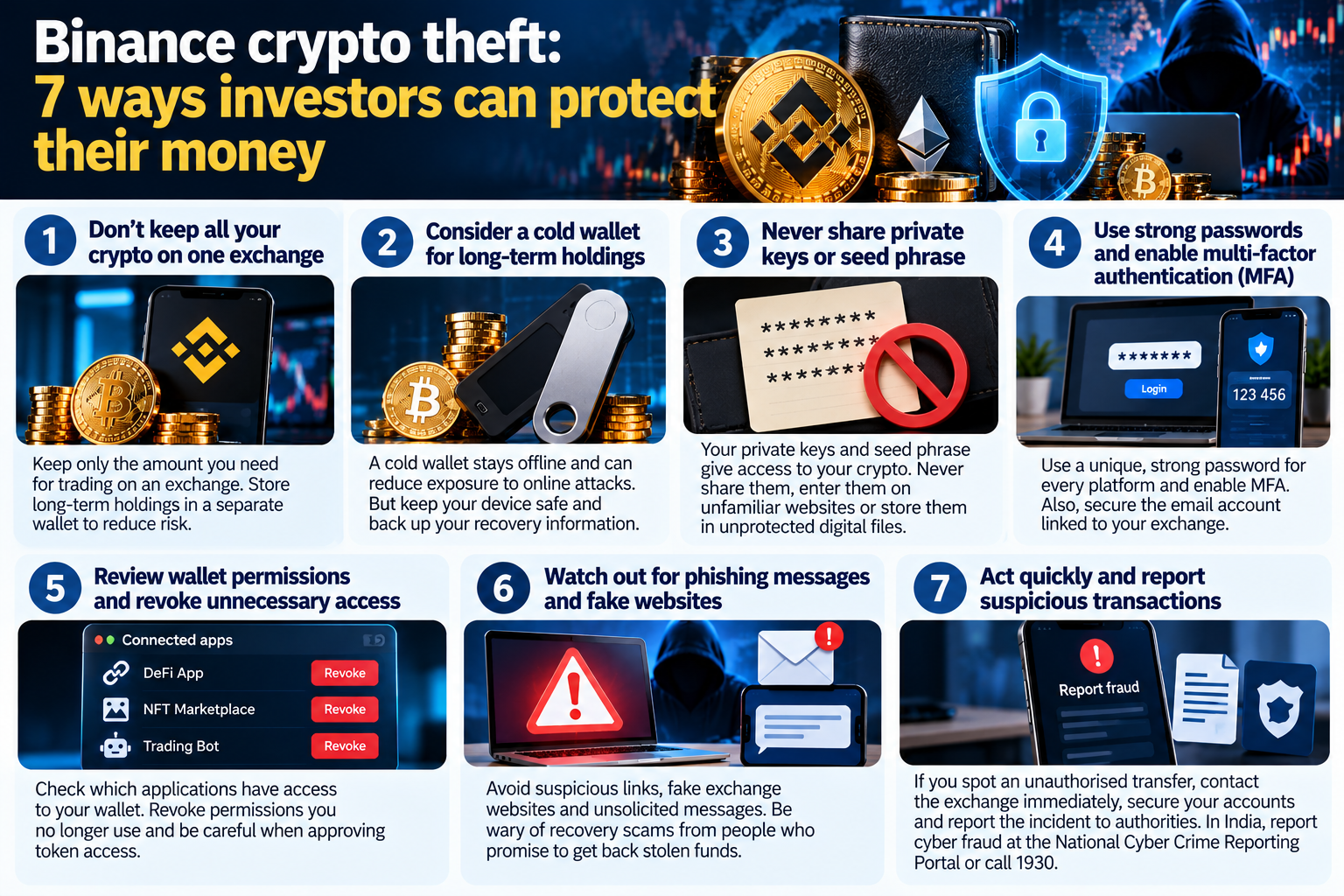
3. Never share private keys or seed phrase
Private keys and seed phrases are among the most important pieces of information in cryptocurrency security.
A private key allows a user to authorise transactions from a wallet. A seed phrase, also known as a recovery phrase, can help restore a wallet if the device is lost or damaged.
Investor.gov warns users never to share their private keys or seed phrases. Anyone who obtains this information may gain control over the assets in the wallet.
Investors should never enter a recovery phrase on an unfamiliar website, share it through email or messaging apps, or send it to someone claiming to represent an exchange.
They should also avoid storing recovery phrases in unprotected screenshots, cloud storage accounts or ordinary digital notes. A secure offline backup can reduce the risk of theft through compromised devices.
4. Strengthen exchange accounts with strong passwords and multi-factor authentication
Strong passwords and multi-factor authentication can make it harder for criminals to access exchange accounts.
Investors should use a unique password for every cryptocurrency platform. Reusing passwords across email, banking and crypto accounts increases the risk of wider compromise if one service suffers a data breach.
Multi-factor authentication adds a verification step beyond the password. Depending on the platform, users may be able to use an authenticator app, a hardware security key or another approved method.
Investors should also secure the email account linked to their exchange profile. Criminals who gain access to an email account may use it to reset passwords or intercept security notifications.
The SEC’s Investor.gov bulletin also recommends strong passwords and multi-factor authentication for online crypto accounts.
5. Review wallet permissions and revoke unnecessary token approvals
Using decentralised applications, or dApps, often requires investors to give a platform permission to interact with their wallets and tokens.
These permissions can create risks if users approve more access than a transaction requires. Some applications request unlimited token allowances, which may allow a malicious smart contract to withdraw all the tokens covered by that approval.
Coinbase’s official help guide on dApp permissions warns users about this risk. It advises them to review existing permissions, disconnect from applications they no longer use and revoke unnecessary token approvals.
Investors should regularly check which applications have access to their wallets and whether those permissions are still required. They should also read approval requests carefully before signing transactions.
Connecting a wallet to an application does not necessarily give it permission to move all funds. Token approvals, however, may grant broader access. Users should understand what they are authorising before proceeding.
6. Watch out for fake websites, phishing messages and recovery scams
Hackers do not always target an exchange’s internal systems. They may also go after individual investors through fake websites, emails, text messages and social media accounts.
Fraudsters often impersonate exchanges, wallet providers or customer support teams. They may send messages about suspicious transactions, account restrictions or urgent security checks to persuade users to click malicious links or reveal login details and recovery phrases.
The FBI warns that cryptocurrency scammers also use social media, dating platforms and WhatsApp or Telegram groups to build trust before promoting fake investment opportunities.
Some fraudsters allow victims to withdraw small amounts initially, creating a false sense of security and encouraging them to invest larger sums.
Investors should access exchange accounts through official websites or applications rather than links in unsolicited messages. They should also verify support requests through the platform’s official channels.
Another risk emerges after a theft. Criminals may contact victims and promise to recover lost cryptocurrency in exchange for an advance fee. The FBI warns that such recovery schemes often target people who have already lost money.
Investors should never pay an unknown person who promises guaranteed recovery of stolen crypto assets.
7. Act quickly and report suspicious transactions
A quick response can be important when an investor discovers an unauthorised transfer or suspects a scam. Reporting the incident promptly may help authorities and service providers trace funds or block further transfers.
Investors should immediately contact the exchange or wallet provider through its official support channel. They should secure their email and exchange accounts, change compromised passwords and revoke suspicious wallet permissions where possible.
They should also preserve transaction records, including wallet addresses, transaction IDs or hashes, cryptocurrency type, amount, and the date and time of the transfer. Screenshots, emails and messages related to the incident may also help an investigation.
The FBI asks victims of cryptocurrency investment fraud to report cases through its Internet Crime Complaint Center (IC3). It recommends providing transaction details and information about the people or platforms involved.
Indian investors can report financial cyber fraud through the National Cyber Crime Reporting Portal or by calling the government’s toll-free helpline 1930. The Ministry of Home Affairs said the Citizen Financial Cyber Fraud Reporting and Management System had helped save more than Rs 11,158 crore across over 32.80 lakh complaints by June 30, 2026.
Early reporting can help authorities coordinate with banks and other financial institutions to stop the movement of funds. However, it does not guarantee recovery, particularly if criminals have already moved cryptocurrency across multiple wallets or blockchains.
Does moving crypto to a personal wallet remove all risks?
Moving cryptocurrency away from an exchange can reduce dependence on a third-party platform, but it does not make an investment risk-free.
Self-custody gives investors direct control over their private keys. It also makes them responsible for securing those keys, maintaining backups and authorising every transaction.
Investor.gov warns that users who lose their private keys or seed phrases may permanently lose access to their cryptocurrency. A cold wallet can also be stolen, damaged or misplaced.
Third-party custody offers a different arrangement. An exchange or professional custodian manages access to the private keys. This may be more convenient for investors who lack the technical knowledge to manage a personal wallet. However, it also means they depend on the custodian’s security systems and financial health.
Before choosing an exchange or wallet provider, investors should examine how it stores assets, whether it uses hot or cold wallets, who controls the private keys and what happens if the company fails.
They should also check the terms of any insurance or customer-protection programme. A platform’s reserve fund or proof-of-reserves report does not automatically guarantee compensation for every type of loss.
The Binance incident shows why these questions matter. The exchange has promised to cover the losses through its SAFU fund and company funds, but investors should not assume that every crypto platform offers the same protection.
Reuters reported that Binance had set aside around $6.34 billion in company funds internally to cover the incident. The exchange also has a separate $1 billion bitcoin reserve fund designed to protect customer assets. These are Binance-specific arrangements, not a standard guarantee across the cryptocurrency industry.
For investors, the broader lesson is to treat security as part of the cryptocurrency investment decision. Choosing an asset or exchange is only one step. Protecting account access, managing wallet permissions, securing recovery information and knowing how to report fraud are equally important.
Disclaimer: This article is for informational and educational purposes only and does not constitute investment or financial advice. Cryptocurrency investments are highly volatile and carry risks, including hacking, fraud and the possible loss of funds. Investors should independently assess the risks and consult a qualified financial adviser before making investment decisions.