


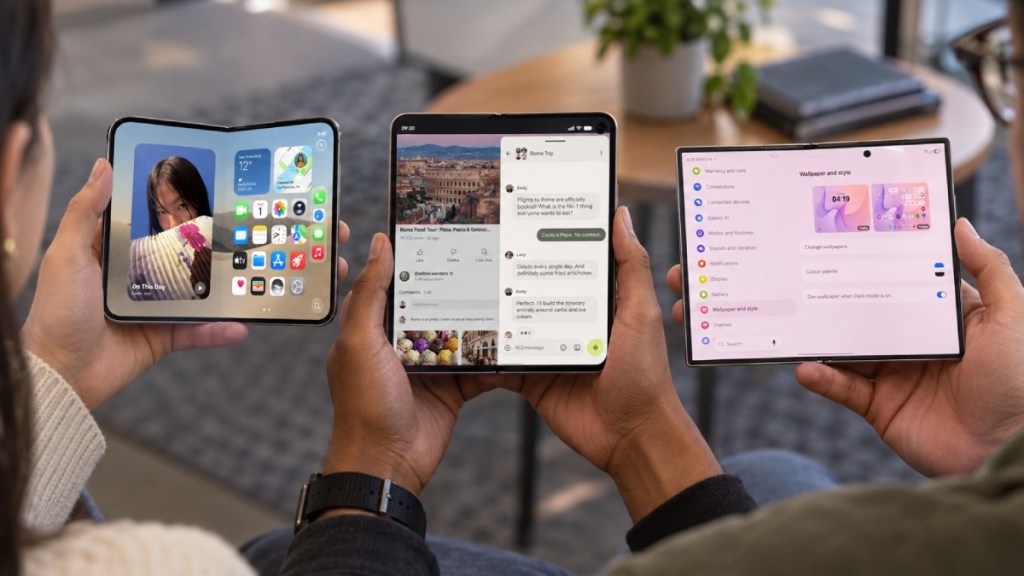

After years of watching from the sidelines, Apple has entered the ring with the iPhone Duo, directly challenging Samsung’s Galaxy Z Fold 8, and Google’s AI-powered Pixel 11 Pro Fold. All the three phones look almost identical, with Samsung and Apple resembling a passport more than ever. Google’s Pixel 11 Pro Fold focuses largely on the AI side of things, especially with its Tensor G6 chip that’s designed to run Gemini models.
In fact, when you look beyond the spec sheet of these three phones, the core philosophies are widely different. While Google’s fold is all about AI, Samsung’s Fold 8 is centered around the widescreen experience. Apple, meanwhile, wants its iPhone Duo to best represent the idea of a foldable phone, especially with a UI that adapts to the changing screen ratio with elegant animations.
The difference in prices also weigh in for each of these – Samsung’s foldable is the most affordable one in this company, followed by Google’s foldable in a close second. The iPhone Duo, on the other hand, sits in a league of its own.
So, we have interesting choices for the yearning folding phone connoisseur. But how do these stack up against each other when it comes to buying one of these as your daily phone?
Design and Ergonomics
Apple’s first foldable, the iPhone Duo, prioritises pure structural luxury. Built with an aerospace-grade Grade 5 titanium chassis, ceramic shield backing, and a custom variable torque hinge, it lays completely flat with an almost imperceptible crease (it’s still there if you look at it from an angle). It also opts for a wider, passport-style shape that feels solid, despite being heavy in hand at 254 gram.
On the other hand, Samsung’s Galaxy Z Fold 8 continues to refine its sleek and tall form factor. At 201 grams, it is the lightest of the lot, rivalling some slab-type flagship phones. It also measures a paper-thin 4.5 mm when unfolded. With the Fold 8, Samsung has achieved the lightest and thinnest dynamic hinge in the market. The phone is also protected by an IP48 water-and-dust resistance rating.
Google’s Pixel 11 Pro Fold strikes a pragmatic middle ground with rounded corners, a smooth matte finish, and a reshaped rear camera island housing the new “HiLight” LED status indicator ring. It is slightly heavier at 239 grams, but its squarish profile offers an extremely balanced grip when holding the device open for extended periods.
Displays
The iPhone Duo features a wide 5.4-inch outer cover screen and unfolds into a massive 7.6-inch inner Canvas display. Apple uses maskless laser lithography polymer layers to smooth out the crease, paired with low-frequency LTPO panels that support Apple Pencil input on both surfaces. No foldable phone at the moment supports a professional-grade stylus.
Samsung’s Galaxy Z Fold 8 uses its Dynamic AMOLED 2X technology across a 5.5-inch cover panel and a widescreen 7.6-inch main inner display. The main display hits a very high peak brightness of 3,000 nits, thus making it brightest display we have seen on a foldable phone in this class.
Google’s Pixel 11 Pro Fold, meanwhile, sticks to a highly usable 6.1-inch outer display paired with an 8-inch Super Actua inner screen. It promises vivid colour accuracy and reflection reduction, making it preferable for split-screen document editing and media consumption.
Software and AI specialisation
Software is where these devices stand divided.
Apple’s adaptive iOS 27: Designed around multithreading, iOS 27 adapts seamlessly when opening the inner screen. Users can run parallel apps side-by-side, split controls dynamically to the lower half in semi-folded stance, or pin floating video windows effortlessly.
Samsung’s One UI 9: Built on Android 17, Samsung’s One UI 9 remains the king of raw power-user multitasking. Featuring a permanent desktop-style taskbar, support for three simultaneous app windows, floating pop-up views, and various intuitive features, it is essentially a mini laptop in your pocket.
Google’s Gemini Intelligence: The Pixel 11 Pro Fold shines through ambient AI as part of its Gemini Intelligence suite. Driven by Android 17 and Tensor hardware, its software features system-wide AI agents capable of complex tasks like scanning long documents to automatically generate calendar events or controlling apps via “App Bubbles”.
Cameras
Apple made a noticeable trade-off with the iPhone Duo, i.e., to keep the device thin, it omitted a dedicated telephoto lens. It relies instead on dual 48MP Fusion main and ultrawide cameras. What it lacks in optical reach, it makes up for with “Duo Preview” (using the outer screen for framing) and exceptional 4K video capture powered by the A20 Pro silicon. Note that the Duo doesn’t feature the same sort of camera stability as the iPhone 18 Pro.
Samsung too equips the Galaxy Z Fold 8 with a dual 50MP system (wide and ultrawide) that leans heavily on ProVisual AI engine tuning. Colour science is punchy and vibrant, with 8K video recording capabilities and dual-recording shooting modes tailored for content creators.
Google’s Pixel 11 Pro Fold takes the crown for photography versatility. Utilising Google’s computational photography pipeline and a dedicated telephoto shooter (48 MP main sensor, a 10.5 MP ultrawide lens, and a 10.8 MP telephoto lens with 5x optical zoom), it delivers stong portrait blur, sharp low-light captures, and superior skin-tone accuracy, backed by generative photo-editing tools that let you recompose photos after taking them.
Battery Life
iPhone Duo: Due to the extreme energy efficiency of the 3nm A20 Pro chip, Apple promises all-day endurance despite housing a split battery system. Power management is tightly optimised, though charging speeds remain capped around standard MagSafe and USB-C rates.
Galaxy Z Fold 8: The Fold 8 houses a 4,800mAh silicon-carbon battery pack, backed by the Qualcomm Snapdragon 8 Elite Gen 5 processor. In our review, we found that it easily delivers 6 to 7 hours of screen-on time. It also supports faster 45W wired charging along with 20W wireless charging.
Pixel 11 Pro Fold: The Pixel 11 Pro Fold packs a large battery designed around Tensor G6’s efficiency cores. While it easily lasts a full day under normal use, heavy multi-window gaming or continuous AI task processing drains the battery quicker than on the Samsung or Apple hardware.
Price in India
Considering the prices, these foldable devices qualify as luxurious purchases. However, it is the Android side of the universe that delivers on the value-for-money aspect.
Samsung Galaxy Z Fold 8: Starts at Rs 1,79,999 for the 256GB base model.
Google Pixel 11 Pro Fold: Launched at Rs 1,86,999 for the 256GB model.
Apple iPhone Duo: Commands an eye-watering starting price of Rs 2,99,900 for the 256GB variant, scaling up to Rs 4,49,900 for the 2TB edition.
Verdict
If you want the absolute ultimate status symbol with unmatched build refinement and seamless iOS integration, and money is no bar, the iPhone Duo stands in a league of its own and is definitely worth considering.
For serious multitaskers and power users who want a proven, ultra-slim productivity machine while spending a reasonable amount, the Galaxy Z Fold 8 remains the easy choice. It’s got all the essentials of a modern-day flagship foldable with a well refined software and more.
Meanwhile, if you prioritise point-and-shoot camera quality alongside smart, effortless AI software features, the Pixel 11 Pro Fold offers the most practical and intelligent daily foldable experience for a reasonable price.