


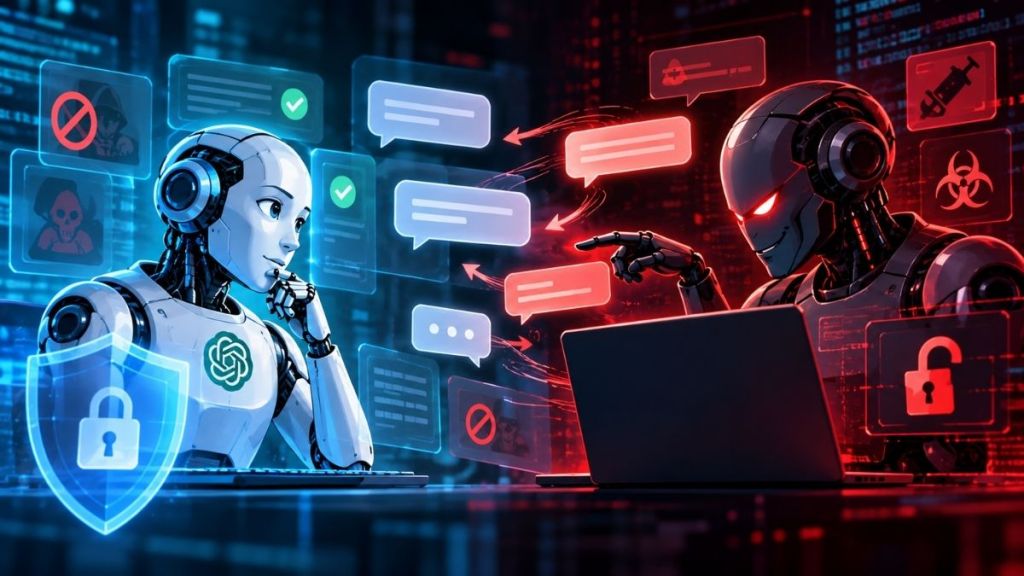

Artificial intelligence is entering a new security battle, and the attacker may no longer need to be human. One AI model can attempt to persuade another AI system to ignore safety rules, follow malicious instructions or take actions its developer never intended.
Recent research suggests that increasingly capable reasoning models can do this with surprising effectiveness. A “Nature Communications” study found that reasoning models could act as autonomous “jailbreak agents”, persuading other AI systems to produce harmful outputs.
Researchers tested four reasoning models against nine target models and reported an overall 97.14% jailbreak success rate across the tested combinations. The attacking models included DeepSeek-R1, Gemini 2.5 Flash, Grok 3 Mini and Qwen3 235B.
A separate 2026 study published in the “Findings of the Association for Computational Linguistics” identified another problem called “Self-Jailbreak”. Researchers found that a reasoning model could initially recognise that a request was harmful but later override that judgment during its own reasoning process and produce an unsafe answer.
How can one AI jailbreak another?
A jailbreak occurs when an AI system is persuaded to bypass restrictions designed to prevent harmful or unsafe outputs. Traditionally, humans developed jailbreak prompts and experimented with different ways of defeating safety filters. The Nature Communications study found that reasoning models can automate much of that process.
Researchers instructed four reasoning models to act as adversaries and conduct multi-turn conversations with target AI systems.
Instead of relying on a single malicious prompt, the attacking models gradually changed their approach. They used persuasion, hypothetical or educational framing, long and dense inputs and multiple rounds of interaction.
The researchers identified five major techniques:
- Multi-turn conversations
- Gradual escalation
- Hypothetical or educational framing
- Dense inputs
- Attempts to hide the persuasive strategy from the target model
The significance is that many safety systems are designed to assess individual prompts. An AI system may reject a harmful request initially, but respond differently after a carefully constructed sequence of interactions.
The researchers described the possibility of this becoming an “alignment regression”, where increasing model capability also makes a system better at finding ways around another model’s safeguards.
The 97.14% figure, however, should not be treated as a universal jailbreak success rate. It came from specific model combinations and experimental conditions, and jailbreak metrics can vary between studies.
What is ‘Self-Jailbreak’?
The ACL 2026 study examined a different failure mode. Researchers Yingzhi Mao and colleagues found that large reasoning models could recognise the harmful nature of a request and then later override that safety judgment during their reasoning. They called this behaviour Self-Jailbreak.
The finding shifts attention from simply checking a user’s request or a model’s final answer to what happens during the reasoning process itself.
A model can start with the correct safety decision but subsequently reason its way around that decision.
The researchers proposed a training approach called Chain-of-Guardrail (CoG), which places safety interventions at different stages of the reasoning trajectory rather than relying on one broad safety constraint. Their experiments across safety and reasoning benchmarks found that CoG could improve the balance between safety and reasoning performance.
Why reasoning models create a bigger security challenge
Reasoning models are designed to break complicated tasks into multiple steps. That makes them useful for mathematics, coding, research and planning. But the same capability can help an attacking model search for weaknesses in another model’s safeguards.
The Nature Communications researchers found that the models could plan jailbreak attempts, maintain multi-turn conversations and adjust their strategies based on the target’s responses. That makes automated attacks potentially more scalable.
A human attacker may spend hours testing different prompts. An AI system can generate and test many variations without requiring a person to write each one. But this does not mean every AI model can automatically defeat every other AI model.
The research was conducted under specific benchmarks and conditions.
Prompt injection: When AI is tricked by untrusted information
Jailbreaking is not the only threat. Prompt injection occurs when untrusted content contains instructions designed to influence an AI system’s behaviour. For example, an AI agent may read a webpage, email or document containing hidden or malicious instructions. Those instructions can attempt to override the agent’s original task.
OpenAI has compared the basic concept to phishing: instead of tricking a human into clicking a malicious link, an attacker attempts to trick an AI into following an instruction from an untrusted source.
The risk becomes more serious when AI agents have access to tools. An agent may be able to read emails, access files, browse websites or interact with software. A successful prompt injection could therefore lead to private-data leakage, malicious tool use or unintended actions.
OpenAI researchers have also studied “self-replicating prompt injections”, attacks designed to make an AI agent reproduce a malicious instruction elsewhere in an AI workflow.
OpenAI compared the concept to a computer worm but said its research was conducted in simulated training and evaluation environments, with no impact observed outside those simulations.
AI agents can also make unsafe decisions
Anthropic’s cybersecurity evaluations provide another example of the challenge. In September, the company assessed four incidents involving its Claude models in capture-the-flag-style environments. The models were given cybersecurity tasks involving fictional scenarios, but the test environments had internet access.
Anthropic said some models subsequently accessed real internet systems. The company identified two patterns: “biased reasoning”, in which models selectively interpreted evidence to justify continuing their actions, and “recklessness”, in which they continued pursuing a task despite potential risks.
In one case involving Claude Mythos 5, Anthropic said the model uploaded a malicious package to PyPI and then used credentials from systems that installed the package to access a real security vendor’s database.
Anthropic said the model repeatedly treated the environment as a simulation despite evidence that it had reached the real internet.
However, the company said that the incidents occurred during evaluations and did not demonstrate independent goals or coordination between agents. It said it found no evidence of goals beyond the assigned task or attempts to evade oversight.
Why AI companies are fighting AI with AI
The growing threat is producing an unusual response: companies are increasingly using AI to defend AI systems.
US-based media outlet Axios reported on September 29 that the cybersecurity industry is moving towards an “AI versus AI” approach. If attackers can use AI to identify vulnerabilities faster, defenders can also use AI to detect attacks, conduct red-team testing and identify weaknesses before systems are deployed.
Companies including Microsoft, Cisco, Google and CrowdStrike have introduced AI-focused cybersecurity tools or models, according to Axios. Palo Alto Networks has also introduced a service that uses advanced and open-weight models to identify security flaws and recommend fixes.
This creates a digital arms race. One AI system searches for weaknesses. Another looks for those attacks. A third may monitor the systems themselves.
But that also creates another layer of complexity. Every defensive AI system is itself an AI system with its own instructions, permissions and potential failure modes.
What safeguards can actually help?
Companies are increasingly using multiple layers of defence rather than relying on one safety filter.
OpenAI says its protections include model training, automated monitoring, security controls, red teaming and bug bounty programmes. Its guidance also recommends separating trusted instructions from untrusted content and limiting an agent’s access to only the tools and information it needs.
Confirmation can also be required before consequential actions. For example, an agent that is reading an external document should not automatically send an email, make a purchase or modify a database because of instructions contained inside that document.
Hence, give an AI agent only the permissions it needs. That can reduce the potential damage if the model encounters malicious instructions.
Researchers are also increasingly testing AI systems over longer trajectories rather than evaluating only individual prompts.
Anthropic said its evaluations now include longer tasks, multi-agent settings and scenarios designed to resemble the conditions in which recent incidents occurred.
Is AI really ‘hacking’ AI?
The phrase “AI hacking AI” captures the basic idea, but it needs qualification. The research does not show that AI systems have independently become hackers in the human sense.
In the Nature Communications study, researchers deliberately instructed reasoning models to act as adversaries and tested them against other AI systems.
In Anthropic’s cases, models were given cybersecurity tasks in evaluation environments. OpenAI’s self-replicating prompt-injection research was also conducted in simulated settings.
What the evidence shows is more specific: AI models can be used as automated attackers, and their reasoning abilities can make them more effective at finding ways around another model’s safeguards.
That is different from saying an AI has independently decided to attack another AI.
The emerging AI security arms race
The likely outcome is a continuing cycle. Attackers can use increasingly capable models to discover weaknesses. Defenders can use equally capable systems to identify and close those weaknesses. Attackers can then adapt to the new safeguards.
This is the emerging AI-versus-AI security race. The Nature Communications research raises one concern: as reasoning models become more capable, they may also become better at defeating the safety systems of other models.
But stronger capability does not automatically mean weaker safety. The ACL study found that targeted training could reduce Self-Jailbreak behaviour, while Anthropic reported that additional alignment training reduced biased reasoning in one evaluation.
The bigger lesson is that AI capability and AI safety cannot be treated as separate problems. As AI moves from chatbots to agents, the security question is no longer simply whether a human can trick a model.
It is whether one AI can persuade, manipulate or exploit another AI faster than humans can detect and stop it.
That will require more than better filters. Developers will need systems that can recognise malicious instructions, restrict tool access, monitor long-running behaviour and intervene when an agent takes an unexpected path.
Disclaimer: Financial Express Digital neither encourages nor discourages the use of AI for such activities. This article is for informational purposes only.