


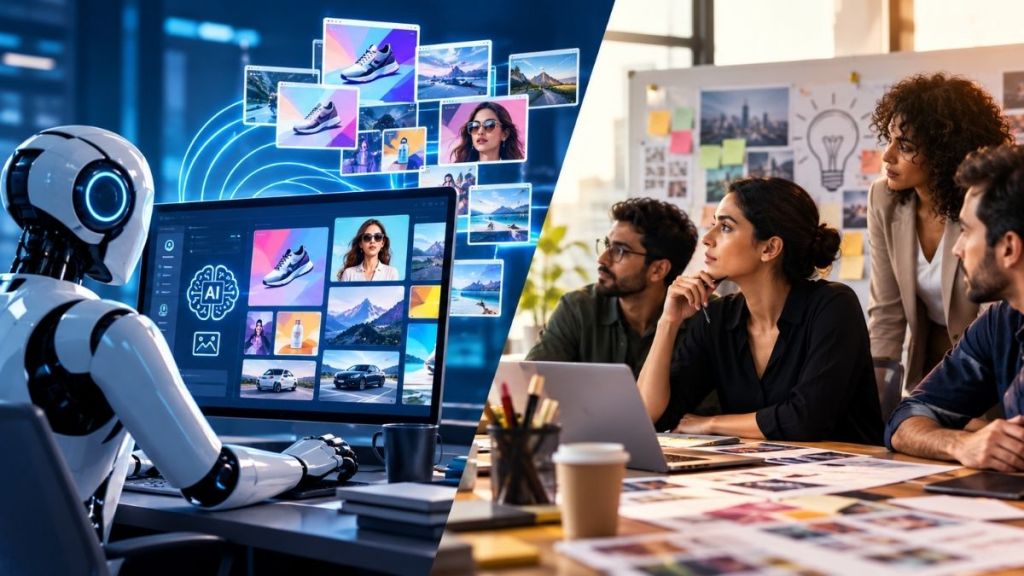

The growing use of artificial intelligence (AI) in advertising is beginning to put pressure on a part of the industry that has long depended on recurring production work — the traditional agency retainer. As brands increasingly use AI to create, adapt, review and publish large volumes of content in-house, agencies could find themselves competing less on execution and more on ideas, strategy and relationships.
Bata India’s recent move to shift from a fully agency-dependent creative model to an AI-led system, in partnership with marketing technology company Zocket, is an early indication of this change. The footwear major expects the system to generate more than $1 million (nearly Rs 1 crore) in annual savings, with AI agents being used across briefing, content creation, review, publishing, response management and post-performance learning. Its marketing team will retain control over strategy and final approvals.
The significance of the move is less about another brand adopting AI and more about how much of the agency workflow can now be automated. Tasks such as creating multiple versions of an advertisement, adapting content for different platforms and markets, producing social media assets and making performance-led changes have traditionally formed a substantial part of agency work.
“This isn’t headcount replacement; it’s retainer replacement,” Divyat Kanyal, founder of ad production firm Tall Creative Studios, told FE. The model could be replicated particularly in high-volume categories such as footwear, apparel, FMCG and retail, where brands need large amounts of content and frequent adaptations, he added.
The shift is already visible across the industry. The AI Marketing Maturity Study for Q1 2026 by MMA India, EY and Mobavenue, based on more than 60 senior marketing leaders across over 11 sectors, found creative and content to be the most evolved AI use case among Indian marketers. However, only 35% had moved to full-stack AI in this area, while the rest continued to use standalone tools.
Advertising effectiveness is also making the economics harder to ignore. Kantar data showed that 15% of unfinished ads tested in India in 2025 were GenAI-crafted animatic films, with 80% of these emerging in the final six months of the year. GenAI ads performed at par with traditionally produced ads on several measures, including emotional response.
However, the automation of production does not necessarily mean the automation of creativity. Samit Sinha, founder of Alchemist Brand Consulting, expects AI-generated advertising to become increasingly difficult to distinguish from traditionally produced work, but believes that, for the foreseeable future, AI will be used more for production than ideation.
That distinction could determine which parts of the agency model survive. As execution becomes cheaper and faster, the value of the creative idea, consumer insight and judgement behind a campaign could increase. At the same time, if every brand has access to similar AI capabilities, production efficiency itself is unlikely to remain a differentiator.
There is also a longer-term concern for the advertising talent pipeline. Much of the repetitive production, copy, design and versioning work now being automated has traditionally been where young professionals learnt the craft. Kanyal said agencies risk losing junior and mid-level roles that have historically produced the next generation of creative talent.
The result could be an advertising industry with fewer people involved in execution, but greater emphasis on those who can originate distinctive ideas and manage brands and clients. As AI makes production increasingly commoditised, agencies may ultimately have to sell less of the work that fills their retainers, and more of the thinking that gives brands a reason to retain them.