


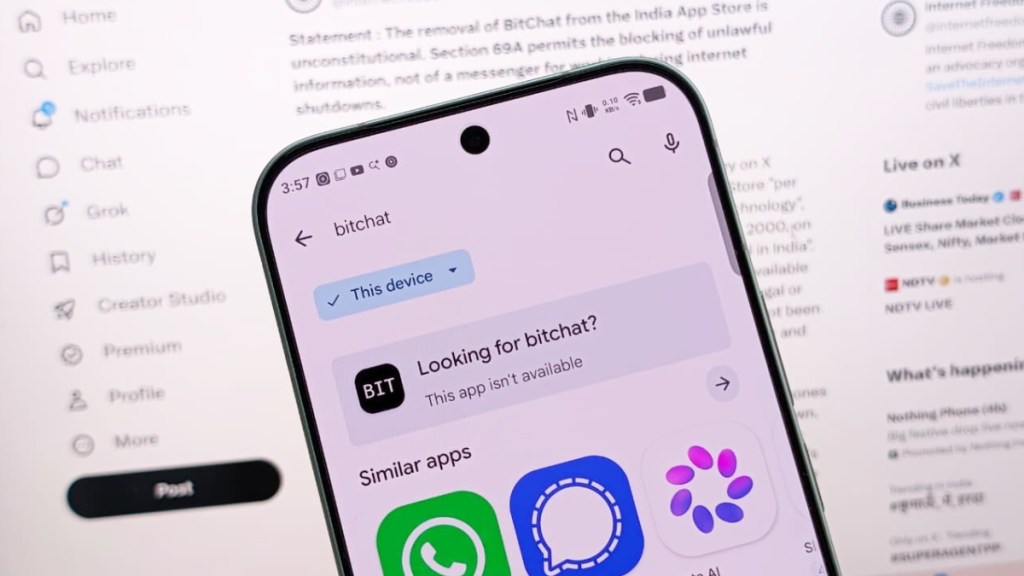

Amid the protests in New Delhi, the Indian government quietly banned a messenger app that allowed users to text each other without using internet connectivity, bypassing the internet restrictions. The app in the spotlight is Jack Dorsey’s Bitchat messenger app – one that relies on Bluetooth connectivity to share messages.
Developed by Twitter co-founder Jack Dorsey, Bitchat relies entirely on peer-to-peer Bluetooth mesh networking. It requires no cellular coverage, no SIM cards, and no centralised routing servers to send messages. Users simply broadcast encrypted packets directly from device to device, building short-range ad-hoc networks that bypass traditional telecom switches entirely.
However, things don’t look positive for Bitchat. Following a directive issued by India’s Ministry of Electronics and Information Technology (MeitY) citing Countering the Financing of Terrorism (CFT) provisions and law enforcement compliance, Apple and Google have purged Bitchat from their respective app stores across India.
Jack Dorsey’s Bitchat taken down in India
Unlike traditional messaging platforms like WhatsApp or Telegram, which maintain central infrastructure capable of being subpoenaed or blocked via IP blacklists, Bitchat operates as a pure protocol. It hosts no content, retains no databases, and collects no metadata.
Because Bitchat operates without intermediary servers, Indian digital rights organisations have raised sharp legal questions regarding the takedown order issued under Section 69A of the Information Technology Act.
“The removal of BitChat from the India App Store is unconstitutional. Section 69A permits the blocking of unlawful information, not of a messenger for working during internet shutdowns,” stated the Internet Freedom Foundation (IFF).
This is not the first time government authorities have attempted to restrict Bitchat’s footprint. Previously, there were efforts to target the open-source repository directly, issuing strict timelines to remove hosting files from platforms like GitHub.
Is the ban effective?
However, enforcing takedowns on decentralised infrastructure has proved notoriously difficult:
Instant code mirroring: Within hours of initial blocking attempts, developers copied the application’s codebase across alternative peer-to-peer repositories, including decentralised networks like Radicle.
Local mesh persistence: App store removals prevent new downloads, but they cannot disable software already installed on users’ devices. Existing nodes continue to route local messages automatically.
Side-loading and forking: Thousands of independent forks remain active worldwide, allowing technical users to build and distribute binaries independently of official app stores.
Jack Dorsey acknowledges takedown
Following the order, Dorsey acknowledged the delisting of the app from the Apple App Store and Google Play Store in India. However, the app is still available to download globally.