


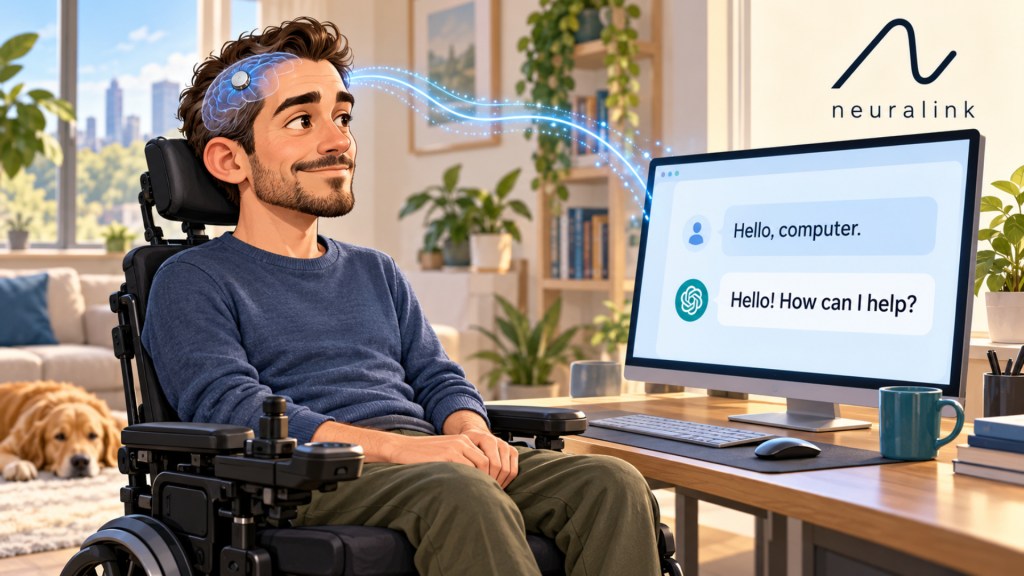

After debuting his “flying car” a few weeks ago, Elon Musk’s neurotechnology firm, Neuralink, has outlined its flagship medical and brain-computer interface (BCI) applications – Telepathy and Blindsight.
Building on the previous BCI chips and interfaces, Telepathy and Blighsight are being positioned as direct bridges between human neural architecture and external machines. The two products are aimed at restoring lost motor control, speed-of-thought digital interactions, and sensory perception, thus helping extend these technologies to address real-world problems.
Telepathy – Neuralink’s attempt at mind control
Telepathy is Neuralink’s primary motor interface, engineered to capture real-time electrical signals from the brain and translate them into digital commands. Made primarily for individuals who have lost limb function, such as those living with severe spinal cord injuries or Amyotrophic Lateral Sclerosis (ALS), the implant gives users direct control over computers, smartphones, and physical peripherals purely through intent.
How it works
Electrode array: Telepathy operates using 1,024 bio-compatible electrodes spread across 64 flexible polyimide threads. Each thread is significantly thinner than a human hair to minimise long-term tissue inflammation and surgical micro-trauma.
Application-specific processing: Custom microchips (ASICs) amplify, digitise, and wirelessly stream neural firing patterns to an external device with low latency.
High-bandwidth expansion: Beyond basic cursor control or typing, Telepathy aims to achieve output bandwidths that far exceed human speech or manual typing speeds by utilising pretrained neural encoders trained on tens of thousands of hours of clinical brain data.
In clinical trials, quadriplegic participants equipped with Telepathy implants have successfully navigated operating systems, played complex online video games, written text, and manipulated robotic arms simply by visualising physical movements.
Is it ready for market?
Telepathy is currently in active human testing. It began under the PRIME Study (Precision Robotically Implanted Brain-Computer Interface). Quadriplegic trial participants have received the N1 implant to test brain-to-computer cursor control, typing, and video gaming.
At the moment, the focus of the trials are to evaluate safety, wireless connectivity, real-time decoding accuracy, and stability of the thread electrodes inside brain tissue over multi-year periods.
Blindsight – Neuralink’s attempt at restoring vision
Blindsight is Neuralink’s attempt at routing external visual information directly into the brain’s visual cortex, i.e., it attempts to give the blind vision using technology. Designed for individuals experiencing complete sight loss, including those with severed optic nerves, ocular trauma, or congenital blindness, Blindsight technically bypasses the eyes.
Here’s how it works:
Digital capture: External cameras or optical sensors capture high-definition visual imagery from the user’s environment.
Signal translation: Processing hardware translates light, depth, and edge data into custom spatial electrical frequencies.
Cortical delivery: Micro-electrode arrays implanted in the primary visual cortex (V1) deliver small electrical pulses.
Phosphene mapping: These micro-current pulses stimulate targeted neuron clusters, causing the visual cortex to register individual points of light known as phosphenes. By driving thousands of these points simultaneously, the brain constructs a real-time, low-resolution visual map.
Neuralink says that the initial visual quality is expected to resemble low-resolution graphics or coarse pixel matrices to the patient. However, future technological iterations are designed to scale electrode density over time. This scaling could eventually allow resolutions exceeding natural human sight. It is said that the input could eventually include overlay modes for infrared or radar spectrums – ones that human eyes can’t see.
At the moment, Blindsight is in pre-clinical testing phase and is moving toward initial human trials. The US FDA granted Blindsight its Breakthrough Device Designation – an administrative status intended to expedite development and regulatory review for life-changing technologies.
For now, the idea is to extensively test in non-human primate models. Human clinical trials are targeted next to begin assessing initial cortical micro-stimulation and basic phosphene image mapping in human subjects.
Neuralink builds a specific robot for the surgery
A crucial requirement for both Telepathy and Blindsight is Neuralink’s purpose-built R1 Surgical Robot, which is built for inserting ultra-thin, flexible threads into delicate brain tissue without rupturing blood vessels.
The robot uses optical coherence tomography (OCT) and high-speed computer vision to map surface capillaries on the brain, weaving thread needles around micro-vessels to reduce surgical bleeding and tissue damage. Capable of inserting up to 6 flexible threads (192 electrodes) per minute, the R1 automates the most intricate stages of the surgical insertion process.