


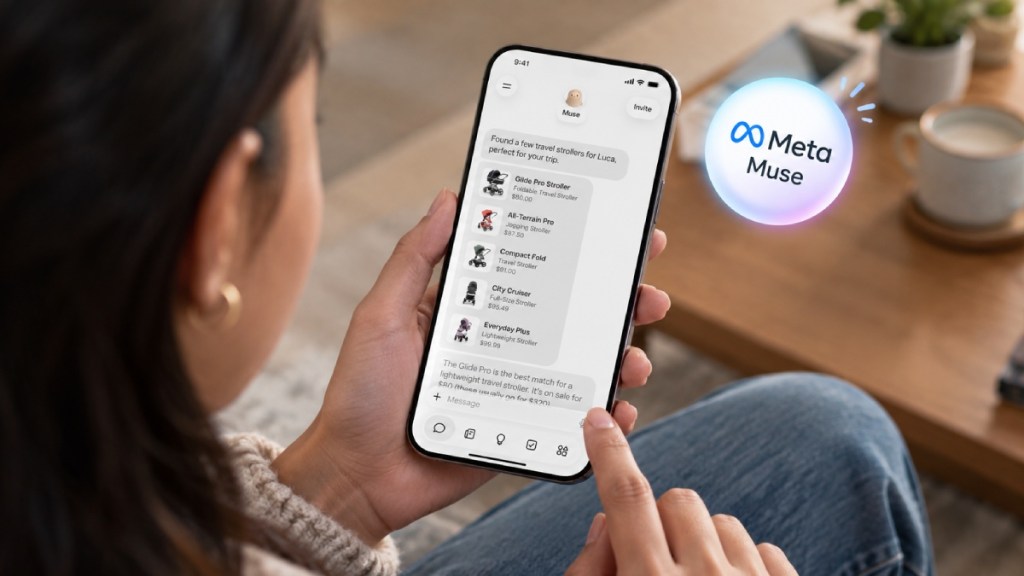

Meta has officially launched Muse Spark Open as its take on an “open-weight” AI model. Meta, in fact, is describing it as the most capable US open-weight model released to date. Designed specifically for complex coding and autonomous agentic workflows, the model boasts of 816 billion parameters (with 42 billion active at any given time via a mixture-of-experts architecture) and a massive 1-million-token context window.
Similar to most other large-scale open-weight models, Muse Spark Open is available immediately for download on platforms such as Hugging Face, OpenRouter, and Groq, and is even capable of running locally across high-end hardware setups like dual Apple Mac Studio rigs equipped with M5 Ultra chips.
Meta says that Muse Spark Open allows developers to run, fine-tune, and build products locally without paying upfront license fees.
However, there’s a catch in the “free” open-weight AI model, as Meta wants to gatekeep it in a clever way.
What’s the catch in Meta’s open-weight
While independent developers, academic researchers, and early-stage startups can deploy Muse Spark Open without financial limitations, Meta’s updated licensing agreement introduces strict commercial guardrails targeted directly at high-earning tech firms and cloud API vendors.
Under the new terms, here’s how Meta dictates using the new AI:
The Revenue Cap: Any business or ecosystem of affiliates generating more than $20 million in gross revenue over a trailing 12-month period must notify Meta and sign a separate commercial license agreement before offering model access or derivative outputs via an Application Programming Interface (API) or model-as-a-service product.
Open derivatives and training: Developers are permitted to use Muse Spark Open to distil smaller models or train custom variants, but commercial monetisation at scale remains strictly governed by Meta’s enterprise revenue tier.
How Meta Muse Spark Open compares with DeepSeek
Meta’s launch puts it in direct competition with open-weight powerhouse DeepSeek, whose frontier coding and agentic models currently hold the benchmark for open AI performance. While Meta’s 816B-parameter (42B active) model matches DeepSeek’s massive 1M-token context window for processing large codebases, the key difference lies in open philosophy and commercial accessibility.
DeepSeek’s models are distributed under permissive open licenses (like MIT), allowing companies and cloud providers to monetise, host, and re-share API access without revenue ceilings. Meta, by contrast, uses open weights as a developer magnet while enforcing a $20M commercial threshold to protect its core platform and prevent cloud competitors from freely monetising its multi-billion-dollar R&D investments.
| Feature | Meta Muse Spark Open | DeepSeek Open Models |
| Primary Focus | Coding and Autonomous Agents | Coding and Advanced Reasoning |
| Active Parameters | 42B (out of 816B total) | Variable MoE active parameters |
| Context Window | 1 Million tokens | Up to 1M+ tokens |
| Licensing Model | Restricted ($20M revenue cap for API hosting) | Permissive / MIT-style open license |