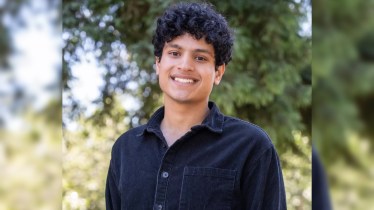
The world has a bunch of new, youngest self-made billionaires. Meet Adarsh Hiremath, a 22-year-old, who, along with his co-founders Brendan Foody and Surya Midha (both also 22), has got a landmark achievement after their AI model training startup, Mercor, recently soared to a $10 billion valuation. This milestone reportedly breaks a two-decade-old record previously held by tech titan Mark Zuckerberg, who introduced the world to Facebook, the biggest social media network today.
The three friends from Silicon Valley’s Bay Area, who first met at a school debate during their High School Diploma in Bellarmine College Preparatory and later received the prestigious Thiel Fellowship to drop out of college and build a startup, are now at the helm of the largest global hiring marketplace for high-skill data labeling and AI model training.
The growth of Mercor and Meta’s role in it
Mercor’s hypergrowth trajectory was not initially anticipated, according to Hiremath. The company launched in 2023 and quickly reached $1 million in revenue within nine months, but the major turning point came in June 2025.
That turning point was Meta’s $14 billion acquisition of a 49 per cent stake in Scale AI, a sector leader. This deal instantly put Scale’s multimillion-dollar data annotation projects from competitors like Google and OpenAI up for grabs. Mercor moved swiftly to capture this market vacuum.
“It felt surreal. I would still be in college if I hadn’t founded this company,” said Hiremath, a Harvard dropout of Indian origin, told The Economic Times. “It was a crazy moment because all of a sudden, these AI labs and former customers of Scale were looking to spend in alternative ways. And Mercor emerged as number one on that list,” Hiremath recalled.
Mercor’s platform currently generates $500 million in annual recurring revenue (ARR). The company employs a network of 30,000 expert contractors, including doctors, lawyers, consultants, and bankers, to train, test, and challenge frontier AI models.
To attract top-tier expertise, Mercor offers an average payout of $85 per hour, significantly exceeding industry peer rates. The platform now pays out $1.5 million every single day to its network.
The company’s valuation quadrupled in just eight months, climbing from $2 billion to $10 billion, following a successful $350 million Series C funding round in October 2025 led by Felicis Ventures, Benchmark, and General Catalyst. Hiremath explained the need for fresh capital despite strong cash flows, stating they “wanted a balance sheet that allowed us to actualise our scale of ambition,” which includes strategic acquisitions and hiring the best people.
Mercor’s roots and its view on AI’s future
Despite the founders’ American upbringing, Mercor maintains a strong connection to India, the home country of Hiremath’s parents (from Karnataka) and co-founder Surya Midha’s family.
Hiremath highlighted that India remains a crucial talent hub. “The initial talent that we placed in startups based in Silicon Valley was actually largely based out of India,” he said. Mercor now operates sizeable operations, products, and engineering teams distributed across India, reinforcing the country’s role in the global AI talent pipeline.
Regarding concerns about smarter AI models diminishing the need for human training, Hiremath argued the opposite is true. “As models get smarter… there’s going to be more opportunities to guide them to do the right thing,” said Hiremath.