


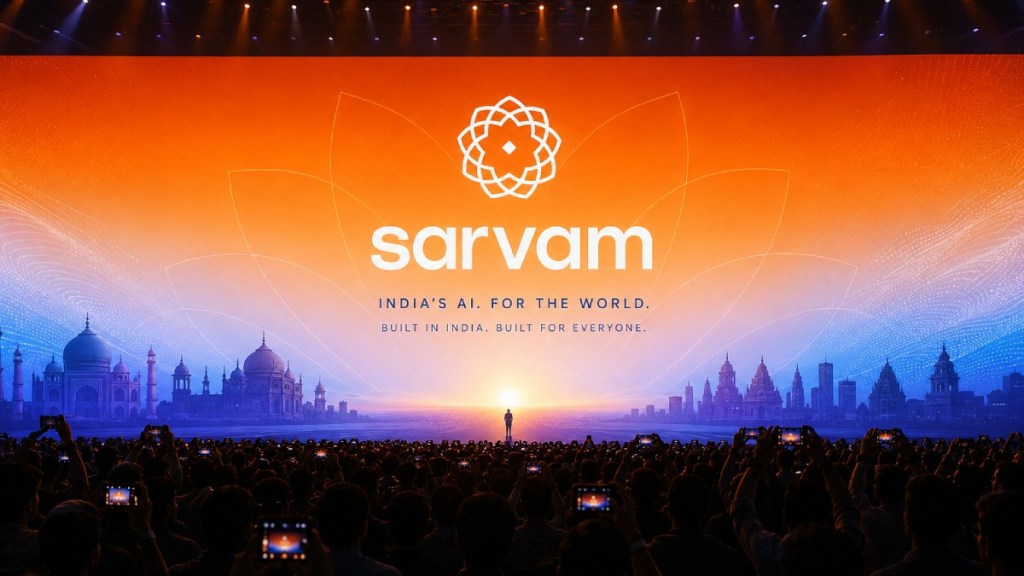

The Anthropic Fable 5 controversy has shifted the conversation around AI towards a single direction overnight – AI sovereignty. India is now accelerating its efforts to create an AI model of its own, and once again, its hopes are resting on Sarvam AI – the Bengaluru-based AI startup.
Sarvam, on the other hand, has taken on the responsibility of developing India’s own AI model for India more seriously than any other player who came before. Think about it – Ola’s Krutrim, a highly celebrated locally developed LLM, was shut down at a time when Sarvam AI was making waves in the industry with its local-first approach to AI development. With a recent funding round that raised the company’s valuation to $1.5 billion post-money, the question that everyone’s raising is this – Is Sarvam AI on the verge of its breakout “OpenAI moment”?
But what exactly does an “OpenAI moment” mean in a sovereign context?
In the global tech scenario, the “OpenAI moment” refers to a sharp inflection point, much like ChatGPT’s launch in late 2022 – where a company’s technology leaps from a niche developer tool into a mainstream and mass-scale cultural phenomenon.
For an indigenous player like Sarvam, however, this moment isn’t about chasing viral consumer hype. Instead, it is about achieving a breakthrough in self-reliance that fundamentally alters a nation’s digital infrastructure.
Geopolitics in AI – Thanks to the US and Anthropic
India has historically relied on American software for decades, and despite the recent push for sovereign AI and locally developed alternatives, the pace has been rather slow. Indian tech leaders have been quick to point out the vulnerability of over-reliance on the US, with Zoho co-founder and Chief Scientist Sridhar Vembu noting that “globalisation is dead” and technology has become the ultimate geopolitical weapon.
Reacting directly to the restrictions on Claude Fable 5, Sarvam AI co-founder Pratyush Kumar shared a reality check on X (formerly Twitter), stating, “For AI users, it is clear that you should not confuse access with ownership, or adoption itself as an advantage. If the most significant tech differentiator you are leveraging has external control loops, then you have to accept you are vulnerable.”
Within hours of the restrictions on Fable 5, this controversy completely reframed the conversation around Sovereign AI. It proved that foreign language models are never geopolitically neutral. For a country like India, building a self-reliant stack is no longer just a milestone – it is a matter of crucial national security.
While the industry watches for a flashy consumer breakthrough, independent analysts suggest the company’s trajectory will look fundamentally different from its Silicon Valley counterparts. As Prabhu Ram, VP-Industry Research Group,
CyberMedia Research (CMR), says in a note shared with Financial Express Online, “Sarvam AI’s strength lies not in replicating OpenAI’s trajectory, but in owning a lane that global frontier labs have largely ignored — India’s vernacular context at scale.”
But why is Sarvam AI India’s best hope right now?
At a time when the focus on Indian AI was centred around Bhavish Aggarwal’s Ola Krutrim, Vivek Raghavan and Pratyush Kumar kickstarted Sarvam AI in 2023 with a singular vision – to build full-stack AI tailored specifically to India’s unique challenges in linguistic, enterprise, and governance needs.
Rather than merely building wrapper applications on top of Western APIs, Sarvam chose the harder, capital-intensive route of training foundation models from scratch.
And soon enough, the startup managed to check landmark achievements.
The IndiaAI Mission Selection (2025): Recognising its potential, the Ministry of Electronics and Information Technology (MeitY) selected Sarvam AI as a primary partner to engineer an indigenous foundational model under the government’s flagship IndiaAI Mission.
Population-scale collaborations: Sarvam integrated its multilingual voice systems with the Unique Identification Authority of India (UIDAI) to bring voice-based AI access to Aadhaar-related services.
The February 2026 model drop: Sarvam shook up the open-source community by releasing two major indigenous large language models (LLMs) designed with a Mixture-of-Experts (MoE) architecture:
– Sarvam-30B: A 30-billion-parameter model optimised for edge intelligence and consumer hardware.
– Sarvam-105B: A massive 105-billion-parameter model boasting a 128,000-token context window, optimised for complex reasoning, coding, and enterprise workloads.
Sarvam Kaze: The AI startup entered the hardware space with an indigenous AI-powered wearable glass that interprets the world visually and aurally in real time across more than 10 Indian languages.
Becoming a $1.5 billion unicorn
Sarvam’s big moment this year comes just as the sovereign AI discussion reaches its peak. The company closed a massive $234 million opening tranche of its Series B funding round, officially pushing Sarvam AI into the Unicorn Club at a post-money valuation of $1.5 billion.
According to CMR’s Prabhu Ram, “With its most recent capital infusion, Sarvam now has meaningful runway: accelerated model development, expanded compute infrastructure, and the strategic flexibility to pursue larger opportunities — from talent acquisition to potential international expansion — without the pressure of premature commercialisation.”
The fresh capital is specifically kept aside to train next-generation frontier models targeting:
- Agentic AI (autonomous workflow execution)
- Advanced coding models
- Cybersecurity defenses
Sarvam’s challenges are immense
While Sarvam AI’s $1.5 billion valuation marks a major milestone for India’s sovereign AI ecosystem, the path for the startup ahead is still ridden with steep structural and capital hurdles. Foundational model development requires immense and continuous CapEx, making Sarvam’s fresh funding look relatively modest against Silicon Valley competitors.
In a statement to Financial Express Digital, Tarun Pathak, Director at Counterpoint Research, said, “We believe this investment still looks small compared to what is happening on global scheme of things but likely to get Sarvam even more attention and if they continue to scale like this expect some more collaborations.”
Beyond securing capital, Sarvam has another major challenge to overcome – making practical economic utility. Pathak emphasises that “AI requires immense CapEx, and it’s not just about compute power, but having access to that compute is incredibly important. HCLTech’s investment will help Sarvam build an AI ecosystem that is not only tailored for Indian enterprises but is also highly cost-effective and efficient.”
Securing hardware is only the basic need for LLM development, since the true challenge is deploying it efficiently for a price-sensitive enterprise base.
Conclusion: Has Sarvam’s ‘OpenAI moment’ arrived?
“The next 12 to 18 months will determine whether Sarvam has the product velocity to define a category — not just participate in one,” says Prabhu Ram.
By pairing raw compute infrastructure (like domestic Nvidia Blackwell clusters) with deep vernacular intelligence, Sarvam is doing what no other Indian AI entity has managed to achieve—systematically breaking the dependency cycle on Silicon Valley.
However, a $1.5 billion valuation and infrastructure milestones are only the foundation, as the real test lies in sustaining this momentum against rapidly evolving global competition. Ultimately, the coming year will serve as the true crucible for the company’s grand ambitions.