


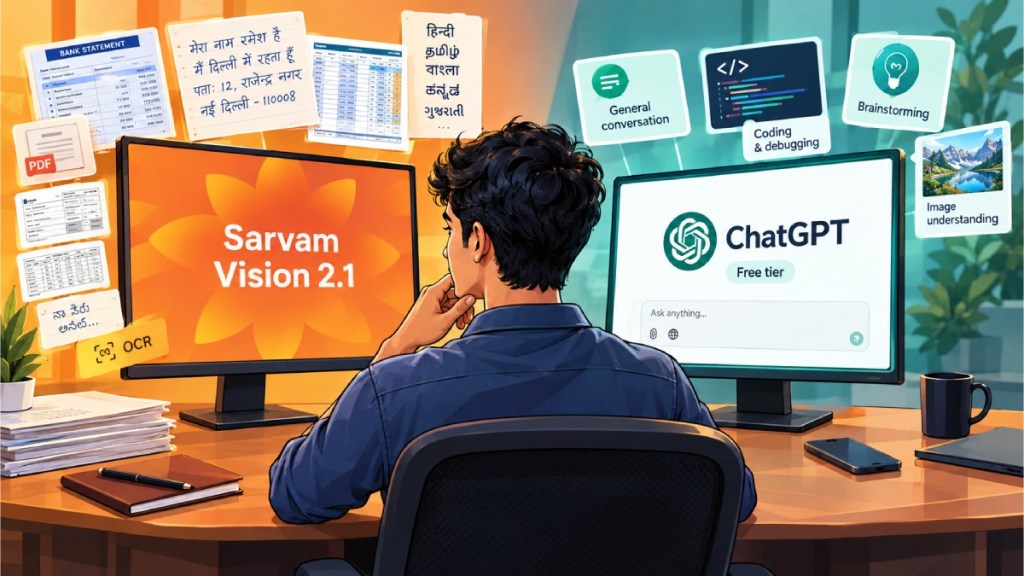

Is Sarvam Vision 2.1 finally India’s time to take on ChatGPT? Sarvam AI has thrown down a high-stakes gauntlet with its latest model, designed to specifically cater to heavy-duty document intelligence, multi-page layout processing, and complex Indic scripts. The Vision 2.1 model takes aim at one of the biggest friction points in modern AI adoption – handling real-world, cluttered, non-English documents.
We put Sarvam Vision 2.1 through its paces alongside ChatGPT‘s free tier to see if India’s homegrown specialised AI can outsmart the world’s favourite general-purpose conversational assistant.
Sarvam Vision 2.1 vs ChatGPT: What the benchmarks say
When ChatGPT’s free tier processes images, it relies on broad general-purpose Vision-Language models. Hence, ChatGPT excels at describing scene elements or answering casual queries about uploaded photos. However, it frequently stumbles over dense text, complex table borders, multi-column layouts, and handwritten notes.
Sarvam Vision 2.1 takes a radically specialised approach, utilising a VLM architecture coupled with a dedicated semantic layout parser and reading order network.
On the Sarvam Indic OCR Bench (a test covering 22 official Indian languages), Sarvam Vision 2.1 recorded an 87.39% word accuracy rate. This easily outpaced ChatGPT’s free-tier engine, which logged 63.69%.
Real-world document intelligence and table parsing
Sarvam Vision 2.1: Whether tasked with digitising scanned bank statements, parsing handwritten Hindi notes, or extracting nested tables into clean Markdown or HTML, Vision 2.1 preserves structure with remarkable precision. It natively parses multi-page documents up to 10 pages per job.
ChatGPT (Free Tier): While ChatGPT can read clear English text from photos well, it often hallucinates numerical values inside borderless financial tables or skips fine print, footnotes, and headers in multi-column PDFs.
Multilingual and script handling
Sarvam Vision 2.1: Built ground-up for 23 languages (22 Indian languages + English). It smoothly navigates code-mixed inputs (e.g., Hinglish) and distinct regional scripts including Devanagari, Bengali, Tamil, Kannada, and Gujarati.
ChatGPT (Free Tier): Translates major Indian languages adequately in pure text, but its visual recognition (OCR) on regional handwritten scripts or low-resolution scans drops noticeably.
General reasoning and conversational depth
ChatGPT (Free Tier): Clear winner for general assistance. ChatGPT isn’t just an OCR engine; it’s a full conversational partner capable of brainstorming, coding assistance, extended multi-turn chat, and synthesis.
Sarvam Vision 2.1: Functionally specialised. Vision 2.1 is built to extract, digitise, and structure visual data into Markdown, JSON, or HTML. It is an enterprise-ready document processor rather than a general open-domain chatbot.
So, Sarvam 2.1 Vision or ChatGPT: Which is better?
Sarvam Vision 2.1 isn’t trying to replace ChatGPT. In fact, it’s proving that a focused and highly optimised sovereign model can outperform global giants at something it was designed to do.
Hence, if your workload involves extracting structured tables, converting scanned PDFs to clean text, digitising invoices, or processing handwritten documents in Indian regional languages, Sarvam Vision 2.1 is a better choice than the free tier of ChatGPT. It removes the hallucinations and formatting errors that plague general-purpose models on complex layout tasks.
However, if you are looking for an all-in-one conversational assistant to help write code, brainstorm ideas, draft essays, or answer open-ended questions, nothing beats ChatGPT’s free tier.