


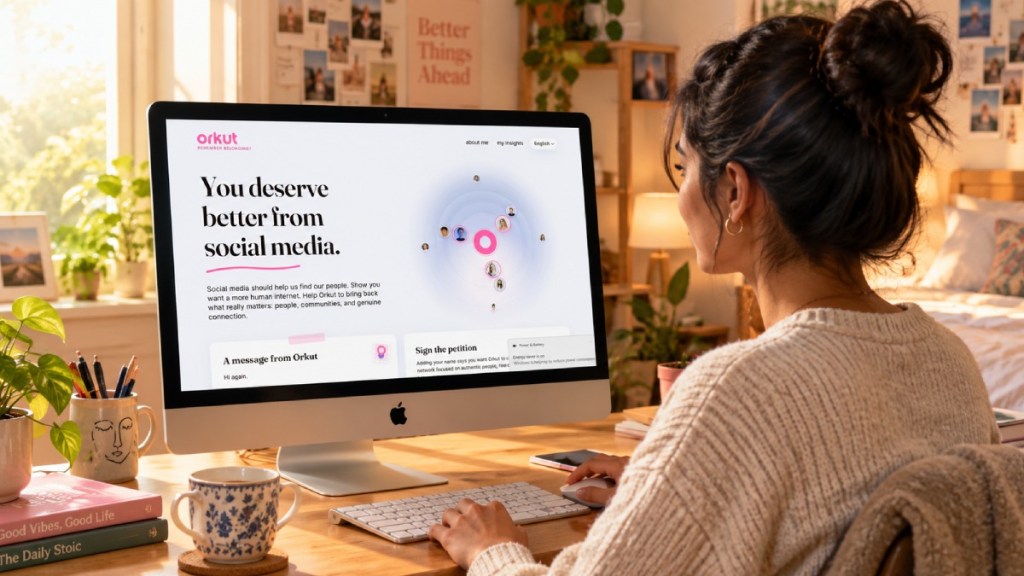

Is Orkut coming back? Decades after its rise to its peak, followed by its disappearance from the scene, rumour mills and online posts in communities have now flared up with claims that Google’s long-lost social network might be making a triumphant return to reclaim the social media mantle it once held.
At a time when Mark Zuckerberg’s Meta is entangled in controversies related to content management, AI and all the modern complexities, people are seeking a less messy social media platform to connect and express. Beyond Facebook, Instagram and Threads, X (formerly Twitter) and Reddit have been managing the load. But Orkut wants to return with a goal that none of us expected – “make the internet human again”. That’s bold in an age where even your toothbrush has AI to clean your teeth.
But why the sudden hype around Orkut’s return? That’s because “https://orkut.com/en/” has gone live and is currently asking for petitions to bring it back from the dead. Orkut is currently taking signatures from those who “want Orkut to create a new social network focused on authentic people, real connection, and genuine belonging.”
For those of you who are clueless about this name, here’s a little history lesson on what made Orkut such a big thing back then, and why the millennials are excited to see its potential return.
What made Orkut special?
Launched by Google in January 2004 – just weeks before Mark Zuckerberg unveiled Harvard-born Facebook – Orkut quickly became an international phenomenon. While it gained moderate traction in the US, it erupted into a cultural phenomenon in countries like Brazil and India. It was in these nations where Orkut found the majority of its hundreds of millions of users.
Unlike Facebook, Orkut felt like an open online playground rather than a hyper-curated broadcast station, owing to:
Scraps and testimonials: People didn’t post for algorithmic reach; they left “scraps” on public walls or agonised over glowing “testimonials” that required manual approval before appearing on a friend’s profile.
Communities: Before Reddit subreddits went mainstream, Orkut hosted millions of user-created communities. From sprawling interest groups to meme-centric hubs like “I hate getting up early,” these forums were where real digital friendships formed.
Profile Views: You could see who viewed your profile, a terrifying yet exhilarating feature that today’s privacy-focused or stealth-browse platforms have largely erased. LinkedIn still does it, but you need to pay to see the names nd details.
However, Orkut’s popularity was challenged by Facebook‘s meteoric rise and the entry of other platforms like Instagram and Twitter. By the early 2010s, Google’s shifting focus toward Google+, alongside performance slowdowns, sealed Orkut’s fate.
In September 2014, Google officially turned off the lights. Years later, Google+ was also shut down.
Inside the new Orkut: Will it be the same or different?
Visiting “orkut.com” today reveals that it’s no longer an archived URL or a tribute page — it is an active global movement. The site features an open letter from Orkut Büyükkökten, the ex-Google employee who founded the platform, alongside a public support petition designed to gauge global demand for a completely reimagined social platform.
However, Orkut’s founder wants the new Orkut, if it happens, to fight AI Slop and algorithmic fatigue. Here’s what Büyükkökten’s letter imagines the new Orkut as:
The death of authenticity: Büyükkökten argues that generative AI, bots, and deepfakes are dissolving the foundational premise of social media – it’s all about humans. There’s an actual human being on the other side of every message.
Community over feeds: Rather than relying on algorithmic feeds built to maximise time-on-site, the revived Orkut stands for interest-based communities where users act as members rather than passive audiences.
Global sign-up campaign: The site invites users worldwide to add their names to a petition, track global sign-up percentages by country, and generate custom supporter badges (ORKT-SMPL-CODE) to share with friends.
Hence, instead of trying to resurrect a 2004-era codebase, the current “orkut.com” initiative serves as a digital town square for users exhausted by engagement-driven platforms, laying the groundwork for a future network built around identity verification and genuine human connection.
Does Orkut have a future?
Based on Orkut Büyükkökten’s letter, it seems the founder wants Orkut to turn into a lasting alternative to the current-gen social platforms. The next-generation platform will likely need three core pillars:
Proof of humanity: Using transparent verification so users know every message, scrap, or comment comes from a real person rather than an AI bot or scraper.
Intentional communities over viral feeds: The new Orkut wants to replace global viral distribution with intimate, interest-based spaces where kindness and conversation matter more than raw view counts.
User-controlled algorithms: New Orkut wants to give users explicit toggles over what they see, rather than letting AI maximise screen time.
“I see a different future for the internet, one built around real people, one with a human on the other side of every message. A future not focused on algorithms, eyeballs, and time-on-site optimisation. The next generation deserves a better world, one where their communities reward kindness, curiosity, friendship, trust, and connection,” says Büyükkökten.
Whether the new project launches as “Orkut 2.0” or under a fresh identity, the overwhelming interest in its return proves one thing – millions of internet users are exhausted by the current state of social media, and there’s a longing for an internet that felt human.