


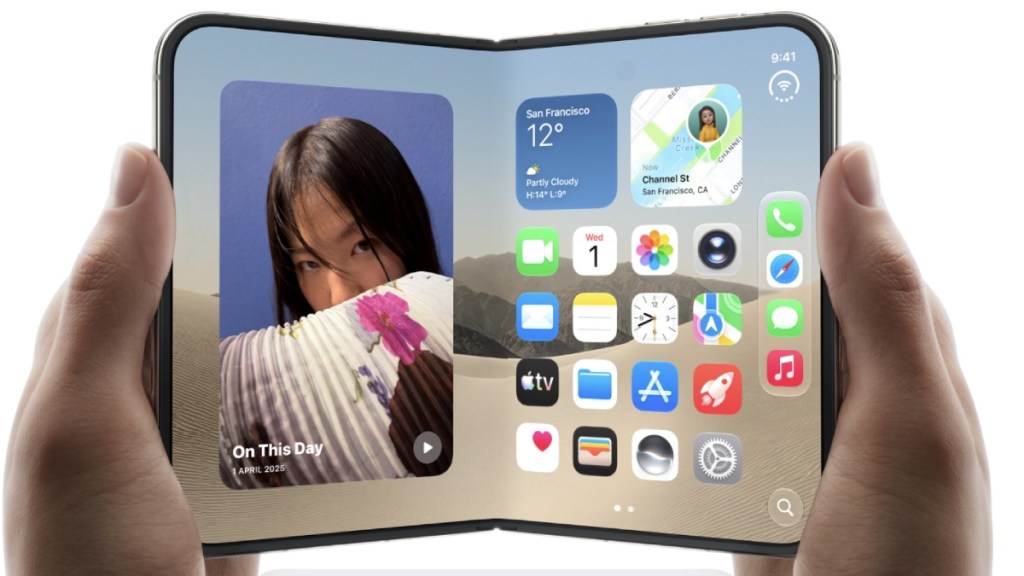

Apple’s maiden foldable smartphone is here, and it is not called either the iPhone Fold or the iPhone Ultra. It is the iPhone Duo, a name that is reminiscent of Microsoft’s Surface Duo from yesteryear. It looks a lot like Samsung’s Galaxy Z Fold 8 from afar, but it carries a price tag that makes Samsung’s Fold 8 seem like the bargain of the year.
Let’s look at the price first. The iPhone Duo starts at Rs 2.9 lakh. That’s almost a lakh more than what most of the competition offered this year. You pay even more for greater storage capacity.
iPhone Duo price and storage variants in India
– 256GB variant costs Rs 2,99,900
– 512GB variant costs Rs 3,24,900
– 1TB variant costs Rs 3,74,900
– 2TB variant costs Rs 4,49,900
The iPhone Duo will be available in Star White and Night Sky colourways. Note that Apple will start taking pre-orders in mid-October and deliver the first units by the end of October.
What is the iPhone Duo all about?
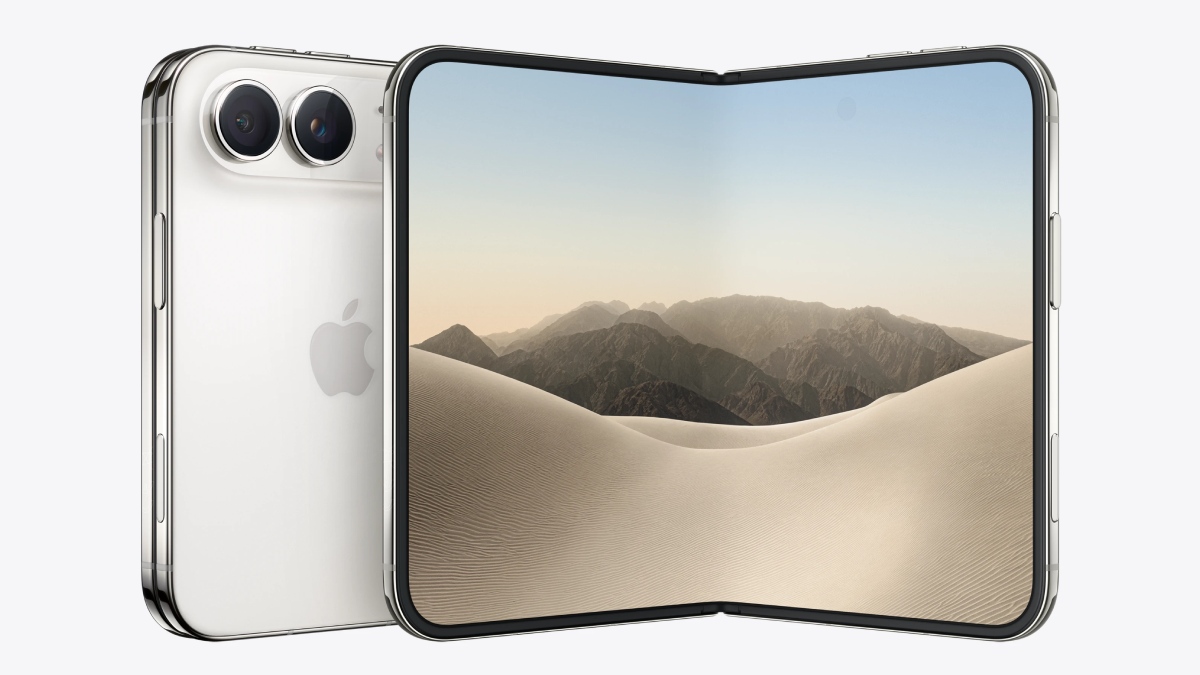
Apple said that it wanted to retain the familiar size and portability of the conventional smartphone while offering more productivity, which is why we see a widescreen display format. Hence, rather than treating a folding device as simply a smartphone that opens into a tablet, Apple’s form factor prioritises context-aware hardware and software integration.
Powered by the 2-nanometer A20 Pro chip and an adaptive version of iOS 27, the iPhone Duo shifts focus toward dynamic layout scaling, cross-display input support, and continuous ambient utility. The cover screen measures 5.4 inches, and the inner main display measures 7.6 inches.
iPhone Duo and its obsession with adaptivity
Unlike most foldables that run standard mobile interfaces stretched across a larger canvas, Apple says its implementation centres on an adaptive iOS 27 interface. The system dynamically shifts controls to peripheral edges as the hinge flexes, preventing hand strain and preserving unobstructed viewing areas. Something that Android foldables can learn and adapt.
Folded configurations also unlock dedicated tabletop modes with automatic spatial audio re-balancing across its quad-speaker setup. There’s also a standalone StandBy mode that operates as a desktop display without requiring an active charging source.
Dual-display stylus support
While Samsung dropped support for its S Pen stylus from the latest foldables, Apple has enabled support for the USB-C Apple Pencil across both its 5.4-inch cover screen and 7.6-inch inner display.
For authentication, Apple bypassed under-display camera cutouts in favour of a side-mounted Touch ID sensor embedded in the power button. The system supports multi-finger enrollment and integrated unlocking via a paired Apple Watch. Even Apple couldn’t embed facial recognition in its foldable!
Structurally strong design
The iPhone Duo’s chassis relies on a Grade 5 titanium frame housing a 100-plus component precision hinge. To protect the main internal folding surface, the display uses a laminated stack combining a titanium backing plate, a scratch-resistant polymer matrix, glass protection layers, and an anti-glare nano-texture cover layer. In simple words, the iPhone Duo is structurally strong.
Performance
The device is powered by the A20 Pro chip from the iPhone 18 Pro, manufactured on TSMC’s 2-nanometer node. To prevent thermal throttling across the foldable chassis during intense multitasking or gaming, Apple has integrated a custom-designed vapour chamber cooling system alongside a dedicated dual-display processing engine.
Smarter iOS 27
Running on iOS 27, Apple’s latest operating system introduces split-view capabilities that allow users to run two active apps side by side or open two separate windows of the same app. Deeply integrated Apple Intelligence and Siri AI features utilise local context to assist with on-screen content. Apple says that apps such as Zoom, Slack, Detail, and Netflix can make use of adaptive interface transitions to offer a premium user experience.
Battery with fast charging
Apple implemented a split dual-battery layout distributed across both halves of the titanium enclosure. Combined with the power efficiency gains of the 2nm silicon, Apple says that the architecture provides all-day battery life and supports high-peak brightness output of up to 3,000 nits across both panels. As far as charging is concerned, the iPhone Duo can charge up to 50 per cent in around 20 minutes or wirelessly charge up to 50 per cent in around 30 minutes. There’s support for MagSafe and Qi2 chargers.
Cameras
The camera layout on the iPhone Duo is driven by a 48-megapixel Fusion Main sensor with zero shutter lag, a sensor-shift optical image stabilisation system, and an integrated 2x optical-quality telephoto lens. It is complemented by a 48-megapixel Fusion Ultra Wide camera and a hidden under-display FaceTime camera on the inner screen. The folding design unlocks unique shooting modes, including hands-free tabletop capture, dual-screen preview modes for subjects, and direct integration with a physical Camera Control button – implementations we have seen previously.