


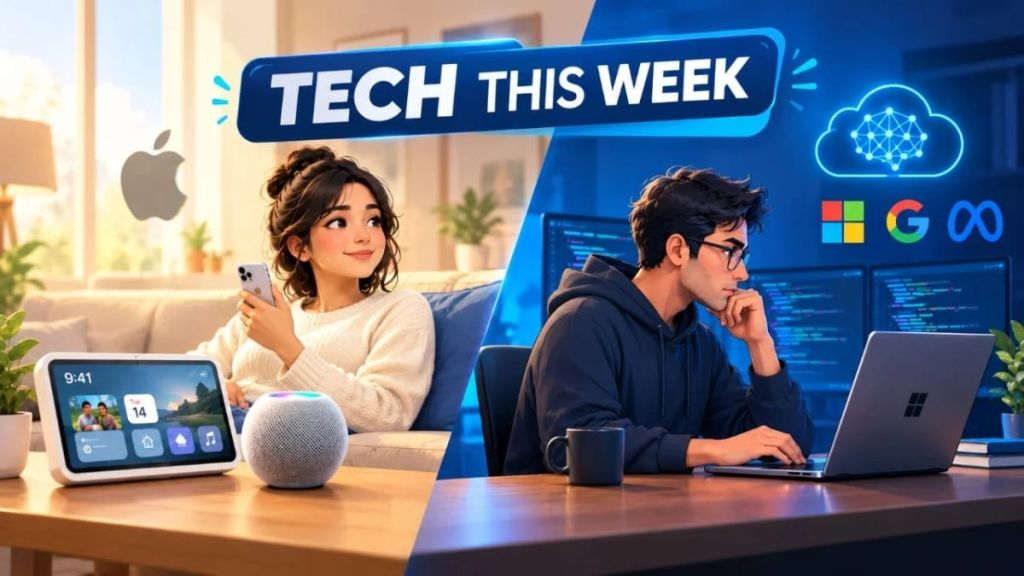

For twenty-five years, personal computing enjoyed a rare alignment: the laptop built for daily consumer use was also the primary machine for developers and hackers. When Steve Jobs put OS X on a Unix foundation, Apple unified mainstream software design with deep terminal utility.
That truce is showing visible cracks. In mid-October, the tech landscape delivered an unmistakable signal: personal computing is splitting into two distinct camps. On one end stands Apple, building seamless, closed appliances for the living room. On the other stand Microsoft, Google, and Meta, engineering open, complex AI runtimes for builders.
Tech For Domestic Use: Apple, HomeView, and Ambient Gadgets
Apple’s showcase this week put its domestic ambitions front and centre, turning smart homes from passive sensor networks into active command hubs.
Between analyst projections around the Apple HomeView smart display and our breakdown on whether the Apple HomeView is useful, the Rs 39,900 device signals a major strategic leap. Powered by Apple’s A18 silicon, the 7-inch hub incorporates multi-user facial recognition to surface individual calendars and widgets when recognised family members walk by, while defaulting to a neutral ambient clock and music dashboard for guests. It also functions as a native Thread border router and Matter controller capable of streaming up to nine live camera feeds simultaneously, with an optional Rs 6,900 wall mount.
Alongside it, the Apple HomePod Mini 2 made its long-awaited debut six years after the original. Repositioned at Rs 18,900 due to persistent global silicon constraints, the S10-powered compact speaker drops casual impulse-buy pricing to target committed ecosystem users. It introduces voice recognition for up to six household members, integrated temperature and humidity monitoring, Sound Recognition for smoke alarms, and modular surround pairing with Apple TV 4K across five colourways.
That consumer push is expanding across everyday lifestyle tech:
- Ambient Wearables: Amazon made a bold pivot into ambient hardware with its Amazon Bee AI wearables. Splitting the concept across two form factors—the $74.99 clip-on Bee Frontier and the $99.99 MagSafe card-sized Bee Eclipse with 21-day battery life—the devices passively record conversations, generating structured summaries and syncing calendar reminders while surfacing contextual shopping prompts.
- Affordable Audio: Nothing’s sub-brand seized consumer attention with the CMF Speaker M launch, introducing accessible, design-led personal audio tailored for festive shopping.
The Handset Dilemma: Ultra-Luxury Foldables vs. Everyday Flagships
The divide between practical utility and high-concept tech was most visible in mobile hardware, where folding devices faced intense scrutiny over whether form factors justify extreme price points.
Apple’s ultra-premium entry sparked debate over whether its steep Rs 2.99 lakh entry price delivers genuine daily utility:
- Buyers weighed the iPhone Duo trade-offs against standard Pro Max phones. Despite boasting a 2nm A20 Pro chip, Grade 5 titanium chassis, and dual-screen Apple Pencil Pro support across its 5.4-inch cover and 7.6-inch inner displays, the device trades away Face ID for a power-button Touch ID sensor and omits a telephoto camera.
- This dynamic crystallised in the iPhone Duo vs Galaxy Fold comparison. While the iPhone Duo sets benchmarks for gapless hinge design and IP68 durability, Samsung’s Rs 1,79,999 Galaxy Z Fold 8 undercuts it by more than a lakh. With an ultra-light 201g chassis, 45W charging, One UI 9 multitasking, and sharper computational zoom, Samsung demonstrated that an eighth-generation device often delivers better everyday ergonomics than a first-generation luxury experiment.
Outside foldables, conventional flagships pushed performance envelopes. While Oppo readied ColorOS 17 neural features on its next Find series, OnePlus previewed the upcoming OnePlus 16 flagship, packing a massive 9,000mAh battery, a 185Hz display, and a 200MP camera setup.
The Office Room AI
While Apple focuses on consumer hardware, its enterprise rivals are taking the opposite route: opening up the software engine to capture developer runtimes.
Microsoft used its hardware and Windows on ARM showcase to highlight deep silicon collaboration with NVIDIA. Under the RTX Spark architecture, developers get direct access to local neural processing units and graphics silicon on client machines, sidestepping closed-garden limits.
Meta complemented this shift with its release of Meta Muse Spark Open, touting it as an 816-billion-parameter mixture-of-experts model with a 1-million-token context window designed for coding and autonomous agentic loops. While freely downloadable for independent researchers on Groq and Hugging Face, Meta added a revenue threshold: businesses generating over $20 million annually must sign commercial licensing agreements to deploy API products.
Google is executing a two-pronged strategy of its own: pushing Gemini enterprise workflows to automate back-office operations, while partnering with Unity to embed generative design tools directly into 3D game engines.
Physical Pipes: Satellites, Drones, and Rockets
The battle extends beyond operating systems into real-world distribution networks:
- Extreme Mobility: Automotive tech collided with rocketry as details emerged around Tesla’s thruster-equipped Roadster. The vehicle integrates SpaceX-derived cold-gas thrusters housed behind the licence plate, promising sub-1-second 0–60 mph acceleration and brief flight capabilities ahead of a targeted 2028 production run.
- Satellite Broadband: Space tech heated up locally as Starlink’s India rollout plans prepare to challenge domestic telecoms like Reliance Jio and Airtel in the race for orbital internet delivery.
- Autonomous Delivery: Quick-commerce and delivery giants, including Zomato testing automated systems, are evaluating drone corridors to bypass peak-hour urban traffic bottlenecks.
- Launch Capabilities: Skyroot Aerospace secured fresh commercial launch contracts with US customers, while ISRO hit a key propulsion test milestone with its heavy-payload semi-cryogenic engine.
Security Boundaries and Regulatory Moats
As systems become more autonomous, security risks multiply. Check Point Research flagged a wave of QR-based email phishing specifically engineered to deceive automated enterprise agents and bypass multi-factor authentication. Meanwhile, critical software updates were issued to patch memory overflow vulnerabilities in Citrix NetScaler and file-read flaws in Atlassian deployments.
At the policy level, corporate calls for strict governance grew louder, matching India’s AI consultation framework and the Lancet Commission’s warnings on systemic model misuse. High compliance bars may keep enterprises secure, but they also serve as an effective moat protecting legacy players from lean, open-source challengers.
This Week’s Bottom Line
The era of a single platform serving ordinary households and deep-tech hackers has closed. Apple is building the definitive smart home appliance, while its competitors race to power the invisible developer infrastructure behind it. For buyers and builders alike, the technology you choose will increasingly depend on whether you want an appliance or an engine.