


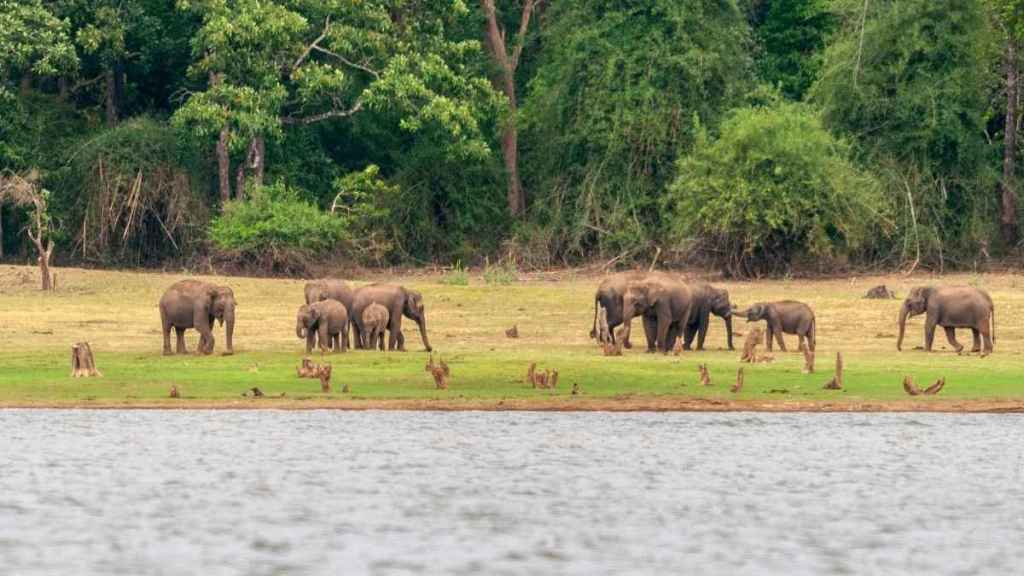

In India’s elephant corridors, artificial intelligence (AI) is being deployed to detect animals approaching villages and alert forest officials, while camera systems in protected areas are being used to identify species and monitor wildlife movements. From tracking elephants in Chhattisgarh to monitoring leopards along pilgrimage routes in Andhra Pradesh, conservation authorities are incorporating AI into efforts to manage human-wildlife conflict and process large volumes of field data.
In Jharkhand, the government announced plans in March to install AI-powered thermal cameras in vulnerable stretches of Dalma Wildlife Sanctuary and the Chandil and Chakulia forest ranges around Jamshedpur. The system is designed to detect elephants approaching human settlements and send real-time alerts to forest officials, who can warn villagers and dispatch rapid-response teams. The cameras are also intended to detect early signs of forest fires.
In Chhattisgarh, the Gajsanket app combines elephant-tracking information, geographical mapping and automated SMS, voice and WhatsApp alerts to warn communities about elephant movements. According to a July account published by NITI Aayog’s Frontier Tech initiative, reported conflict incidents in Udanti-Sitanadi Tiger Reserve declined from 445 in 2022-23 to 107 in 2024-25. The account attributes the change to a combination of interventions, including monitoring, forest management and enforcement, rather than the app alone.
In West Bengal, an AI-enabled camera-alert system has been studied in an elephant-conflict hotspot. A paper published in Conservation Science and Practice in November 2025 reported that the system detected 266 elephant events near villages and transmitted alerts in an average of about 42 seconds. The cameras recorded more than 33,000 human-detection events along routes used by elephants, providing data on the overlap between human activity and wildlife movement.
At Debrigarh Wildlife Sanctuary in Odisha, AI-enabled camera traps use a convolutional neural network to identify eight species, including gaur, leopard, sambar, spotted deer, wild pig, sloth bear and nilgai. Images are processed on the device, filtering wildlife records and reducing the number of photographs that require manual review. A central control room monitors feeds from surveillance equipment.
In Andhra Pradesh, the Tirupati Forest Division introduced an AI-based monitoring initiative in the Seshachalam Biosphere in September 2025. The deployment included 100 camera traps along the Alipiri footpath leading to Tirumala, alongside more than 30 solar-powered live-streaming cameras at strategic locations. The system was designed to monitor leopards and sloth bears.
The technology is also being used to process camera-trap images at scale. In March, Google reported that its open-source SpeciesNet model could classify nearly 2,500 animal categories. Trained on 65 million labelled images contributed by conservation partners, the model has been used by researchers studying species ranging from pumas and ocelots in Colombia to lions and elephants in Tanzania’s Serengeti National Park.
A separate study published in Science of the Total Environment in August examined SpeciesNet’s performance on Australian camera-trap images. Researchers analysed more than 2.18 million images from 454 camera deployments covering 121 species. Fine-tuning the model with locally collected images improved classification performance, with F1-scores often exceeding 95%.
In Australia, conservation partners used Wildlife Insights to process more than seven million camera-trap images from eight regions affected by the 2019-20 bushfires. The analysis identified more than 150 native species and helped researchers monitor animals including koalas, brush-tailed rock-wallabies and Kangaroo Island dunnarts across burnt and unburnt landscapes.
Another application is acoustic monitoring. AI systems can analyse recordings of forest soundscapes to identify animal calls, track species presence and detect sounds associated with illegal activity. Rainforest Connection uses acoustic sensors and machine learning to monitor forests for threats such as illegal logging.
Across these deployments, AI is being used for specific operational tasks where they are identifying species, tracking animal movements, transmitting alerts and analysing habitat changes. The systems depend on reliable field data, accurate detection and the ability of researchers and forest officials to verify findings and respond to information they generate.