


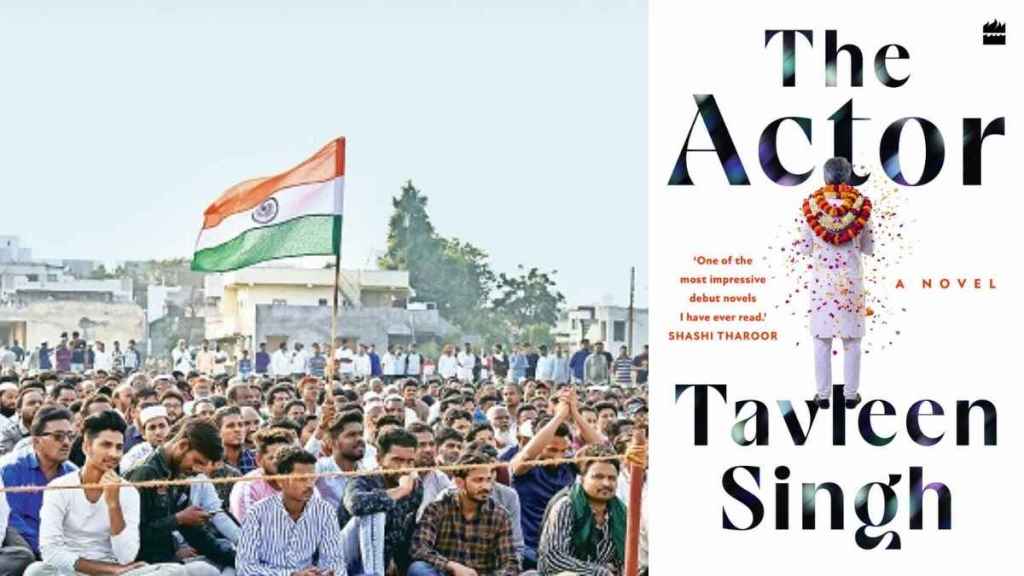

There is a lovely reversal at the heart of Tavleen Singh’s The Actor. Amit Singh, a fading Bollywood star, arrives at Assi Ghat in Varanasi to a crowd that has come, at least partly, to see him. He knows the highs brought by applause and crowds, and the power of a familiar face. Then his childhood friend Naresh Khanna begins to speak. Slowly, the crowd forgets the actor and listens to the politician. For Amit, it is an early lesson in his new world: politics has its own stage, its own stars and, as he is about to discover, its own dangers.
But the longer one stays with The Actor, the more one suspects that Singh is interested in something larger than the familiar idea that politicians perform. What happens when performance becomes power, when an image becomes an identity, and when a personality becomes larger than the institution that carries it?
Amit’s life is already coming apart when Naresh offers him an unexpected second act. Three films have failed, his marriage is falling apart and his fans are drifting away. Naresh, a two-term MP and Amit’s childhood friend, wants him to join a new political party committed to secularism, plurality and free speech.
What begins as an attempt by Amit to escape the ignominy of professional failure soon becomes an education in politics, history and the wounds of a country changing around him. Alongside Naresh is Maya, a discerning political journalist to whom Amit is instantly drawn, who becomes both his guide to this unfamiliar world and, eventually, something more.
There is politics in the book, citizen voices, drama, romance and sex. Many incidents and personalities feel uncannily recognisable, as though drawn from people and events we have seen or heard, with names changed, roles shifted and scenes woven differently for fiction. That is where the book’s central curiosity begins.
For an author who has spent decades as a keen observer of Delhi’s power corridors, Singh appears to have done something more intriguing than imagine a future India. The Actor feels almost “not-novel” in the literal sense of the word: not entirely freshly imagined. Is this really fiction about a future India, or an adaptation of Indian politics, with the names changed, storyline tweaked, the clock moved forward and fiction saying what journalism cannot?
Singh is careful about Guruji, the powerful political leader who dominates the novel. Yet readers are likely to play the guessing game anyway. Guruji is a former yoga guru who once lived in a Himalayan cave, has been elected prime minister four times, has built an extraordinary public persona and presides over a political order in which dissent and minorities increasingly find themselves under pressure. His politics is inseparable from personality.
The novel offers the clue that matters most: “It was his ability to build up a cult around his own personality that was his real skill.” That sentence makes Guruji more than a fictional antagonist. It captures how a leader can become the message, with loyalty to the person overshadowing institutions.
Fiction, however, allows readers to recognise the present inside an imagined future. This is where a comparison with Shashi Tharoor’s The Great Indian Novel becomes irresistible. Many years ago, Tharoor took the Mahabharata and recast its characters and epic conflicts as a version of the then Indian political life when he wrote the novel. Singh borrows the India she has spent a lifetime watching, moves it into a future only slightly removed from the present, and populates it with politicians, journalists, celebrities and power brokers.
One wonders how many of today’s political participants have found their way into The Actor. Yet reducing the book to a political identity quiz would do it a disservice. At its centre is Amit, whose journey from celebrity to politics becomes the emotional spine. He is Sikh by birth and carries a family history marked by Partition, but has lived largely outside the ideological battles consuming the country. His political education begins through people rather than theory. He discovers that the instincts that made him a successful actor — reading an audience, commanding attention and understanding the value of an image — have an unexpected use in politics.
Naresh is the person who opens that door. His concerns are strikingly ordinary: drinking water, electricity, roads, schools, hospitals and jobs. He asks why Indians should be promised tomorrow when so many still wait for basic improvements today. His travels through Uttar Pradesh and Bihar are also a search for a country beyond Delhi’s political vocabulary.
Then there is Maya, the political journalist who becomes Amit’s guide and eventually his lover. She may be the character through whom Singh’s Delhi comes most vividly alive. Maya belongs to the ecosystem of journalists, politicians and socialites whose lives overlap in drawing rooms, newspaper offices and power corridors. She knows how politics works because she has spent years watching it up close. She understands its risks before Amit does.
After the Assi Ghat rally, Maya warns Naresh about challenging Guruji. Naresh accepts the danger. Maya points out that she can afford to say so because she is not the one taking the risk. It captures the novel’s understanding of power. It is not merely exercised in Parliament or from a stage. It enters friendships, careers, bedrooms and private conversations, altering what people dare to say and what they are willing to risk.
Singh’s settings strengthen this sense of political theatre. Varanasi, the Ganga and the vast Assi Ghat rally are rendered cinematically. Delhi, with its flowering trees, old bungalows, guarded political residences and familiar social circuits, becomes more than a backdrop. Mumbai brings the machinery of celebrities and power into the frame. The movement between these worlds places the actor, politician and journalist on different stages.
The political world is strongest when Singh moves backstage. Speeches and rallies are only the visible part of power. Behind them are advisers, journalists, financiers, alliances, ambitions and private bargains. This is where her decades of political observation become an asset. Her knowledge of Delhi’s ecosystem gives the novel an insider’s texture without requiring the reader to know every real-world reference.
The title eventually becomes larger than Amit Singh. He is the obvious actor, but Guruji is performing too. Politicians perform, journalists interpret performances and crowds participate in them. That is what gives The Actor its contemporary edge. As a novel, The Actor is an absorbing read, with Singh letting her characters and their unfolding journeys carry the reader through its world rather than spelling out its meanings. Whatever one makes of the real-life echoes one may see in its characters, the book’s literary value lies in the story it tells and the world it creates.
Srinath Sridharan is an author and corporate adviser