


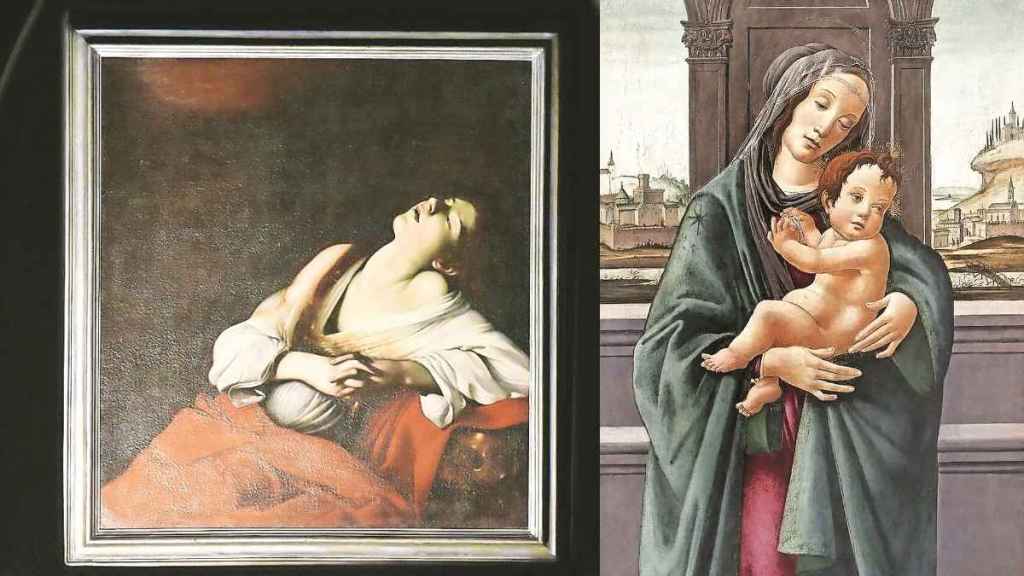

When Sandro Botticelli’s Madonna and Child arrived in New Delhi in June, it did more than bring a Renaissance masterpiece to India for the first time. On loan from the Museo Stibbert in Florence, the 15th-century painting is the highlight of One Mother, Many Mother Tongues, an exhibition at the Humayun’s Tomb Museum brought together 27 artworks and sculptures from museums and private collections in India and Italy.
At its inauguration, Italian Ambassador Antonio Bartoli described culture as “a vehicle for friendship and interaction between people and societies of Italy and India”, expressing confidence that it would foster “greater mutual understanding and ever and ever stronger bonds”.
From Botticelli and Caravaggio to Salvador Dali and Australia’s First Nations art, India is increasingly hosting internationally significant artworks that until recently were more likely to travel between museums in Europe, North America or East Asia. Behind the growing number of loans lies a deeper transformation of stronger museum infrastructure, maturing cultural institutions, expanding philanthropy and a recognition that India is an important cultural partner.
“There is a noticeable increase in international exhibitions, artwork loans and institutional collaborations involving India,” says Shefali Munjal, co-founder and patron, Serendipity Arts. “What is particularly encouraging is that these engagements are becoming more meaningful and multidimensional. They are no longer limited to presenting artworks; they increasingly involve research, education, public programming and long-term cultural exchange.”
Major showcases
The Italian exhibition is only the latest in a series of major international showcases. Earlier in 2025, Dali Comes to India brought more than 200 etchings, watercolours and tapestries from the Pierre Argillet Collection to New Delhi, offering Indian audiences one of the country’s largest exhibitions dedicated to the Spanish surrealist.
In the same year, the Serendipity Arts Festival in Goa exhibited Maddalena in Estasi (Magdalene in Ecstasy), a 400-year-old masterpiece attributed to Caravaggio. Rather than presenting it as a standalone attraction, the painting was displayed alongside contemporary site-specific installations, creating a dialogue between a 17th-century masterpiece and contemporary artistic practice.
According to Munjal, the exhibition attracted thousands of visitors, demonstrating growing public curiosity for international art when presented within broader cultural narratives.
The momentum was set to continue. The National Museum of Australia, in partnership with the Kiran Nadar Museum of Art (KNMA), brought Songlines: Tracking the Seven Sisters to Delhi. The exhibition, comprising nearly 300 paintings, objects, photographs and multimedia works, will be the first major National Museum of Australia exhibition to tour India after successful runs in the United Kingdom, Germany, France and Finland. “After its successful tour of Europe, we are delighted to bring Australia’s cultural treasures closer to home, and to India where ancient connections are deeply shared,” said Katherine McMahon, director, National Museum of Australia.
For KNMA founder Kiran Nadar, such collaborations represent more than exhibition-making. “The opening of Songlines exhibition in India marks a significant milestone in our ongoing commitment to cross-cultural dialogue and public engagement with art,” she said. “Through collaborations like these, we aim to deepen understanding and appreciation of shared human heritage.”
Industry leaders say India’s emergence as a destination for major international exhibitions has been years in the making. “What has changed is the maturity of the ecosystem,” says Munjal. “We now have stronger institutions, more diverse platforms for artistic engagement, greater private and philanthropic investment in culture, and audiences that are increasingly curious, informed and internationally connected.”
International loans, however, require much more than audience interest. “The practical considerations are substantial,” Munjal says. “Conservation standards, climate control, transportation logistics, security protocols and insurance requirements are understandably rigorous.”
Perhaps even more important is institutional credibility. “Beyond the technical and operational aspects, one of the most important factors is trust,” she says. “International loans are built on confidence in an institution’s ability to care for and present artworks responsibly.” That confidence has grown as Indian museums, festivals and private institutions have invested in conservation expertise and exhibition infrastructure over the past decade.
Reclaiming history
Yet not everyone sees the trend simply as importing foreign art. “I think it’s important to distinguish between bringing international art to India and bringing back histories of India that happen to have been created elsewhere,” says Ashish Anand, CEO and managing director, DAG.
“At DAG, our interest has never been in exhibiting international artists simply because they are international. Rather, we have consistently sought out artists whose work deepens our understanding of India’s artistic and cultural past.”
That philosophy has guided DAG’s scholarship for nearly three decades. Its exhibitions on William Hodges and Thomas and William Daniell encouraged Indian audiences to revisit artists who documented the subcontinent during the colonial period. More recently, Destination India brought together artists from Denmark, France, Germany, Holland, Japan and the United States, demonstrating how India attracted artists from across the world for nearly two centuries. “Their works now form an integral part of India’s visual heritage, regardless of where the artists were born,” Anand says.
He argues that this sustained scholarship has reshaped both public understanding and collecting patterns. “When we first began exhibiting artists such as William Hodges, Marius Bauer, Baltazard Solvyns and the Daniells, they were known largely to specialists and museum audiences abroad,” Anand says. “Today, there is a far greater appreciation among Indian audiences of their contribution to the visual history of India.”
Artists such as Edwin Lord Weeks, he adds, are increasingly finding Indian buyers, with works that once circulated largely through overseas markets now entering Indian collections and auctions.
The nature of international collaborations is evolving as well. “What I find most noteworthy today is the growing shift from transactional exhibition partnerships to long-term, collaborative cultural exchanges,” Munjal says.
Rather than simply lending artworks, museums are increasingly collaborating on conservation, research, artist residencies, education and public programming.
For international institutions, India is no longer just another stop on a touring schedule but an increasingly significant partner. “There is a growing interest among international institutions in building sustained relationships with Indian organisations rather than engaging through isolated projects,” Munjal says. “That reflects a broader understanding that some of the most exciting conversations around culture, heritage and contemporary creativity are increasingly taking place in and through India.”
Anand believes audiences have also evolved. “Ultimately,” he says, “the most significant change is that Indian audiences are no longer asking whether an artist is ‘Indian’ or ‘foreign’. They are asking a far more meaningful question: what does this work contribute to our understanding of India?”
That question may ultimately define India’s place in the global museum landscape. Botticelli’s Madonna and Child left Delhi for Bengaluru in August before returning to Florence. Other masterpieces will undoubtedly follow. But if the current momentum continues, it will be because the country has become a place where museums, governments and cultural institutions increasingly believe global artistic conversations should take place.