


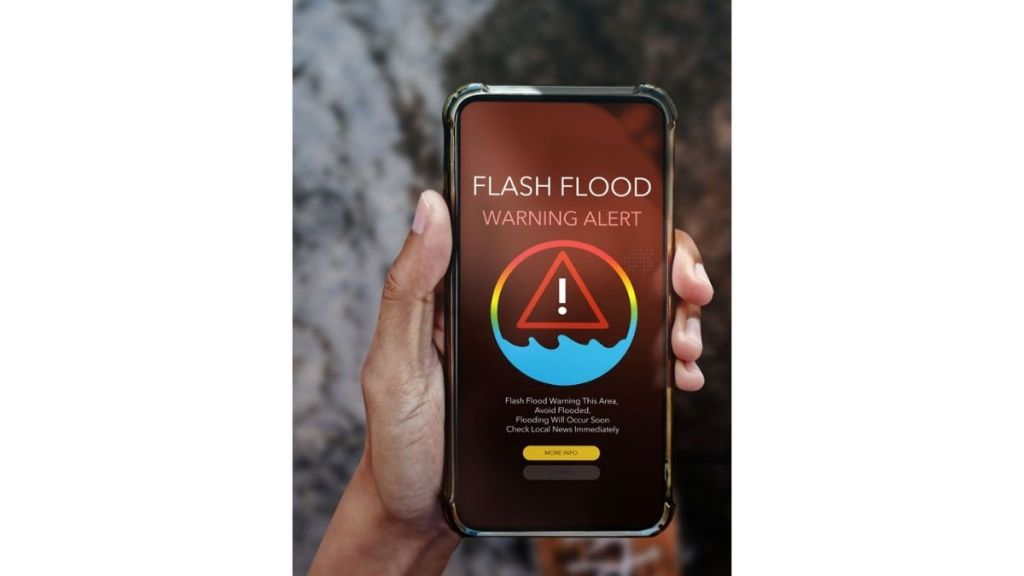

A shrill, shrieking sound emanating from your phone? You better be warned — a tornado, rainstorm or earthquake has probably been registered by the weather department. Emergency alert systems on smartphones are becoming a crucial part of disaster preparedness across the world — a way for governments and public welfare bodies, through mobile networks and phone manufacturers, to warn people about threats ranging from extreme weather incidents to earthquakes and public-safety emergencies.
At the heart of many government warning systems is ‘Cell Broadcast’, a technology that can send the same message simultaneously to phones in a defined geographic area. Unlike an ordinary SMS, cell-broadcast messages do not require authorities to know recipients’ phone numbers and are designed to remain effective even when mobile networks are congested. In India, this technology took a major step forward this year in April. The Department of Telecommunications said its indigenous Cell Broadcast Solution, developed by the Centre for Development of Telematics (C-DOT) with the National Disaster Management Authority and the Ministry of Home Affairs, has been rolled out nationally. The system supports all kinds of networks — whether it’s 2G, 3G, 4G or 5G — and is designed to deliver multilingual alerts to mobile users, including people who are roaming.
For Android phones, Google’s operating system includes wireless emergency alerts, which can display disaster warnings, threat notifications and, in supported countries, AMBER (America’s Missing: Broadcast Emergency Response) alerts. Android also includes emergency SOS, available on the Android 12 and following models. Depending on the device and configuration of it, pressing the power button five times can initiate an emergency call, notify emergency contacts, share location and begin other safety actions. Availability varies by country and handset.
Google’s Pixel phones add several safety services through the ‘personal safety system’. These include emergency SOS, safety check, crisis alerts, emergency location service and, on supported models, car crash detection as well. Pixel 4a and later devices, including Fold models, support car crash detection in India and 19 other countries including the USA, UK, France, Belgium, Ireland and Canada, among others.
As for Samsung Galaxy devices, they also provide wireless emergency alerts. Depending on the carrier, users can receive national, extreme and severe threat warnings, AMBER alerts, public-safety messages and test alerts. However, the exact options can differ between carriers, as per Samsung.
Apple’s iPhone uses a different but complementary system. Government alerts can provide warnings about imminent threats, extreme weather, public safety and other emergencies, and are generally enabled by default, although the categories and ability to disable them vary by country and network provider.
Apple has also expanded emergency capabilities beyond just the conventional broadcast warnings. Enhanced safety alerts, available in the United States and Taiwan on iOS 26.2 or later models, can provide additional warnings for natural disasters like earthquake and flood information through mobile data or Wi-Fi. For supported iPhone 14 and newer models, Apple offers emergency SOS via satellite. When cellular and Wi-Fi connections are unavailable, the phone can connect to satellites to communicate with emergency services, provided the user has a clear view of the sky. Availability remains country-specific — this satellite feature does not work on iPhones bought in Armenia, Belarus, mainland China, Kazakhstan, Kyrgyzstan, or Russia.
The expanding and evolving range of emergency alert systems means that the smartphone is increasingly becoming an emergency-information device and is not just restricted to a communications tool. However, users should not assume that every alert service works everywhere. Government infrastructure, carrier support, phone hardware, operating-system version and local regulations all impact availability of the facility. Emergency alerts work best when the technology is supported, enabled and understood before a crisis occurs.