


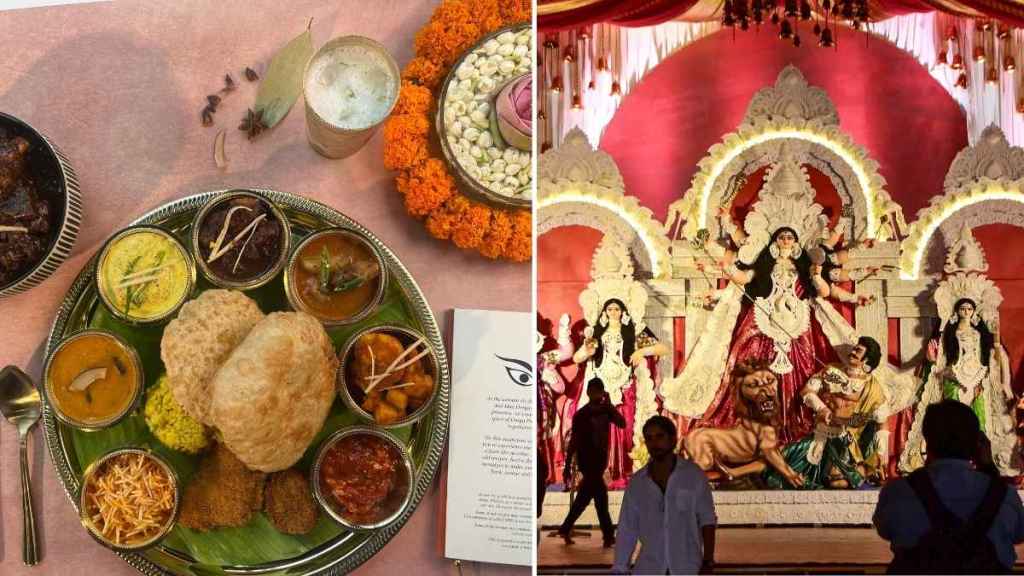

Durga Pujo arrives not only with the sounds of the dhak, the fragrance of shiuli flowers and illuminated pandals, but also at the dining table. Food is woven into the festival’s rituals and memories — from the comforting bhoger khichuri of Ashtami to elaborate family meals where fish, meat, fried snacks and sweets take centrestage. Yet many dishes associated with Bengali feasting have histories that extend well beyond Pujo.
The festival table itself carries these layers. The vegetarian bhog — typically khichuri, labra, chutney and payesh — represents the ritual side of the celebration, while elaborate home meals bring fish and meat into the festivities. Over generations, dishes that were not necessarily created for Pujo have acquired a place in culinary memory. Kosha Mangsho is one such dish. Its name comes from koshano, the slow process of cooking meat with onions, spices and aromatics until the mixture darkens and the oil separates. Its lineage reflects Bengal’s engagement with Mughal cooking, but the Bengali version developed its own character through pungent mustard oil, dark spices and slow cooking. During Pujo, it is served with luchi, making it an emblem of indulgent Bengali feasting.
Fish, meanwhile, speaks to Bengal’s relationship with its rivers and landscape. Paturi is an ancient indigenous cooking technique, deriving its name from paata (leaf). Fish and other ingredients were wrapped in leaves and steamed or dry-roasted, allowing them to cook gently while absorbing the leaf’s aroma. The technique is associated with eastern Bengal, where hilsa was commonly used. In Kolkata, the availability of sweet, firm bhetki gave rise to Bhetki Paturi. Mustard paste, mustard oil and spices are layered over the fish before it is enclosed in banana leaf and steamed.
Loitta Maach Bhaja, made with loitta or Bombay duck, represents a simpler strand of the cuisine, associated with Bengal’s coastal and eastern food traditions. Unlike elaborate fish preparations, the dish relies on minimal seasoning and careful frying, allowing the distinctive flavour and delicate texture of the fish to remain at the forefront. It reflects a broader Bengali culinary principle: letting the primary ingredient speak for itself.
The story of Bhetki Fry, breaded and fried fish, is linked to colonial Calcutta and the rise of the city’s cabin culture. Places such as Mitra Cafe and Chitto Babur Dokan helped popularise the dish, which later moved from old Kolkata’s cabins to wedding feasts and celebratory meals. Kasundi and sliced onions became its indispensable accompaniments. Pujo cuisine also draws its character from seasonal produce, lesser-known cuts and simple home-style cooking. Phulkopi ar Motorshutir Roast, made with cauliflower and green peas, reflects the importance of seasonal winter produce, while Mete Chorchori, prepared with liver and potatoes, showcases the Bengali kitchen’s resourceful use of different cuts.
For Kaushik Misra, executive chef, Taj Mahal Hotel, New Delhi, food and Pujo remain deeply connected to childhood. “I grew up in Bengal, surrounded by the sights, sounds and flavours of Pujo. For me, Pujo is a time of reverence, nostalgia and homecoming. The street food and pandals take me back to my childhood, while the Ashtami bhoger khichuri brings a sense of warmth and homeliness, along with a deep spiritual connection to Ma Durga,” he says. As Ankit Pahuja, executive chef, The Park Kolkata, says, “Bengali cuisine is a reflection of our region’s rich cultural heritage, shaped by seasonal ingredients, local produce and generations of culinary wisdom.”
And then there is mishti. The history of Bengali confectionery was transformed by the introduction of chhana, with the Portuguese credited with bringing the technique of splitting milk with acid in the 16th-17th centuries. Bengali confectioners turned the ingredient into an elaborate repertoire of sweets. Bhapa Sandesh represents its gentler side. Instead of directly caramelising chhana in a pan, the mixture is steamed, resulting in a soft, moist sweet.
BHAPA SANDESH
Ingredients
Full-fat milk (for fresh chhana) – 2 ltr
Lemon juice or vinegar (diluted in
50ml water) – 3 tbsp
Powdered sugar or Nolen gur
(date palm jaggery) – 100 gms
Green cardamom powder – 0.5 tsp
Saffron strands – 10-12
Warm milk (for soaking saffron) – 15 ml
Ghee (for greasing the mould)
Chopped pistachios & almonds
(for garnish)
Method
- For the chhana: Bring milk to a rolling boil. Stir in diluted lemon juice/vinegar and immediately switch off the flame. Let stand until curd and whey separate clearly.
- Strain through cheesecloth, rinse under cold running water to remove acid residue, and hang for 40 minutes to drain off all excess moisture.
- For the mix: Transfer chhana to a wide plate and knead using the heel of the palm for 6-8 minutes until completely smooth, glossy, and grain-free.
- Incorporate powdered sugar (or Nolen gur), cardamom powder, and soaked saffron milk. Mix until a homogenous, velvety paste forms.
- For steaming: Grease a flat, heat-proof steel container with ghee. Spread the prepared chhana mixture evenly into the container, smoothing the top with a spatula.
- Garnish with chopped pistachios and almonds.
- Cover tightly with a lid or aluminium foil. Place the container in a steamer (or inside a pot on a stand with 1-2 inches of simmering water).
- Steam over low-to-medium heat for 15-18 minutes. Remove, allow to cool completely to room temperature, and chill in the refrigerator for 1 hour to set before unmoulding and slicing into squares.
— Recipe by chef Kaushik Misra, Taj Mahal Hotel, New Delhi