


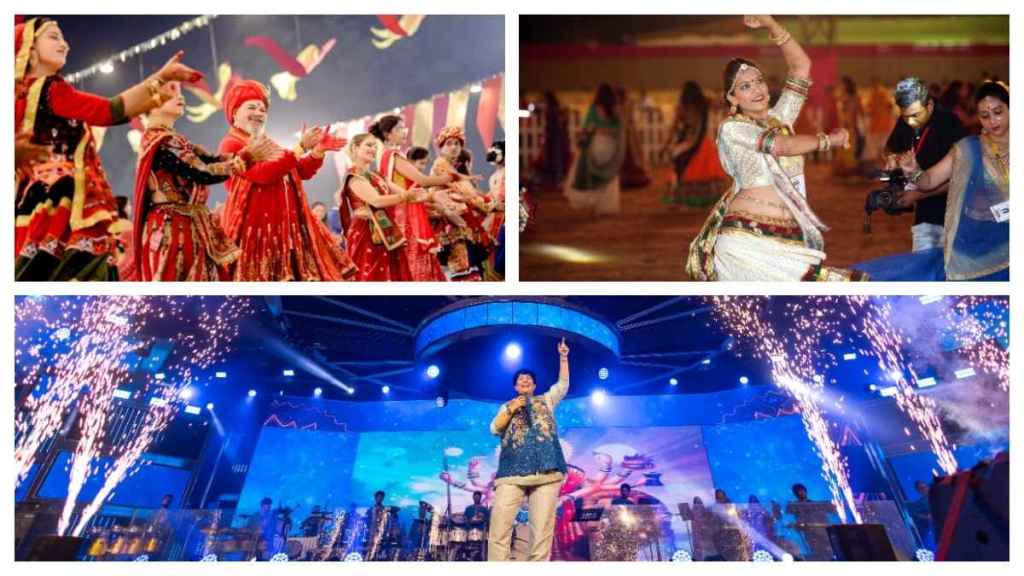

After a gruelling day’s work at the Faculty of Fine Arts, MS University of Baroda, Vadodara, Rutvij Mistry is eager to rush back home. Not to enjoy much-deserved rest, but to get ready to head to the garba ground.
The 51-year-old assistant professor in the Department of Sculpture has been performing garba since the age of six years. His enthusiasm and reverence for Goddess Amba have only grown with each passing year.
Performing in concentric circles alongside men and women, he is a delight to watch. With a smile on his face and dressed in layered traditional attire, his energy levels remain unchanged until the sound system goes silent for the night. “I do not know how I manage to do this. It is a blessing from God,” he says.
Mistry takes at least two hours to get ready. But before that, he performs a long ritual before the goddess. His outfits, each costing between Rs 10,000 and Rs 35,000, are never repeated. He mixes and matches them, pairing a dhoti with a layered dress, jacket and pagdi.
His night ritual is just one expression of a festival that has grown far beyond the garba ground. What was once primarily a community celebration has evolved into a large seasonal economy, bringing together performers, venue owners, food vendors, fashion businesses, transport operators and event organisers.
Mistry is not an exception. Today, you will find lakhs of girls and boys, men and women — each having a different reason to celebrate the nine-night-long Navratri festival.
The words garba and dandiya are synonymous with each Gujarati household and, for that matter, anyone who is in touch with Gujaratis. Much like the Gujarati community that has spread across the country and abroad, garba and dandiya have also become a permanent fixture on the annual cultural calendar wherever they have made their presence felt.
While the scale at which garba and dandiya are organised across the country and abroad has increased year-on-year, in Gujarat alone, the garba industry is estimated at Rs 15,000 crore. “It is growing at a CAGR of 33%,” says Kalash Shah, founder and CEO of LIT Growth Agency that organises the AadhyaShakti Garba celebration in Ahmedabad. The venue can accommodate 4,000 people at a given time.
What began as a celebration rooted in Gujarat over the years has spread geographically. From Ahmedabad and Vadodara, the garba economy now stretches to Mumbai, Bengaluru, Delhi-NCR, Hyderabad, Pune and Kolkata, and has even made inroads into tier-2 cities such as Indore, Lucknow, Patna and Bhopal.
Beyond India, the festival has travelled with the Gujarati diaspora to the US and Canada, where garba nights have become an established part of the festive calendar.
Shoven Shah, founder and CEO of TribeVibe Entertainment, says they have seen the evolution first-hand through the way they produce and promote Navratri experiences with some of the country’s most iconic artistes — “from Falguni Pathak’s landmark move to the Jio World Convention Centre in Mumbai to Aditya Gadhvi’s Rang Morla, his 10-day, 10-performance season in Ahmedabad”.
The scale of this evolution is also reflected in the response from audiences. Radiance Dandiya Navratri Utsav 2025, for instance, featuring Falguni Pathak, recorded over 100,000 attendees across 10 days, and Rang Morla featuring Aditya Gadhvi crossed 60,000 footfalls across cities.
According to Shah of LIT Growth Agency, the ‘A’ category artistes can command a price of Rs 25 lakh per day, which includes the chorus and other junior performers too. Depending on the size of the venue, the rental for the space can vary from Rs 4 lakh to Rs 35 lakh.
Dilip Thakkar, co-chapter head of Ahmedabad for the National Restaurant Association of India, remarks: “It is a business for the party plots, which otherwise are vacant other than the marriage season.”
According to him, the cafes near the garba venues do brisk business, and those spending Rs 10,000 per day in setting up a food stall can earn up to Rs 50,000 per day.
When the event is on a larger scale and the stakes are higher, there are willing takers for the tickets at premium price points. In Mumbai, the standard price of a pass hits Rs 20,000 per day, and in the case of a luxury event, it can even be Rs 2 lakh per person. In the premium packages, the participant is even driven to the garba venue in a chauffeur-driven car. The reveller is also provided with food and other VIP facilities and dropped back home.
Jio World Convention Centre and the garba events at Borivali and Goregaon have become huge attractions. In a city like Mumbai, sponsors look for high conversions. Artistes like Falguni Pathak command a high price, and enthusiasts do not mind paying a premium.
In Ahmedabad and Vadodara too, prices hit the roof. At Safed Parindey, an ultra-luxurious, all-white themed garba event held in the capital city of Gujarat, the price per day per person is around Rs 15,000. For a group of 10, it can go up to Rs 2.75 lakh that includes a gazebo with pickup and drop-off, a foot massage, private dining and even security.
At the Lukshmi Vilas Palace Heritage Garba in Vadodara, VIP tickets can cost anywhere from Rs 14,000 upwards per night to a VVIP dining table costing Rs 1.21 lakh. The latter includes a host of other services.
The business is also about giving garba coaching classes ahead of the festival to brush up the steps and to learn a few new things every year. In Bhopal, choreographer Pratap Rajput and his team from Pinaak Entertainment Agency in Ahmedabad have been teaching individuals who will perform at a five-night event organised by a media house this year. “Up to 4,000 boys and girls have registered,” he says. The month-long coaching costs Rs 3,200-Rs 3,400 per person. Their team coaches garba enthusiasts in Indore as well.
Every year, Rajput says he has seen the scale increase. “Apart from these 4,000 participants, who will perform choreographed garba steps, non-participants will also take part in the garba event,” he adds.
Makeover salons and beauty parlours also see a rise in footfalls, especially in metro cities and tier-1 cities. However, it is the business of rental ensembles that takes the cake. Pooja Barde, 28, is busy doing last-minute fittings and coordinating deliveries these days. Barde rents ensembles through her RentyourRunaway store. She started adding chania cholis and dupattas to her already successful wedding collection in 2023. “It is the age of social media. Youngsters do not wish to repeat the dresses. After all, they have to put the photographs on social media,” she observes. Her outfits can cost anywhere from Rs 1,000 to over Rs 3,500, including jewellery, per night. She personally goes to places like Ahmedabad and Surat to source the materials and gets them stitched in Bhopal.
And there is no dearth of takers for such outfits. NRIs are no exceptions. “About 50% of my revenue from the sale of chaniya cholis and dupattas come from the purchases made by NRIs,” says Kavita Shah of Bijouri’s, a 38-year-old brand of ethnic wear in Ahmedabad. “They love our stuff because it is pure cotton and does not get old. Most importantly, it stands out from the rest,” she remarks.
For those wanting to pay a premium for an experience, there are AC dome venues and sprawling party plots across Gujarat and Mumbai. The revellers also have the choice of choosing the venues based on where their favourite artistes — Falguni Pathak, Parthiv Gohil, Jigardan Gadhavi, Atul Purohit, Sachin Limaye, Aditya Gadhvi, Osman Mir, Gita Rabari, Kinjal Dave, Kirtidan Gadhvi, Aishwarya Majmudar, Ishani Dave, or Praful Dave — are performing.
“Where one wants to go and where one can afford to go does not diminish his or her excitement for garba,” says Radhikaraje Gaekwad of Vadodara’s royal family and organiser of the Lukshmi Vilas Palace Heritage Garba in Vadodara.
Meanwhile, in Tirupur, Tamil Nadu, the Gujarati community gets together to enjoy the festival every year. Satish Nagda, secretary of Shri Gujarati Shubhechhak Mandal, says: “Traditional garbas are played, and we also organise a havan during the festival.” The community organisation has been holding the festival for the past 75 years.
Similarly, in Ernakulam, Shri Cochin Gujarati Mahajan has been organising garba for over a century. “Members of the samaj are allowed to take part in the event. Singers perform free of cost,” says Jitendrakumar Jain, president of the organisation.
In fact, places like Tirupur and Ernakulam provide a counterpoint to high tickets in metros and tier-1 cities. Interestingly, Ahmedabad has one event — Navshakti Navratri — where the father-son duo of Praful Dave and Hardik Dave perform. There is no fixed price for the pass, and the entire event is curated by the volunteers.
Bengaluru, too, has several such events, one of them hosted by Shree Bangalore Vaishnav Samaj Charitable Trust & CTT Trust. The celebrations include disco dandiya and a performance by Bhoomi Trivedi and her troupe.
Meanwhile, online ticketing and event discovery platforms such as BookMyShow are also seeing a significant growth in Navratri experiences. Anil Makhija, COO, live entertainment & venues, BookMyShow, says, “Navratri experiences are witnessing over 25% growth year-on-year, reflecting the growing appetite for large-scale festive experiences.”
“Garba has become a nrityotsav. Earlier, people performed garba by clapping, snapping fingers and jumping. Now, you do not find people doing this,” observes Tushar Shukla, an award-winning poet and Padma Shri awardee. “The way garba has changed, and if you consider it as a festival, then you will feel happy,” he quips.
These days, especially in Gujarat, social media is flooded with messages about renting a partner for garba. The charges start at Rs 1,500, depending on the number of hours the person wants to spend with him or her. The partner takes care of one’s purse, helps one take photographs, teaches garba steps and even drops one home.
Before the nine-night festival, artistes also perform in the US and Canada. Ratri before Navratri and Ratri after Navratri — one night events — are common, and they see good participation. An organiser says, on the condition of anonymity, that in Canada, the ticket prices can vary from CAN $15 per person to CAN $65, depending on the scale of the garba and the artiste.
And if you thought that was it, then hold your breath. For the past three years, Ahmedabad has been hosting one-night garba for pets and pet parents as well. Khyati Shah of Pannkh, a boutique store for pets, one such organiser, says, “It is an opportunity for the pets and pet parents to get together. We ensure that the sound is kept at an appropriate decibel,” she adds.
Clothes for the pets begin at Rs 2,000 and can go up to Rs 7,000, says Shah, whose store even designed clothes for the Ambanis’ pet during the wedding celebrations of Anant Ambani.
Pet parents also try to do twinning with their pets. “A pet parent’s outfit can cost anywhere from Rs 7,000 to Rs 50,000,” Shah adds.