


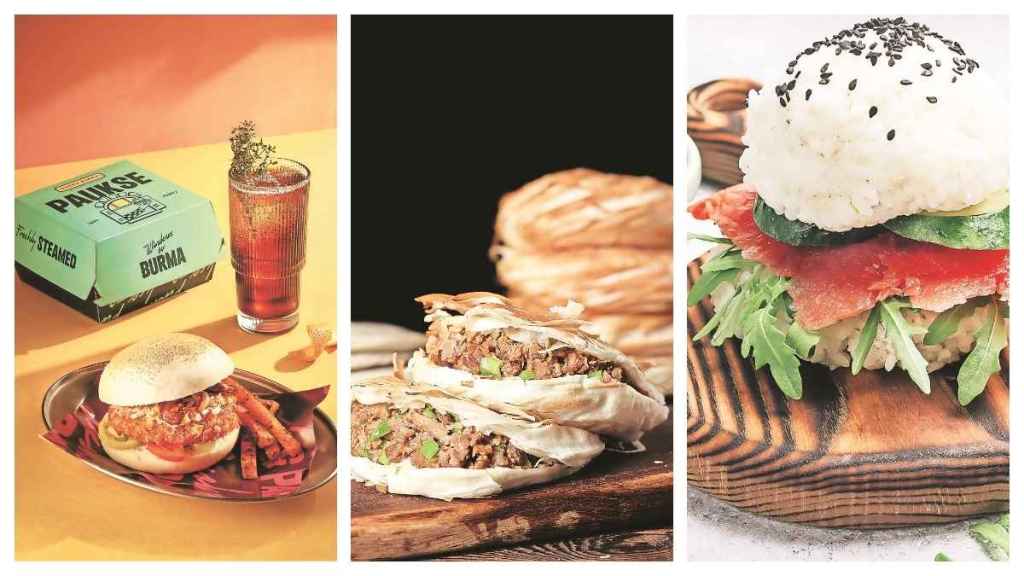

If you thought the burger is a western construct, you need an introduction to Asian versions that range from Japanese rice buns to Burmese steamed wheat versions, Chinese flatbreads, Korean burgers topped high with local flavours, or the very Indian vada pav.
The burger may have travelled across the world in its familiar bun-and-patty avatar, but across Asia it is more a format than a fixed recipe. Rice can replace bread, traditional flatbreads can become buns, local sauces can replace ketchup and mustard, and street-food favourites can find a new life between two halves of a sandwich. Japan’s rice burger replaces the conventional wheat bun with compacted rice patties.
China offers a much older interpretation in Roujiamo, where slow-cooked, seasoned meat is tucked into a wheat flatbread. Another variation, Kaoya Roujiamo, uses roast duck as its filling. Turkey’s Islak Hamburger takes a different route: the beef burger is coated in tomato sauce and steamed, creating its characteristic soft texture. In Korea, burgers are paired with kimchi, gochujang, bulgogi and Korean fried chicken, bringing spicy, fermented and umami-rich flavours to the format.
Southeast Asia has its own variations. Indonesia has rendang burgers, while sambal adds a local kick. In the Philippines, different sauces and local toppings reflect the country’s preference for balancing savoury and sweet flavours. Singapore and Malaysia have seen burgers incorporating satay, sambal and regional sauces. Burma brings another dimension. At Burmese tea shops, PaukSe, steamed buns, and Palata, flaky flatbreads, are everyday staples eaten with curries, fillings and tea. Palata carries a south Indian influence, while PaukSe reflects East Asian connections. This tea-shop culture inspires restaurant chain Burma Burma’s PaukSe and Palata menu. “PaukSe and Palata were chosen because they are an integral part of Burma’s everyday tea shop culture — simple, comforting breads traditionally enjoyed with curries, tea and conversations,” says Ankit Gupta, co-founder, Burma Burma.
India did not simply adopt the burger. It Indianised it. Over the years, the western fast-food staple has been reworked for the Indian palate. The beef patty was never central to the country’s burger story; instead came aloo tikki, paneer, vegetable and chicken fillings. Ketchup made room for mint, coriander and tamarind chutneys, while tandoori, Schezwan and achari flavours reshaped the burger.
Even global chains had to adapt. McDonald’s India built a substantial part of its menu around vegetarian offerings such as the McAloo Tikki and McVeggie. The McAloo Tikki, with its spiced potato patty, is a clear example of localisation: the global burger format remains, but the flavour profile is unmistakably Indian.
India’s street-food culture offers an even more interesting parallel. Vada Pav is not technically a burger, but its soft pav, crisp potato vada and punchy garlic, green and tamarind chutneys deliver many of the qualities that make the burger successful: portable, affordable, filling and designed to be eaten by hand. The burger is definitely global, but in Asia, it speaks a very loud local.