


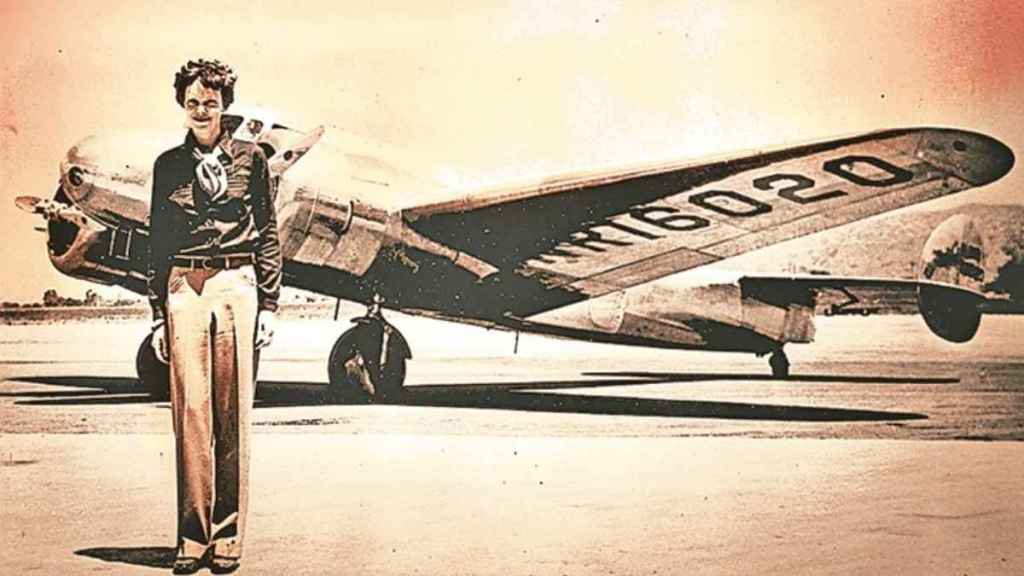

Nearly nine decades after American aviator Amelia Earhart vanished over the Pacific, a new expedition is chasing a fresh clue. Her disappearance remains part of a wider history of a missing aircraft, still unexplained detours and unanswered questions.
Earhart’s aircraft went down in 1937, in the Republic of Kiribati, an independent island nation in the central Pacific Ocean. Several attempts have been made to unravel exactly where and how Earheart and her navigator Fred Noonan disappeared, but to no avail.
As per the new expedition to Nikumaroro, a tiny island in the Republic of Kiribati, a 17-member team has embarked on a mission to investigate a possible aircraft wreck believed by some to be the remains of Earhart’s Lockheed Electra. The team reached the atoll on October 12, after a five-day, 830-nautical-mile voyage, hoping to determine whether the submerged object corresponds to a shape visible in satellite imagery. But the interpretation is disputed, and until physical evidence emerges, the mystery remains open.
Eight years after Earhart vanished, another group of American aviators disappeared under circumstances that would fuel decades of speculation.
Flight 19 and its disappearance over the Bermuda Triangle is another one for the books.
On December 5, 1945, five US Navy TBM Avenger torpedo bombers, popularly known as Flight 19 collectively , took off on a routine training mission over the Bahamas. During the flight, the pilots reported navigational difficulties and confusion over their position. As daylight faded and weather conditions deteriorated, communications became increasingly alarming. The 14 airmen aboard the five aircraft were never found. The incident became closely associated with the Bermuda Triangle, the loosely defined region of the Atlantic Ocean often linked to mysterious disappearances.
During the Korean War in 1951, a Douglas DC-4 aircraft took off from Vancouver, Canada, on a flight to Tokyo, to assist in the Korean Airlift. Carrying 31 passengers and a six-person crew, the airliner encountered rain, low visibility and icing conditions as it approached Anchorage in Alaska, for a refuelling stop. The plane had reported no issues as it checked in near the Alaskan panhandle about 90 minutes from arrival. However, that plane would never be heard from again. American and Canadian rescue teams searched for months but found no traces of wreckage.
During the Vietnam War in 1962, 93 US Rangers were dispatched on a secret mission, aboard a charter flight headed to Saigon. After a refuelling stop in Guam, the aircraft never arrived at its next stopover in the Philippines, even despite perfect flying conditions. The disappearance sparked the largest peacetime air-and-sea rescue mission in the Pacific Ocean since Earheart vanished in 1937. The 1,300-person search party scoured 144,000 square miles and turned up nothing.
Sabotage was considered among the reasons for the disappearance of the plane, given that another Flying Tiger plane had crashed in Alaska only hours earlier, killing one of the seven people aboard. But the Civil Aeronautics Board ultimately could not determine a probable cause because of the lack of any recoverable evidence.
Among the recent aviation mysteries, the disappearance of MH 370 on March 8, 2014 stands out most starkly. The Boeing 777 was travelling from Kuala Lumpur to Beijing with 239 people aboard when it disappeared. Satellite communications suggested that the aircraft continued flying for hours, most likely towards the Indian Ocean. MH370 is perhaps the most unsettling of aviation’s great disappearances precisely because it occurred in an era of satellite tracking, digital flight systems and global communications. Pieces of debris believed to belong to the aircraft later washed ashore on islands in the western Indian Ocean and along the African coast, but they did not resolve what caused the flight to deviate from its route or why it disappeared.
The appeal of these mysteries lies in the space between what is known and what can only be imagined – between what machines and warning powers can do, and what nature takes upon herself. Somewhere beneath the Pacific, in the depths of the Indian Ocean or across an unmarked stretch of wilderness, the evidence may still exist.