


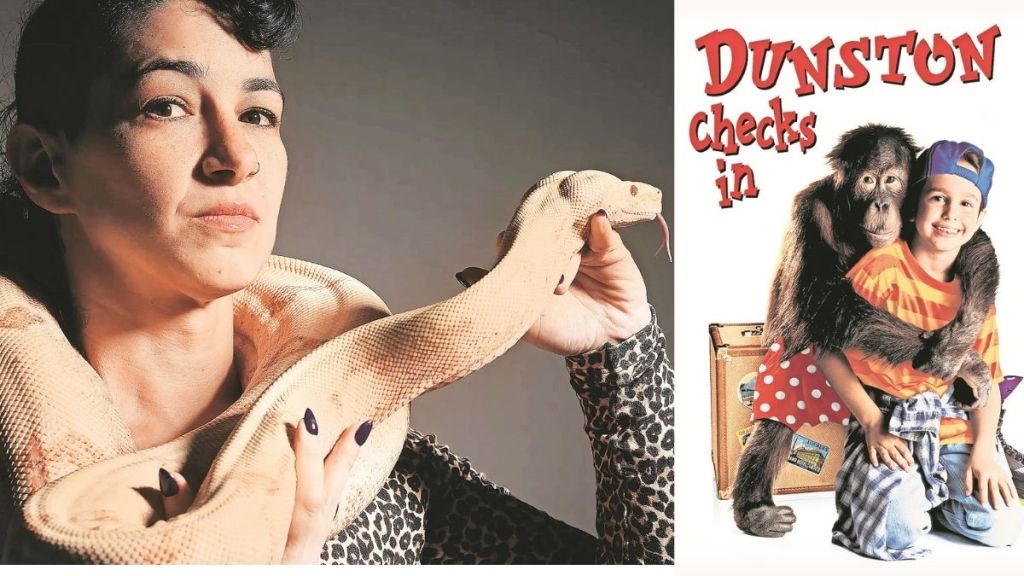

The road to stardom can be a slippery one, quite literally. At New York’s Metropolitan Opera, even the snakes have to audition.
For its production of Mozart’s Così fan tutte, relocated to a 1950s Coney Island carnival, the Met needed a snake for a memorable stage appearance. Several boas were put through the test by Zoe Ziegfeld, the production’s snake handler and a former Coney Island carnival performer. The reptiles were observed slithering, wrapping around their handler and being lifted above her head under simulated stage conditions. But there was only one successful candidate — Princess, a large, striking sun-glow boa constrictor. Her size, colour and calm temperament won her the part. It may sound whimsical, but animal casting is serious business. An animal cannot read a script, hit a mark because a director shouts ‘Action!’, or be persuaded to repeat a brilliant performance simply because the first take went well. Trainers and filmmakers have to work around an animal’s natural behaviour, and establish whether that particular animal is comfortable enough to work at all.
“Animals have to perform as do human talent,” animal supplier Nancy Novograd, who supplied the Met’s snakes, explained in a news report. Sometimes an animal has to demonstrate a particular behaviour or its qualification is being able to remain calm around lights, cameras, music and people.
Hollywood has been conducting versions of these auditions for decades. Animal talent agencies match scripts with creatures that have the right breed, appearance, temperament and training. These days, casting may begin with photographs or videos. But animal auditions have sometimes been considerably more literal. In 1961, for instance, Hollywood held what became known as the ‘Black Cat Cattle Call’ for an Edgar Allan Poe adaptation. Some 152 black cats auditioned for Tales of Terror, released in 1962. Cats with white paws or noses were rejected, as were those deemed too friendly. The filmmakers selected animals whose faces looked suitably sinister.
The process becomes more complicated when the animal has to carry a film. The best example is Dunston Checks In, the 1996 comedy about an orangutan who causes chaos inside a luxury hotel. The central character, Dunston, was played by Sam, a real orangutan. Rather than teaching him to ‘act’, trainers built performances around cues, repetition and rewards. For complicated sequences, production teams relied on mats, specialised sets, stunt substitutes and mechanical effects to keep the animal safe and make scenes repeatable.
Babe, the 1995 film about a pig who wants to become a sheepdog, presented a bigger logistical challenge. The production required pigs, dogs, cats, ducks, horses, mice, a cow and hundreds of sheep. According to the Los Angeles Times, 58 trainers worked with more than 900 animals. The larger point is that an animal audition is rarely about asking, “Can this creature act?” But asking, “Can this creature safely and reliably do what the scene requires?”
As for the recent film Sinners, timber rattlesnakes were selected through video auditions. Their work came with a level of safety planning, a trained handler, medical support and emergency extraction procedures were required on set.
Dogs have also become some of the most recognisable animal performers in cinema. Bing, the Great Dane in The Friend, was selected not merely for his appearance but for his ability to perform specific behaviours and emotional-looking cues. Max, the scruffy dog who played Milo alongside Jim Carrey in The Mask, became a memorable comic performer. Uggie, the Jack Russell Terrier from The Artist, became so celebrated that he won the Palm Dog Award at Cannes.
Then there is Crystal the Monkey, whose film and television career included The Hangover Part II and Night at the Museum. She became one of Hollywood’s best-known animal performers, proof that an animal does not necessarily need dialogue to steal a scene.
Live theatre creates its own challenges. Opera companies have needed dogs for productions such as La Bohème, where the animals must remain composed despite powerful voices, orchestras, stage movement and bright lights. Cats have performed in specialised theatre and variety acts, including the Savitsky Cats, known for elaborate routines involving jumping, climbing and balancing. Even pigs have been trained for stage acts requiring agility, repetition and comic timing. The audition, therefore, is less about obedience than trust. Appearance can matter, too. Princess had the colour and visual presence required for the Met production. But her looks alone would never have secured the role. A beautiful animal that panics under stage lights is not a reliable performer.
There is something strangely democratic about the process. Human actors arrive at auditions with monologues, songs, dance routines and resumes. Animal performers arrive with none of that. They have no understanding of fame, reviews or opening night. But their greatest qualifications may be that they are calm, curious, trainable, and willing to cooperate. Perhaps that is why animal auditions remain so fascinating.