


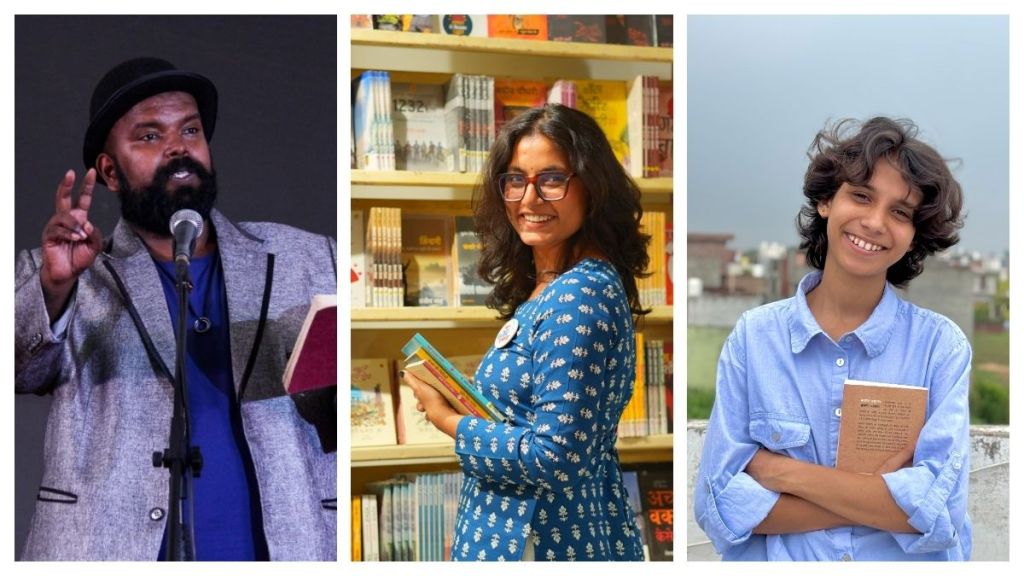

For decades, poetry in India lived in carefully defined spaces. There were slim literary magazines, crowded kavi sammelans, Urdu mushairas stretching into the night, campus open mics and dog-eared books passed between friends. Discovery and audiences were limited while recognition often stayed within literary circles.
Now, poetry arrives in 60-second bursts between skincare tutorials and food videos. India’s poetry ecosystem has quietly migrated onto social media, where reels, recitations and spoken-word clips are creating a new generation of literary audiences. This has created space for a remarkably diverse ecosystem. Hindi and Urdu spoken-word creators such as Nayab Midha (2.9 million followers) and Amandeep Singh (809,000 followers) have built large online followings through emotionally resonant performances. Bengali creator Maharshi Nandi (426,000 followers) recites highly relatable poetry about everyday life, while Ajibar Mandal (45,200) followers), a farmer from Nadia in West Bengal, became an internet sensation through deep-voiced recitations of Bengali verse.
The shift is part of a much larger transformation in Indian media habits. Social media is now India’s dominant destination for content across age groups and interests, with short-form video sitting at the centre of consumption patterns. The latest IPSOS study commissioned by Meta found that 97% of Indian consumers watch short-form videos at least once a day, while 92% identified Reels as their preferred platform. Reels is now reportedly the country’s most watched short-form video format, performing strongly particularly among Gen Z audiences and affluent urban consumers.
For Meta, the platform’s significance lies beyond scale. “India is leading the world in video adoption, and Reels is at the centre of this shift,” said Arun Srinivas, managing director and head of Meta India, in a statement accompanying the report. The company says Reels now drives major cultural conversations online, from fashion and beauty trends to music and memes. Poetry, unexpectedly, has become part of that ecosystem.
Audience & algorithms
Khushi Thakur did not set out to become a literary influencer. The 23-year-old MBA student from Bulandshahr in Uttar Pradesh grew up reading Hindi novels, poems and short stories outside her school curriculum. “I was not interested in studying in school so much but enjoyed reading these books and poems,” she says. Much of her reading material came through internet searches.
Five or six years ago, she began sharing her own poems on a personal Instagram account, but little came of it. She taught herself video-making through YouTube tutorials and gradually immersed herself in Hindi literature. Then, sometime last year, she recorded herself reciting Vinod Kumar Shukla’s Hatasha while sitting on her terrace. “I just balanced my phone on a brick and started recording,” she says. The video went viral with over 5,000 reposts.
Today, her Instagram page, @evermoreavalon, has over 277,000 followers. The account primarily features her reciting poems written by other Hindi poets, from canonical writers such as Mahadevi Varma to Kedarnath Singh. Her selection process is instinctive. “When I read a poem and I feel yeh kavita suni jaani chahiye, something different than the usual but still very much grounded and based on reality without any false hopes,” she says.
The popularity of such content has challenged assumptions about the attention span and cultural preferences of younger audiences online. “People say Gen Zs are like this or like that, but they are open-minded,” she says. She recalls that Kumar Ambuj’s poem Khana Banati Streeya, centred on women’s labour, resonated strongly, particularly among young male audiences.
For Thakur, the problem is not lack of interest in literature, but discoverability. “I think there is an audience, but the right thing is not reaching them somehow.”
The recommendation algorithms of social media platforms have turned poetry into trend-driven content in ways both exciting and unsettling. Certain books and writers periodically dominate feeds. “For example, Dharamvir Bharati’s Gunahon Ka Devta, everyone is reading and it is a trending content,” she says. “But there are also people who would read other stuff as well.”
That tension between virality and literary depth sits at the heart of Instagram poetry culture. Short-form platforms reward immediacy, emotional clarity and visual appeal. But poetry often demands slowness. “Not every poetry can give you that dopamine kick,” says Thakur. “You need to give some poems some time.”
Her own literary explorations increasingly move away from viral titles toward forgotten writers and obscure books discovered in libraries. She recalls reading Anayas, a 1998 book by a writer named Ananya. “I could not find anything about the author. There is nothing written about the writer, I’ve searched everywhere but couldn’t. I just feel grateful that I found this one.”
The emotional intimacy of poetry content online has also created unusually personal creator-audience relationships. Followers regularly message her about how particular poems affected them. One message remains especially haunting. “A person texted me saying a woman follower passed away and she used to like my reels, so now the person is following me,” she says quietly. “To me, it felt like a personal loss.”
Verse & visibility
If Thakur represents literary curation, Delhi-based creator Deepshikha represents the creator economy emerging around poetry itself.
The 23-year-old, originally from Gaya in Bihar, works on the social media team at Rajkamal Prakashan while simultaneously building her own Instagram presence, @deeepshiikhaa, where she recites both her own poems and those of others.
Her entry into poetry content creation was similarly organic. “I have been interested in poetry and literature since I was in school,” she says. “Whenever I used to read poetry and if I really liked that, I remember it myself,” she adds.
One of her first successful videos featured Ahmed Faraz’s Ab uski yaad raat din nahi, magar kabhi kabhi. “I heard it two-three times on YouTube because I really liked that. And I remembered it completely,” she says, adding: “So, I recorded and then I got a very good response on that.”
Unlike older literary traditions that often prized linguistic complexity, Instagram poetry rewards accessibility. “For me, a good poem is that type of poem which anyone can read and understand,” she says. “I don’t really like poems with very heavy words because then it does not reach the masses.”
Much of the success of digital poetry lies in emotional relatability. Breakups, loneliness, nostalgia and homesickness dominate engagement metrics because they mirror the emotional lives of users scrolling late into the night. “There are a lot of things which we can’t communicate. We try to find it in art,” Deepshikha says. “Mostly poetry or ghazal, it says what we want to say but we can’t say it clearly.”
At the same time, poetry has become increasingly shaped by platform aesthetics. Visual style, fonts, background music and editing now matter almost as much as literary quality. “Reels play a very, very big role in popularising poetry,” she says. “That attracts people as well, no? Like the font that you use or the music that you add.”
Publishers are paying attention. Influencers who recite poetry are increasingly used to market books, while poetry-themed content helps drive visibility for authors and publishers online. Yet monetisation remains weak, particularly for Hindi creators. “Hindi publishers don’t want to pay influencers money. But some English publishers do,” she says.
Feeds & fears
For Bengaluru-based spoken-word poet Daniel Sukumar, Instagram’s rise has transformed poetry in more complicated ways. Sukumar (@mannequin_the_poet), who has been writing and performing poetry since 2014, approaches the medium less as emotional catharsis and more as political documentation. His work focuses heavily on caste, class and social inequality.
“I am not a poet who writes for inspiration,” he says. “I write because I am frustrated about something.”
His poetry frequently transforms political anger into intimate personal imagery. One poem about the thickness of sambar in a south Indian household was inspired by a politician’s dismissive comments about onion prices. Another explores caste through the symbolism of onion-less sambar prepared in certain communities.
For Sukumar, poetry becomes a way of processing helplessness. “You experience the world around you and you see all the horrible things that the world is doing and you just let that sit in,” he says.
Unlike creators optimised for reels, Sukumar remains deeply sceptical of social media’s influence on poetry itself. “All of these social media platforms are open towards videos, shorter videos,” he says. “Even poets right now are in a fight to fit their poetry into Instagram.”
He believes the algorithm increasingly privileges appearance and performance over text itself. “The internet wants a head with a face on it to talk,” he says. That creates new anxieties for poets uncomfortable with personal branding culture. “I want to be a poet. I don’t want to be a model.”
His critique reflects a broader tension in the creator economy. While platforms have democratised access to audiences, they have also standardised performance styles and aesthetic expectations.
Political poetry faces additional constraints. Sukumar argues that many creators avoid subjects such as caste because of fears around backlash, audience alienation or platform hostility. “A lot of self-censoring has happened,” he says. “They would talk about mental health, they would talk about other topics but they wouldn’t talk about caste because it’s very political for them.”
Yet he also sees poetry as uniquely capable of disrupting social bubbles. Spoken-word performances about caste practices or honour killings expose audiences to realities they may otherwise never encounter.
His work often draws from deeply disturbing incidents. Recently, he has been unable to stop thinking about the murder of a 19-year-old boy in Tamil Nadu who was allegedly killed for being in a relationship across caste lines. “For me, this has been stuck in my head for the longest time,” he says. “Someday it will come out as a poem.”