


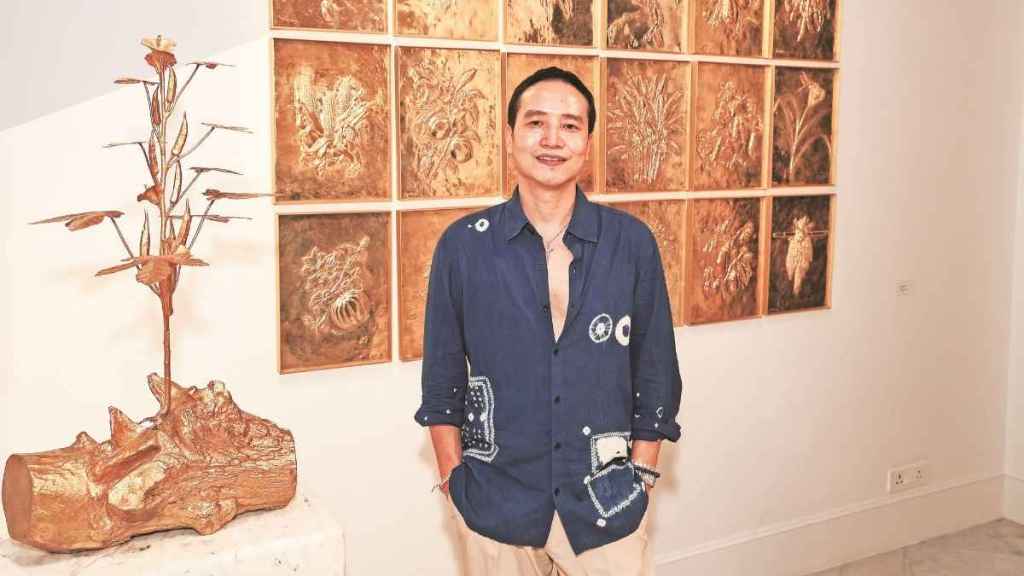

For multidisciplinary artist Jenjum Gadi, Ngok Dollu, which translates to “my village”, is less an attempt to recreate his childhood than to preserve a place that, he says, is slowly disappearing. Born in Tirbin, a small village in Arunachal Pradesh’s Lepa Rada district, Gadi draws on memories of its landscapes, architecture, craft traditions and everyday rhythms for his latest body of work. “I’ve lost my village, and with time, that memory is also fading,” he says. “So, before we lose that memory too, I want to give it a form that can become more permanent.”
On view at Gallery Vayu in New Delhi till September 30, the exhibition brings together brass sculptures rooted in Gadi’s recollections. The works are not literal reproductions of the village. Instead, memory, culture and a way of life come together in forms that move between the recognisable and the imagined. “When I talk about memory in this exhibition, it is a mix of my memory, my culture and traditions, and the way of life I come from,” Gadi says.
Nature is central to that way of life. Gadi describes a worldview in which everything is interconnected and carries meaning. “A tree isn’t just a tree, it serves a purpose. Everything is interconnected and interrelated,” he says. That is also why the works can appear at once literal and fantastical. “Memory itself can sometimes feel like fantasy,” he says. Yet Gadi deliberately keeps the work accessible. “I try to keep it very simple and easy to approach,” says the 44-year-old artist. “A simple thing doesn’t mean that it’s not beautiful or doesn’t have a beautiful memory or a story.”
Brass became an extension of this idea of change. “My work is always inspired by nature,” he says. “I wanted a material that would change because nature is always changing.” Brass develops a patina over time and can behave differently depending on its environment. For Gadi, that quality creates a parallel with nature. He had initially considered silver, but its cost made brass a more practical choice. He has since experimented with silver, including a triptych for his second show, and says he hopes to explore the material further.
But it is the changing landscape of that remains at the heart of Ngok Dollu. Gadi recalls the bamboo and wood houses of his childhood, where several families lived together. There were large verandas, kitchens built around fireplaces and, often, several families under one roof. “If there were three families living together, there would be three fireplaces. There would be so many children,” he says. What he misses most is not simply the architecture, but the social life it enabled. “I feel that sense of closeness and togetherness is going,” he adds.
The physical landscape has changed too. Gadi points to deforestation and land being cleared for cultivation as the population grows. He also speaks of increasing plastic waste and what he describes as a lack of civic sense. At the same time, he sees greater environmental awareness among younger people and hopes development can be balanced with preservation. “Development is important, you can’t stop it. But sometimes it can destroy the essence of a small village. Earlier, the mountains would be covered with trees but it’s not the same anymore,” he adds.
Gadi’s practice also sits within a broader conversation about artists from the northeast and how their work is perceived. He does not see his Arunachali identity as a limitation. Instead, he sees it as a source of stories and cultural knowledge that can expand contemporary art conversations. “There is definitely less exposure for artists from the northeast, but that doesn’t mean there is less talent. It is about opportunity,” he says. Having lived in Delhi for two decades, Gadi now wants to build a bridge between the region and India’s larger art ecosystem. “I want to create that bridge between the northeast and the rest of the country,” he says.
Ultimately, however, Ngok Dollu is about something more elemental. Gadi does not want viewers to feel they need to decode the work. “I want to make simple, straightforward and beautiful art,” he says, adding, “Think about a flower. Do you need an explanation to look at a flower? No. You just look at it and feel happy.”