


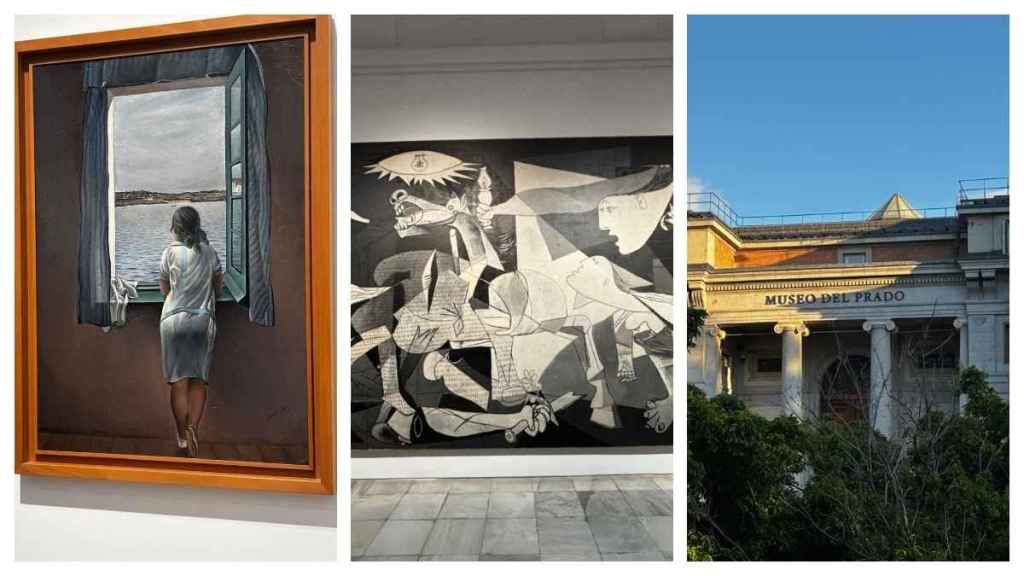

When you discuss Spain, you’ll probably hear about deep-sea diving along the Costa Brava, the Sagrada Familia in Barcelona, or the Tomatina festival in Bunol. But for art fans, there is another Spanish must-do — Madrid’s Golden Triangle of Art. The triangle, which is located along the Paseo del Prado, unites three important museums of the Museo Nacional del Prado, the Museo Nacional Centro de Arte Reina Sofia, and the Thyssen-Bornemisza National Museum.
When taken as a whole, they span almost 800 years of western art, ranging from masters of the middle ages and Renaissance to Picasso, Dali, and modern art. Madrid makes a fitting backdrop with its greenery, lively food scene, thriving wine culture that lends itself to spending hours moving between galleries, cafes and shaded streets.
Start with the old masters
The most powerful of the three is the Museo Nacional del Prado. The museum was established in 1819 and is housed in a structure created in 1785 by architect Juan de Villanueva. After being commissioned by Charles III as a Cabinet of Natural Sciences, Ferdinand VII and Queen Maria Isabel of Braganza transformed it into the Royal Museum of Paintings and Sculptures. The Spanish royal collections, which started to take shape in the 16th century under Emperor Charles V and were enlarged by Habsburg and Bourbon kings, were the source of its collection.
Along with pieces from Europe, the Prado is well-known for Spanish masterpieces, including Velazquez, Goya, and El Greco. Highlights include Bosch’s The Garden of Earthly Delights, El Greco’s The Knight with his Hand on his Chest, Velazquez’s Las Meninas, Rubens’ The Three Graces and Goya’s The Family of Charles IV. General admission is 15 euros, but free entrance is offered in the final two hours before closure from Monday to Saturday & 5 pm to 7 pm on Sundays and holidays.
Follow the evolution of art
The Thyssen-Bornemisza National Museum, a short stroll away, bridges the gap between Reina Sofia’s contemporary artwork and the Prado’s ancient masterpieces.Gothic art, European old masters, Impressionism, Expressionism, and 20th-century European and American painting are all represented among its more than 1,600 pieces. It boasts a collection of North American art from the 18th and 19th centuries, including pieces by John Singleton Copley, Winslow Homer, and John Singer Sargent. Admission is free on Mondays from noon to 4 pm. A normal ticket, which covers both temporary and permanent collections, costs 14 euros.
End with Picasso
The Museo Nacional Centro de Arte Reina Sofia is located at the southernmost point of the triangle, close to Atocha station. Spain’s national museum of modern and contemporary art was opened in 1992 and is named for Queen Sofia. Picasso’s Guernica is its most well-known piece. The massive gray canvas, painted in 1937, shows the destruction caused by the bombing of the Basque town during the Spanish Civil War. Important pieces by Salvador Dali, such as Girl at the Window, are housed in the museum. General entrance is 12 euros, although certain evening and Sunday hours are free, albeit with reservations. Keep at least two days, giving the Prado the most time because of its size. Carry a map of the museum, wear comfortable shoes, and take breaks.
Travel Planner
Best time to visit
Weekday mornings or in the shoulder seasons when tourist crowds are at their lowest
What to wear
Smart casuals and comfortable shoes
What to eat
Try local delicacies such as Bocadillo de calamares and cocido madrileno