



There is an interesting irony about adulthood.
For years, we dream of having choices.
Then, just as those choices become possible, life fills up with obligations.
Education determines our direction.
Careers demand our attention.
Children shape our priorities.
Parents need our support.
EMIs arrive.
Responsibilities accumulate.
Before we know it, decades have passed making decisions that were necessary rather than
optional.
There is nothing wrong with that.
In many ways, that is what adulthood asks of us.
The subtle shift back to choice
But somewhere in our late fifties or early sixties, something begins to shift.
Not dramatically.
Quietly.
Children become independent.
Professional responsibilities become more flexible.
Financial pressures often reduce.
Time, almost unexpectedly, begins to return.
And with it comes something many of us have not experienced for a very long time.
Choice.
The question is…
Do we still know how to choose?
After spending thirty or forty years responding to what life demanded of us, many people find it
surprisingly difficult to answer a much simpler question.
“What do I actually want?”
It sounds like an easy question.
It rarely is.
Because somewhere along the way, we became so accustomed to fulfilling expectations that we
stopped listening to our own curiosity.
I have seen people who spent decades dreaming about retirement, only to discover they had
never really imagined what they wanted retirement to become.
Freedom, by itself, is not a plan.
It is simply empty space.
The opportunity lies in filling that space intentionally.
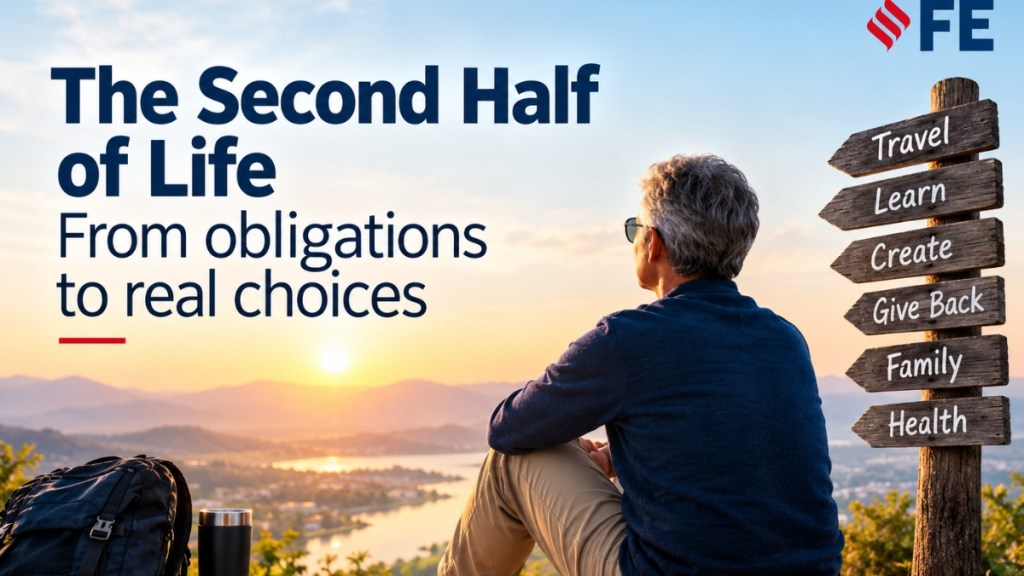
Perhaps you have always wanted to teach.
Perhaps you want to spend six months each year travelling slowly rather than taking hurried
holidays.
Perhaps you want to write.
Or paint.
Or learn photography.
Perhaps you simply want to have breakfast every morning without looking at your phone.
None of these choices are trivial.
Together, they become your life.
From necessity to design
That is why I believe the second half of life is less about retirement and more about design.
No one else can design it for you.
Not your financial planner.
Not your children.
Not your friends.
Not society.
Only you.
And unlike the first half of life, where many decisions were shaped by necessity, this stage offers
something rare.
Intentionality.
The freedom to decide what deserves your time.
Who deserves your attention.
What kind of work still excites you.
Which relationships you want to deepen.
What pace feels right.
How much is enough.
What contribution you still wish to make.
These are deeply personal choices.
There are no universal answers.
Only honest ones.
Perhaps that is why this stage of life can be so rewarding.
Not because it becomes easier.
But because it becomes more authentic.
You stop living the life that circumstances created.
You begin creating the life that reflects who you have become.
And maybe that is one of the greatest privileges of growing older.
Not that life finally slows down.
But that, for the first time in many years, it becomes yours to shape.
So here’s a question worth sitting with: If no one else’s expectations were driving your decisions, what kind of life would you
choose to create from here?
Editor’s Note: This article is part of the ongoing ‘Live to 100’ series by Sanjay Mehta for Financial Express. Across the column, the series explores the essential shifts needed for a fulfilling second half of life from cultivating inner fitness and financial peace of mind to embracing curiosity, intentionality, and lifelong growth. Read previous editions of the series here.
The author is a digital entrepreneur, investor, board advisor and public speaker. He is the founder of Ananta Quest and co-founded Social Wavelength, which became one of India’s leading social media agencies and was later acquired by WPP to become Mirum India.