


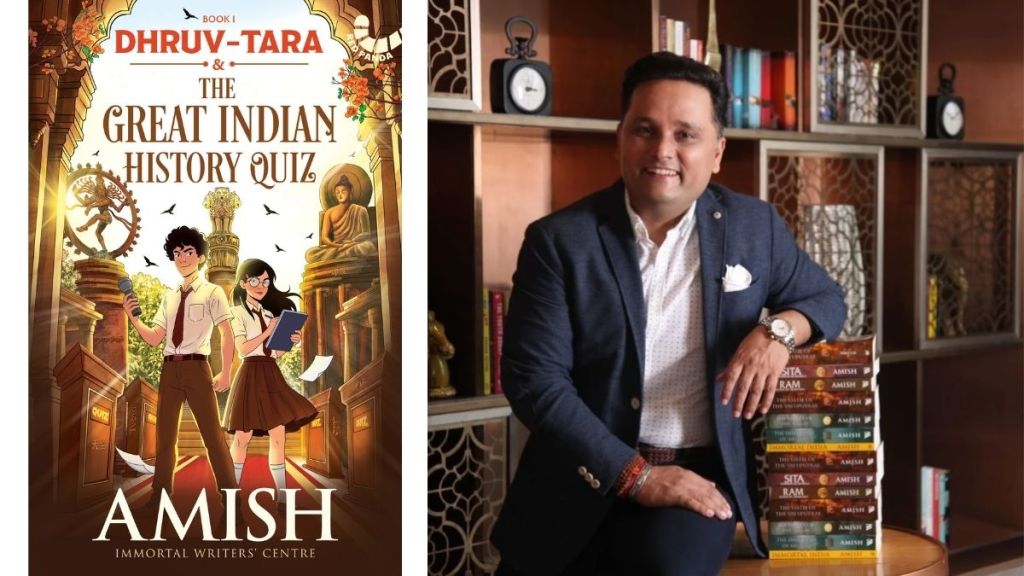

Amish Tripathi’s first children’s book, Dhruv-Tara & The Great Indian History Quiz, is the first in a planned seven-book series that blends adventure with Indian history. In this interview, Tripathi speaks about why he chose to write for children, his belief that history needs to be decolonised and made engaging, the role of storytelling in shaping young minds, and why he believes parents, as much as books, play a crucial role in passing on culture. Edited excerpts:
What made you turn to children’s literature?
All my projects, whether books, documentaries or video games, have to inspire me. I don’t work like a businessman, I work like an artist. Every book begins with an idea or philosophy I want to explore. The story is a wrapper. With the children’s book, the core ideas are twofold. First, the way history has been taught to us has not been sufficiently decolonised. Many Indian students still don’t know that India was the seafaring superpower of the world for much of history. Second, our historians post-1947 made history so boring.
History is such an important subject because unless you understand where you have come from, you will not know where you are going. Children need to understand where India has come from so that they have a vision for where they want to take India. The book follows Dhruv and Tara, two 11-year-olds who dislike each other because they are competing to be number one in class. They are forced to team up for a national quiz contest. Through their adventure, readers also learn a decolonised version of history.
Was it important for you to make history something to be explored rather than just rote learning?
Exactly. If you are just doing rote learning, you don’t appreciate the true wonder of the land that we have been born in. No land or culture is perfect, but unless we understand our country, we won’t know what to cherish, what to improve, or where we are headed. History is, in a way, knowing who you are. We have to do that as a country, and that can only be done through history and literature.
Too often, especially over the last thousand years, history has been taught as the story of invaders rather than our ancestors who fought them. It has also been written in a way that divides us. The book also explains India’s economic journey over the last 2,000 years. During the Turkish invasions, India’s share of global GDP fell from 33% to around 22%, and under British rule, it declined further from 22% to 6%. This is in real numbers of the damage they did to our economy. The book presents these ideas in a simple, engaging way for children.
In an age when books are competing with screens, do they have to entertain first before they can educate?
Through all of history, important philosophies have been wrapped in stories. Ved Vyasa, who compiled the Vedas, also composed the Mahabharata because profound ideas become easier to understand through an engaging story. That is why the Mahabharata is sometimes called the fifth Veda.
The same principle applies today. Children’s forms of engagement may have changed, but storytelling remains the best way to communicate ideas. While social media addiction is a genuine concern, the challenge is also for writers to create books that children want to read. That is a challenge I have decided to take up. Readers aged 15 and above have embraced my books despite the distractions of social media. Now I want to see if I can do the same for readers under 15.
Your novels have always reinterpreted mythology and history. Did writing for children make you simplify it more than how you would write for adults?
No doubt about it. If you are writing for children, the style has to be different. I don’t consciously create a style guide, but I immerse myself in the genre by reading children’s books before I start writing. That is why this book is relatively short, at around 30,000-32,000 words, with short chapters, crisper language and, in some dialogues, Gen Z terms to make it easier for young readers to relate to. I use the same approach with every genre. For the crime fiction novel I am currently writing, set in the UK, I started reading crime novels, simply to get my mind into that world before writing.
Many parents worry that children are becoming disconnected from Indian history and culture. Do you think storytelling can succeed where textbooks often struggle?
It’s the best way. That is what I am trying to do through books, documentaries and podcasts to create content that appeals to young people and gives parents tools to connect their children to Indian culture.
Having lived in the UK, I believe there is much India can learn from the West, but I also saw societies where families and communities were falling apart because traditions had weakened. That made me realise the importance of staying connected to one’s culture. At the same time, parents have an equally important responsibility. Children don’t listen, they imitate. Simply telling them to stay connected to Indian culture is not enough. They have to see their parents practising it.
You’ve written bestselling mythology, historical fiction and non-fiction. After this move into children’s literature, what remains unwritten for you?
I don’t plan my life. I just go where Lord Shiva and Mata tell me to go. I am currently working on a crime fiction novel on a subject that deeply disturbs me. I don’t know what direction I will take next, but Lord Shiva certainly does. My job is simply to follow the lead.
Dhruv-Tara & The Great Indian History Quiz
Amish Tripathi
Red Panda
Pp 200, Rs 350