


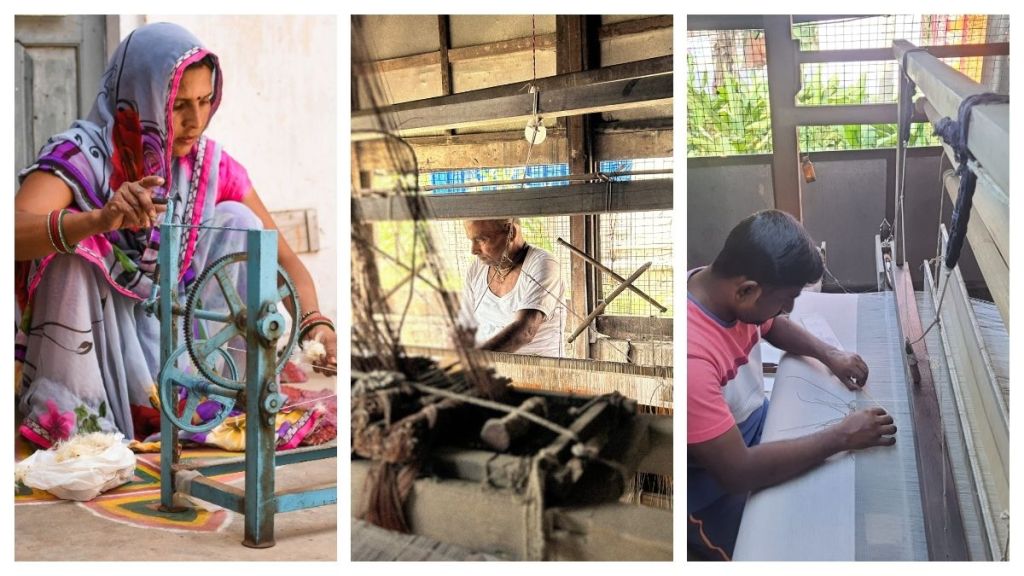

Just have a simple conversation with Vankar Shamji Valji, and you will know how deeply traditional craft can respond to the climate crisis, not as nostalgia, but as a living, adaptive, climate-positive system.
A third-generation weaver from the Vankar community living in the arid village of Bhujodi in Kutch, Gujarat, Shamji, as he is fondly called in his community and by professionals, has reinterpreted the traditional woollen Dhabhla — a thick pastoral blanket — into contemporary stoles and home linens. This is not mere product diversification; it is an ecological argument. Instead of feeding fast-fashion cycles that thrive on planned degeneration, he extends the life and relevance of heritage designs. His collaborations, including with Alamwar Textiles, the Hyderabad-based sustainable fashion and home textile label, focus on upcycling vintage fabrics, reducing textile waste while preserving craftsmanship.
“Weaving in Kutch follows the rhythm of nature. Families farm during the monsoon and weave in the dry months, using hand-spun wool from local sheep. This circular system minimises transport, energy use, and synthetic inputs,” Shamji tells FE during his recent visit to New Delhi.
In this act of Shamji lies a blueprint for climate resilience, seasonality, locality, material intelligence, and human-scale production. Recognised with the National Award for Weaving and the UNESCO Seal of Excellence, Shamji demonstrates that craft is regenerative, while Bhujodi becomes a model of how handicraft sustains livelihoods, strengthens shared value systems, and imagines a low-carbon future led by the human hand.
Clearly, the modern fashion industry is notorious for waste and pollution. Synthetic fibres shed microplastics, dye houses discharge untreated effluents, and overproduction fills landfills at staggering rates. According to the Fashion Transparency Index, which reviews and ranks 250 of the biggest global fashion and apparel brands and retailers, only 34% of brands publish their carbon footprint at the processing level and a mere 22% at the raw material level — revealing how opaque and extractive the global system remains. In fact, India generates over 7.7 million tonne of textile waste annually, accounting for roughly 8.5% of the global total, with around 42% coming from pre-consumer sources and over 50% from post-consumer waste.
However, crafts and handlooms serve as a sustainable, low-carbon alternative to power looms, actively combating the country’s massive textile waste (up to 45,000 metres daily in hubs) by upcycling waste into new, high-fashion products. Utilising natural fibres, these promote circularity, with techniques like patching, weaving, and traditional patchwork converting factory cutting waste into durable products.
Shamji has championed the revival of natural dyes — working with lac, madder, pomegranate peels, turmeric and harda (haritaki) instead of fibre-weakening acid dyes. These plant-based processes reduce chemical discharge and keep dyeing small-scale and community-centred. The result is not only environmentally responsible but materially superior: textiles that age gracefully, retaining integrity rather than degrading into waste.
Since handloom weaving is low-energy by design, it relies on human skill rather than fossil fuel-powered machinery. Also, natural dyeing reduces chemical discharge, and localised production shortens supply chains. Even so, the traditional systems embed circularity not as a marketing slogan but as an operational reality.
Historical reality
Long before sustainability became a corporate imperative, traditional craft ecosystems were inherently climate-aligned. They utilised biodegradable materials — bamboo, cotton, wool, natural fibres — and techniques like Kantha embroidery, which upcycles old textiles, and Kalamkari, which employs vegetable dyes.
As Hema Singh Rance, director, Arts India, at the British Council, observes, “Traditional craft practices have long embedded principles that the fashion industry is now striving to adopt — biodegradability, circularity and low-carbon production. Techniques such as Kantha embroidery, which upcycles existing textiles, and Kalamkari, which uses vegetable dyes or bamboo and natural fibre-based weaving systems, demonstrate how zero-waste thinking has historically been integral to craft ecosystems.”
Institutions like the British Council have actively supported initiatives such as New Landscapes, Crafting Futures, and Making Futures to bring together artisans, designers, technologists, and researchers from India and the UK to explore sustainable futures for fashion and textiles.
Yet Rance cautions that collaboration is not automatically equitable, adding, “Crafts offer a credible pathway towards a climate-positive fashion industry by shifting away from mass production to slow, intentional and place-based making. However, collaboration between artisan communities, technologists and sustainability experts is often hindered by imbalanced partnerships, limited access to digital tools, and innovation approaches that do not fairly benefit artisan communities. Ethical collaboration starts by recognising artisans as partners and co-creators.”
Several experimental collaborations demonstrate how craft knowledge can meet technological innovation responsibly. British Council projects under New Landscapes India, such as partnerships between Botto Labs in India and The Stitch Archive in the UK, are developing bio-based sequins. Alongside Vashishtha Luxury India, embroidery materials are being created from agricultural waste, offering low-impact alternatives for the luxury sector. Meanwhile, collaborations between Post Carbon Lab (UK) and True Tone Ink India explore microbial dyes as regenerative, water-efficient alternatives to synthetic colour systems.
Equally significant is work around indigenous materials such as Desi Oon (native wool), where collaborations with pastoralist communities and academic partners improve traceability and strengthen livelihoods. The Circular Handspun project — between Conserve India, Khadi London, Khamir Crafts and Where Does it Come From? — demonstrates how waste fabrics can be recycled back into usable yarns and reintegrated into the textile value chain. “Complementing these efforts, tools such as the Digital Craft Toolkit help artisans engage with digital technologies, supporting skills development, documentation, and greater transparency across craft and fashion supply chains,” adds Rance.
Artisans as co-innovators
For Ashish Dhaka, academician and director of Fashion Revolution India, an organisation advocating fashion activism, mobilising citizens, brands and policymakers through research, education and advocacy, the shift must be philosophical as much as technical. “Yes, artisans must be positioned not just as makers, but as co-innovators in climate solutions within the fashion industry — by recognising them as authors of knowledge rather than executors of design.”
He describes artisans’ intergenerational expertise in materials, fibre cycles, biodiversity, seasonality, and low-energy processes as a form of ecological intelligence. “This shift requires moving away from hierarchical design interventions toward co-design and research-led collaborations where artisans lead innovation from within craft logic,” adds Dhaka.
Artisan-driven organisations based in Kutch, Gujarat, such as Kala Raksha, Shrujan and Khamir, focus on preserving, developing and promoting traditional Kutchi handicrafts. These brands have demonstrated how equitable frameworks, ensuring shared authorship, intellectual property rights, and fair contracts, can reinforce this repositioning.
Take, for instance, Kala Raksha, which is dedicated to preserving, documenting, and promoting traditional Kutchi embroidery and applique arts, while Shrujan strengthens the livelihoods of female artisans by nurturing their embroidery skills and providing direct market access.
Historically, craft emerged within local economies of exchange rather than profit-driven global markets. Farmers, spinners, weavers and printers worked interdependently. “A farmer would provide cotton to the weaver, the weaver to the printer, and each participant retained a share of value. Craft, in its original form, was never designed for profit maximisation or mass consumption,” Dhaka explains.
Conscious luxury
Handcrafted designer brands are witnessing a meaningful shift in both consumer preferences and brand philosophies. One such example is SaiChi, a Delhi-based label working closely with artisanal processes and material innovation. Maneesha Sharma, co-founder of SaiChi, says, “Today’s women seek pieces that bring together newness, comfort, and appeal, while remaining deeply sensitive and mindful in their material and design preferences.”
She notes a growing appreciation for the story behind a product, the people who made it, the processes involved, and the environmental impact of materials used. “We consciously communicate that our saree fabrics are not plastic-based, whether recycled or otherwise, but made from natural, plant-based yarns selected with environmental mindfulness.”
SaiChi’s philosophy is rooted in longevity. “We believe that while people may afford luxury, the planet may not always afford the choices behind it. Sustainability begins with creating something meant to last. At a time when market trends lean toward sequins, beads, and glitter — materials with significant environmental compromise — we focus on practices such as threadwork, hand painting, and refined, minimal embellishments. For example, traditional tissue fabrics were often stiff, whereas today’s wearer seeks softer, body-hugging drapes. This has led us to explore new material treatments and revive techniques such as fabric beating to achieve unexpected softness, a reminder that craft evolves through continuous research and experimentation.”
Technology as enabler
Technology, when thoughtfully used, becomes an enabler for crafts. Mobile-enabled communication clarifies orders and timelines for artisans, dedicated looms ensure material authenticity, labels are made from surplus fabric with handwritten details, wet waste is composted, and even small operations can embody circular principles.
But Dhaka emphasises that technology must strengthen existing craft systems rather than industrialise them. “Tools such as demand forecasting and virtual sampling can reduce overproduction and material waste. Blockchain and digital documentation can authenticate provenance, trace supply chains, and record social and cultural value,” says Dhaka.
With global emphasis on transparency, digital product passports, and regulatory compliance, the craft sector must upgrade. Like the EU’s Digital Product Passport, part of the Ecodesign for Sustainable Products Regulation (ESPR) approved in 2024, mandates a digital identifier for textiles and other goods to improve circularity and transparency. Accessible via QR code or NFC, it will track a product’s lifecycle from raw materials to disposal, expected to fully phase in around 2028.
Technology can preserve endangered traditions through systematic documentation — archiving techniques, narratives, and cultural contexts beyond legal instruments such as GI tags. When applied contextually, technology safeguards knowledge while making craft-led sustainability visible and accountable.
Overcoming barriers
Climate change directly affects traditional livelihoods. Extreme heat disrupts work rhythms. Material shortages increase costs. Simultaneously, power looms and synthetic blends flood markets with cheaper alternatives.
Krishna Basak, the 36-year-old weaver from West Bengal working with SaiChi, speaks of watching power looms replace handlooms in his village. “I am constantly being told to buy cheaper blended yarn. I choose not to, because I know it has environmental, health and safety issues. When we mix the cheera (flat rice) and make the saree shine with the glaze of the natural starch from it, we are not able to tell the customer why we should be given price for the effort that goes into these processes,” says Basak, adding, “But I try to support more weavers by getting them work so that the remaining handloom households can survive because workers are also migrating to other regions where they find work.”
The pressure is relentless. Market demand prioritises sheen and price over process and integrity.
“There are times I’m told about price differences and about the availability of less expensive sarees with perfect sheen and feel. But I propagate clarity on materials used like azo-free dyeing, pure yarn and attempting authentic product commitment to customers as well as workforce are important to us,” adds Sharma, whose labels are made with surplus fabric and handwritten details, stitched with thread and makes compost from wet waste.
Likewise, the Porgai Artisans’ Association, co-founded by Dr Lalitha Regi, who runs the Tribal Health Initiative in Sittilingi Valley, Dharmapuri, Tamil Nadu, is reviving the traditional Lambadi embroidery, offering sustainable livelihoods to local women facing migration due to climate-induced farming failures, and empowering over 70 artisans with economic independence, promoting ethical, slow fashion as a climate-resilient alternative to poverty-driven migration.
In Assam, the government has taken a strong stance to protect handloom weavers after the traditional gamosa and mekhela sador received Geographical Indication status in 2022. Machine-made imports, often cheaper, threatened the livelihood of artisans. Policy intervention became necessary to preserve cultural identity and economic survival. Such measures highlight a larger truth: climate-positive craft cannot thrive without structural support.
Ethical collaboration demands participatory design, capacity building, and long-term investment. It requires moving beyond extractive engagement models toward shared authorship. When artisans are recognised not merely as custodians of heritage but as critical contributors to climate solutions, the narrative shifts from preservation to leadership.
Climate strategy
Sustainability has been the buzzword for the craft industry. Among a few initiatives, the Ministry of Textiles last year launched the book titled Carbon Footprint Assessment in the Indian Handloom Sector: Methods and Case Studies, jointly prepared by the Office of Development Commissioner for Handlooms, Ministry of Textiles and Department of Textiles & Fibre Engineering, IIT, Delhi. It strengthens the government’s commitment to environmentally conscious handloom production and sustainable development by providing clear, practical methodologies to measure and reduce the carbon footprint of the handloom industry — a vital socio-economic sector and a symbol of India’s rich cultural heritage. The book comprises simple steps to measure carbon footprint through real-world case studies across India, including products such as cotton bedsheets, floor mats, Ikat sarees, Banarasi sarees, and other iconic handloom items. It also includes methodologies for low-cost data collection and emission measurement methods designed specifically for the handloom sector to enhance eco-friendly production.
Similarly, the Sustainable Fashion Dictionary, launched in partnership with Lakme Fashion Week and FDCI, is a key resource for understanding eco-friendly fashion, circular design, and conscious consumption. Printed on recycled paper, it serves as a jargon-free guide for industry professionals and consumers, highlighting terms like ‘rewilding fashion’, which focuses on ecosystem healing, and goes beyond just reducing harm to actively helping the planet heal through natural fibres, organic dyes, and carbon-sequestering farming methods. While the climate crisis demands radical imagination, traditional craft may be one of the most radical responses available.