


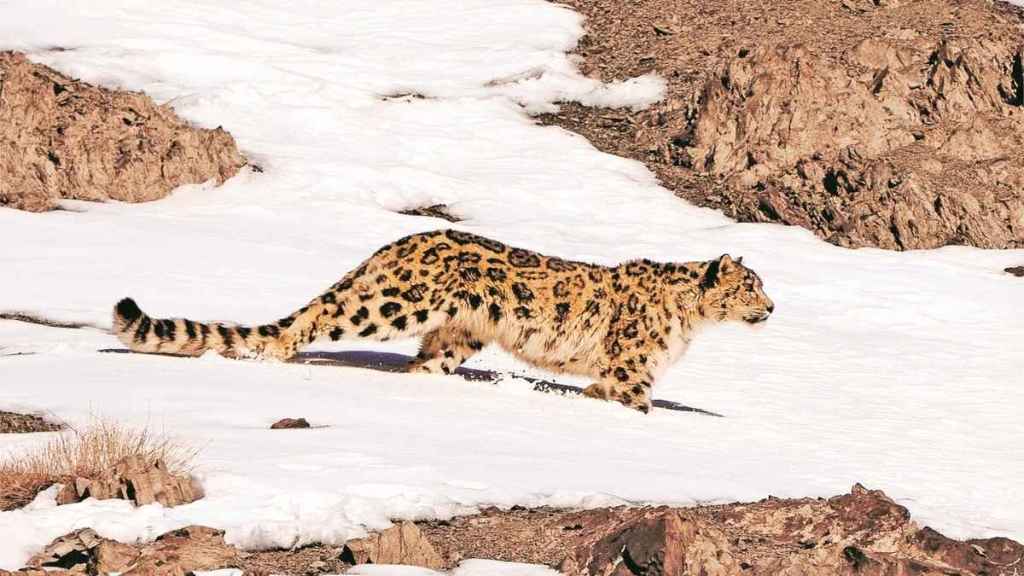

Imagine going on a safari, but instead of forests and grasslands, you are driving through snow-covered valleys, vast high-altitude deserts and rugged mountains. This is a reality in Ladakh, with the elusive snow leopard as the star attraction. The Ladakh administration, with Lt Governor Vinai Kumar Saxena, has launched India’s first high-altitude wildlife safari this October.
The experience brings together wildlife spotting, local communities and responsible tourism, offering visitors a chance to explore Ladakh’s wild side while supporting efforts to protect its wildlife. Saxena has approved guided jeep safaris along with snow leopard and bird-watching trails in the Union Territory, in suitable routes across Hemis National Park, Changthang and Karakoram Wildlife Sanctuaries, and wildlife-rich regions including Nubra, Zanskar, Sham, Kargil and Dras. The safaris have open-back vehicles with guides, aimed at improving the experience while tackling illegal off-roading and reducing disturbance to wildlife.
More to safari: The Ladakh region is home to over 477 snow leopards, more than half of India’s estimated population of 718. The region’s high-altitude ecosystem supports more than 38 mammal species, 340 bird species and around 1,800 vascular plant species.
The new initiative involves local communities with 20 local youths trained in birdwatching, bird identification and spotting skills, while 10 bird-watching hides are created at important hotspots.
This programme is being overseen by the Snow Leopard and High-Altitude Nature (SHAN) Conservation Society, which aims to link conservation with sustainable livelihoods.
Other measures include installing waste bins in villages, promoting plastic-free tourism, establishing wildlife clubs in government schools and training women artisans to create wildlife-themed souvenirs.
Other destinations: Ladakh joins a small group of destinations where wildlife encounters can be experienced in a mountain environment. The Andes, Peru and Chile have high-altitude landscapes to spot vicuñas, guanacos, Andean condors and, in some regions, pumas. The Tibetan Plateau is one of the world’s most dramatic high-altitude ecosystems, home to wild yaks, Tibetan antelopes or chiru, and kiangs, the wild Tibetan asses. East African Highlands, Kenya and Rwanda have high-elevation landscapes of Mount Kenya and Volcanoes National Park, combining alpine and montane habitats with wildlife, including mountain gorillas in Rwanda.
Travel Planner
- Acclimatise first: Ladakh’s altitude can affect even fit travellers. Spend at least 48 hours acclimatising in Leh before heading higher. Avoid packing too much.
- Stay hydrated: Drink water and avoid alcohol. Eat light, nutritious meals.
- Dress in layers: Pack thermal layers, an insulated jacket, gloves, woollen socks, a warm cap. Sunglasses, sunscreen, lip balm are essential in the mountain sun.
- Pack for wildlife watching: Binoculars, a camera with a telephoto lens, spare batteries, a power bank and a backpack are useful.
- Respect the wildlife: Carry a reusable water bottle, avoid single-use plastic and take your waste back with you.
- Prepare for remoteness: Carry medicines, personal supplies, apt footwear. Mobile connectivity may be limited in remote areas.
- Support local communities: Use local guides, homestays and locally operated tourism services.
- Best time to go: October to April
- Activities: Guided jeep safaris, snow leopard tracking and birdwatching.